
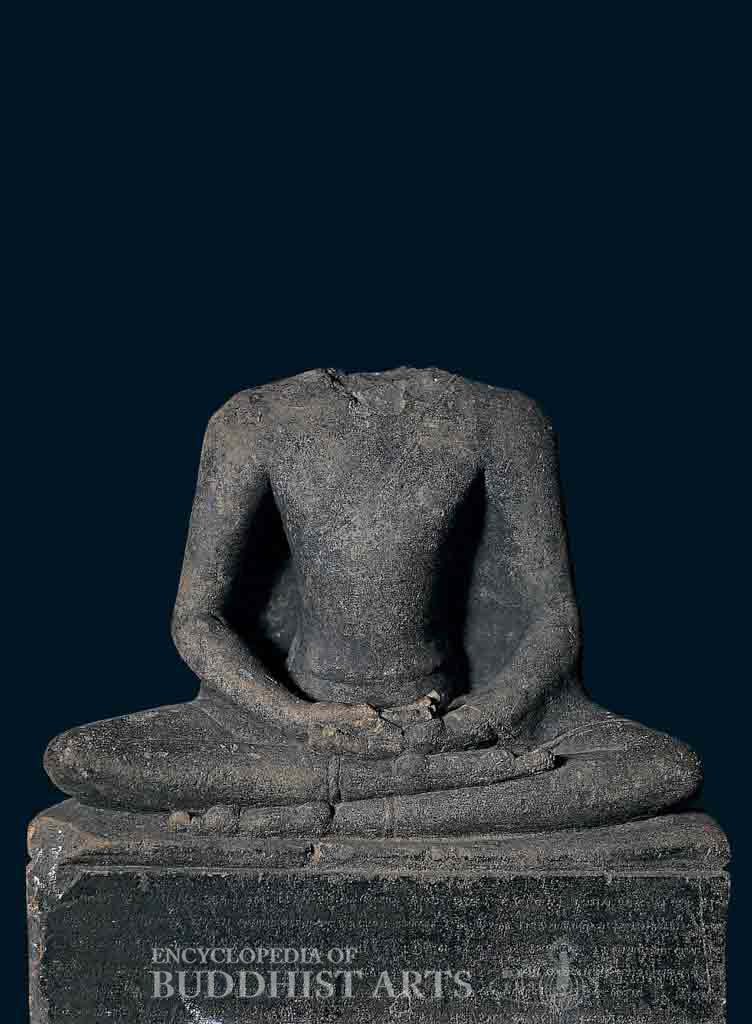
Thayekhittaya: Seated Buddha
Sandstone
Thayekhittaya: Seated Buddha
MYANMAR, Bago, Hmawza
This statue, excavated from the site of Thayekhittaya in 1927, has inscriptions in Sanskrit and Pyu on all sides of the throne. The inscriptions state the statue was commissioned by King Jayacandravarman to ask for blessings for himself as well as for his deceased brother, Harivikrama, who died in 695. The area where the figure was found was influenced by India and imported its sculptural style from eastern and southern India, especially from the region of present day Andhra Pradesh.
The headless body is seated on a rectangular throne that has to accommodate the very long legs and feet folded in half lotus position; a posture common to Buddha statues sculpted in southern India and Sri Lanka. The hands are in dhyana (meditation) mudra. The monastic robe leaves the right shoulder bare and is close fitting that its presence is principally indicated by hemlines, which is likely influenced by the Sarnath style.
For more details, go to the Encyclopedia of Buddhist Arts: Sculpture St-Z, page 1205.
Cite this article:
author = Hsingyun and Youheng and Lovelock, Yann and Chou, Yuan and Huntington, Susan and Edson, Gary and Neather, Robert,
booktitle = {Encyclopedia of Buddhist Arts: Sculpture St-Z},
pages = 1205,
title = {{Thayekhittaya: Seated Buddha}},
volume = 13,
year = {2016}}