
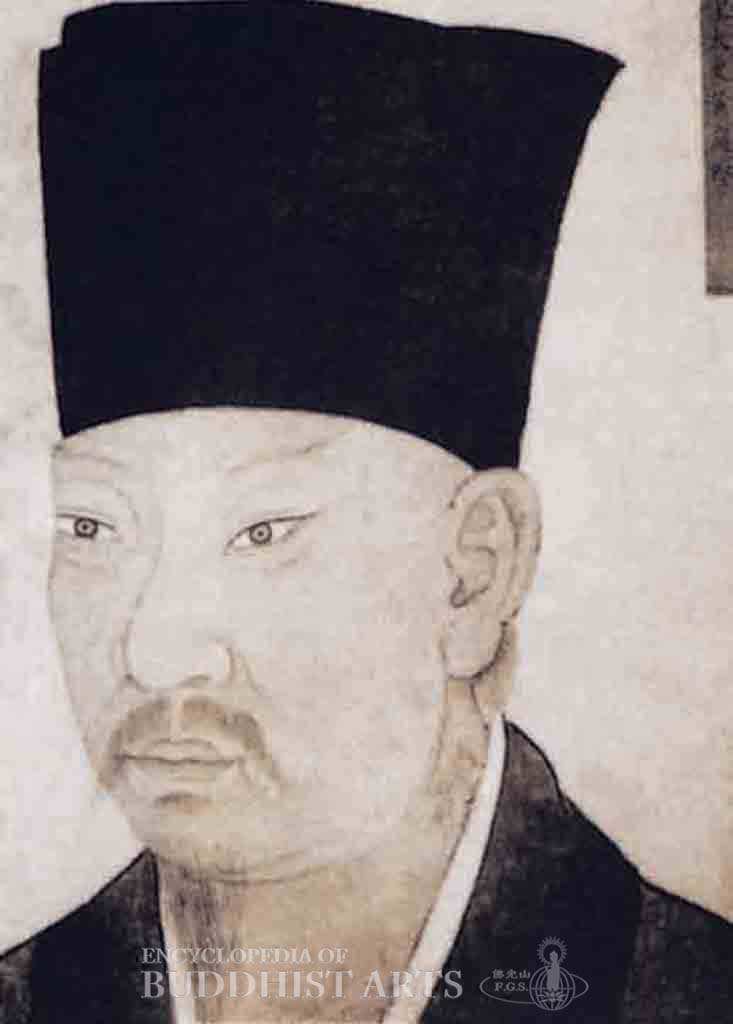
Huang Tingjian
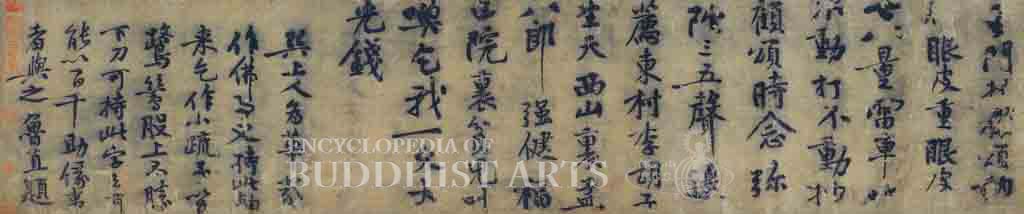
Avatamsaka Service Supplication by Huang Tingjian (detail); Northern Song dynasty, dated 1086–1094
Ink on satin
Huang Tingjian
CHINA, Jiangxi, Jiujiang; Northern Song dynasty
Huang Tingjian, also known as Luzhi or Peiwong, was a painter, poet, calligrapher, and government official. He was born in Fenning, Hongzhou (present day Xiushui, Jiujiang), and became an Imperial Scholar in 1067. As a devout Buddhist, Huang studied under many highly accomplished monks, and practiced diligently to pursue Dharma wisdom.
Huang was skilled in calligraphy, infusing the essence of Chan into his work with intent to invoke a feeling of liberation from attachment and desire. Specializing in cursive, running, and regular scripts. His cursive script style of calligraphy in particular was influenced by Zhang Xu and Huaisu, and utilized strokes that were delicately thin but sturdy and unrestrained. In his running script, Huang imitated the styles of Wang Xizhi and Wang Xianzhi, exhibiting smooth and grandiose strokes. His regular script style followed that of Yan Zhenqing, expressed in steady strokes, exhibited a form of well-defined and tight structure. He eventually established his own calligraphic style, referred to as Huang script, which was free-flowing, open, and sturdy. Huang was reputed alongside Su Shi, Mi Fu, and Cai Xiang, and was referred to as as one of the Four Masters of the Song dynasty (960–1279).
His works include Making Vows, Poems at the Pinewind Pavilion, Postscript for the Huangzhou Cold-Food Poems, and Poetic Exchange Between Master Hanshan and Pang Yun, all of which are kept at the National Palace Museum in Taipei. His Chan Saying and a few other works are kept at the Palace Museum in Beijing. Also, his Avatamsaka Service Supplication written in running script is kept at Shanghai Museum.
For more details, go to the Encyclopedia of Buddhist Arts: People, page 103.
Cite this article:
author = Hsingyun and Youheng and Youlu and Pokorski, Stefanie and Yichao and Mankuang and Miaohsi,
booktitle = {Encyclopedia of Buddhist Arts: People },
pages = 103,
title = {{Huang Tingjian}},
volume = 19,
year = {2016}}