
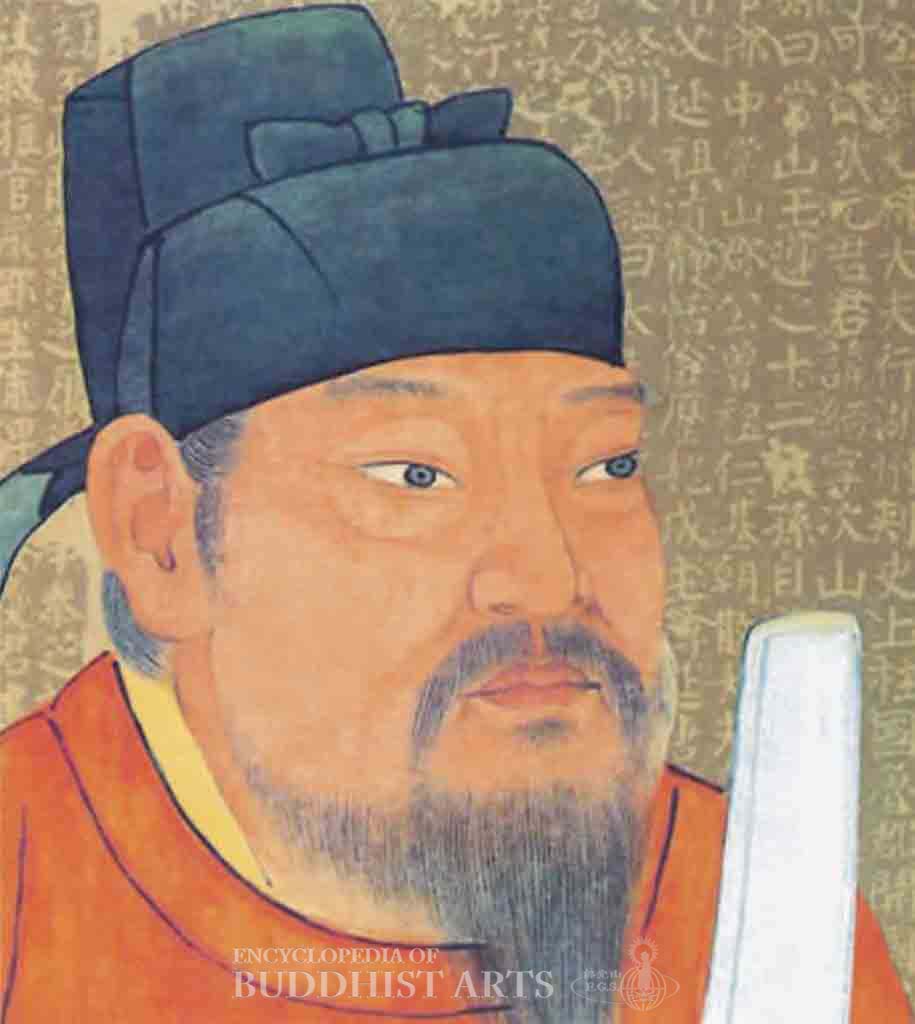
Yan Zhenqing

Prabhutaratna Pagoda Stele at Qianfu Temple by Yan Zhenqing (detail); Tang dynasty, dated 752
Rubbing
Yan Zhenqing
CHINA, Shaanxi, Xi’an; Tang dynasty
Yan Zhenqing was a calligrapher from Wannian (present day Xi’an, Shaanxi). Throughout his career, he served as an official for Emperor Xuanzong (reigned 712–756), Emperor Suzong (reigned 756–762), Emperor Daizong (reigned 762–779), and Emperor Dezong (reigned 779–805) of the Tang dynasty. He became an Imperial Scholar and was reputed for being righteous, loyal to the emperors, and kind to the people.
Yan studied calligraphy under Chu Suiliang, Xu Hao, and Zhang Xu and inherited the stylistic features of these renowned masters. His powerful and elegant calligraphy comprised the influential Yan script, which was a unique style that greatly differed from that which was popular during his time. He also specialized in seal and Wei clerical scripts, while his regular script, considered a model of perfection, appears full and bold. His running script is strong, fluid, and natural. In general, Yan’s calligraphy exhibits strokes that are round in form with a broad structure that is strict in composition. He was reputed alongside Liu Gongquan, both of whom had far-reaching influences in the history of calligraphic art.
The Prabhutaratna Pagoda Stele, written in the year 752 and now kept in the Xi’an Beilin Museum in Shaanxi, exemplifies Yan’s earlier works in which his Chinese characters are square and tidy, resembling Xu Hao’s calligraphic style. Mid-career works are represented by the monumental cliff carving of Praise to the Revival of the Great Tang on Wuxi Cliff in Hunan. Wang Shizhen of the Ming dynasty (1368–1644) praised this work to be the “best of Yan script.” Magu Altar Record is representative of his later works and shows his immense creativity and skill.
The inscriptions on the murals at Daci Temple in Sichuan were written by Yan. He composed the calligraphy for the Stele of an Edict to Establish Free Life Ponds Nationwide in 759, and in 773 he rewrote it again for a Song dynasty (960-1279) stele in Zhejiang whose original work was missing. The stele at Linggu Temple in Jiangsu features an image of Master Baozhi painted by Wu Daozi, a verse composed by Li Bai, and an inscription written by Yan. Another stele exhibiting Yan’s calligraphy is the Chronicle of Merits for the Eight Precepts Observance Ceremony.
For more details, go to the Encyclopedia of Buddhist Arts: People, page 315.
Cite this article:
author = Hsingyun and Youheng and Youlu and Pokorski, Stefanie and Yichao and Mankuang and Miaohsi,
booktitle = {Encyclopedia of Buddhist Arts: People },
pages = 315,
title = {{Yan Zhenqing}},
volume = 19,
year = {2016}}