
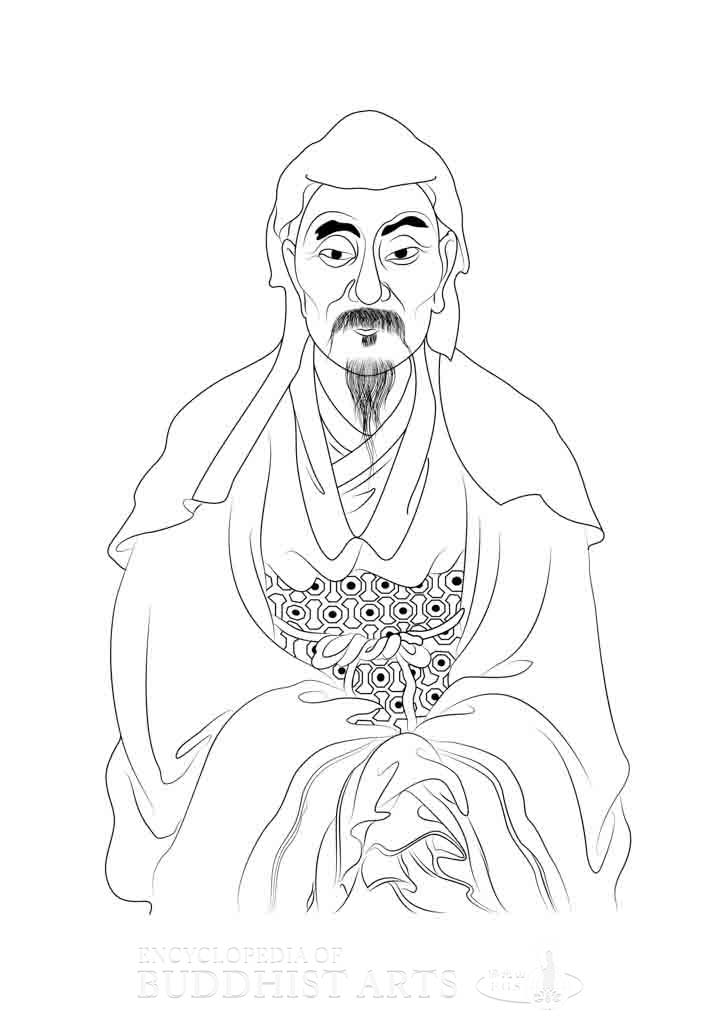
Zhao Mengfu
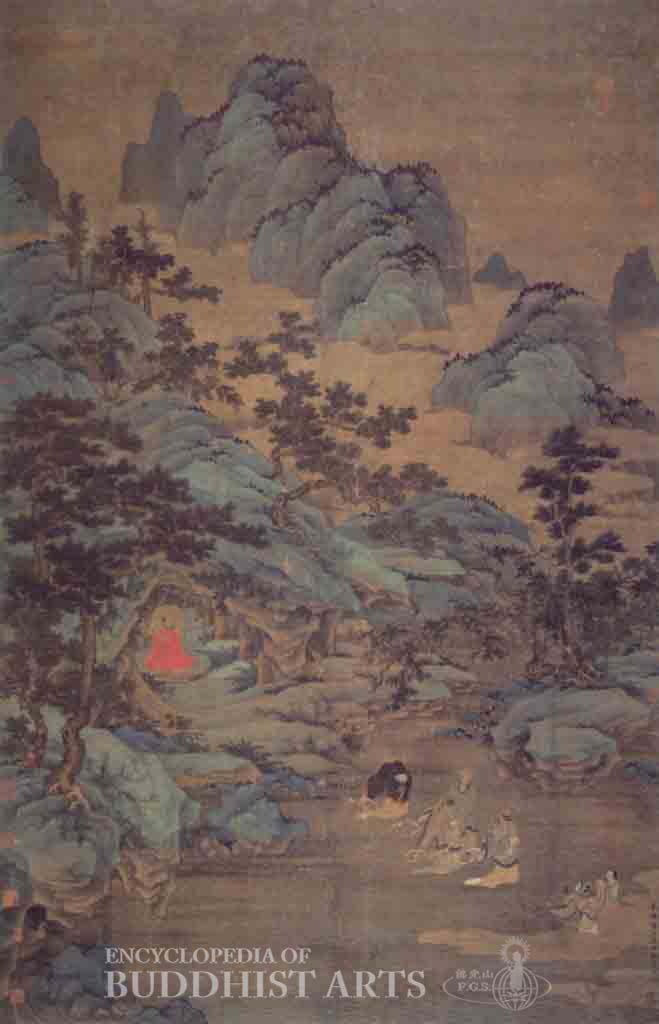
Naga Kings Paying Homage to the Buddha by Zhao Mengfu; Yuan dynasty
Color on silk
Zhao Mengfu
CHINA, Zhejiang, Huzhou; Southern Song to Yuan dynasty (1127–1368)
Also known as Zi’ang or Songxue Daoren, and posthumously titled Wenmin, Zhao Mengfu was a famous calligrapher, painter, scholar, poet, and seal engraver. Recommended by Cheng Jufu, Zhao became director of the Military Bureau, and eventually, he became a scholar in the Hanlin Academy. A devout Buddhist, he and his wife Guan Daosheng were disciples of Chan Master Zhongfeng Mingben. He authored ten fascicles of Literary Collection of Songxuezhai.
Erudite, talented, and good at music, Zhao also composed poems and essays. He was an expert in studying ancient artifacts and was an accomplished calligrapher and painter. In calligraphy, he initially followed the style of Emperor Gaozong (reigned 1127–1162) of the Song dynasty. In his middle age, he focused on the styles of Wang Xizhi, Wang Xianzhi, and Li Yong. Zhao was versatile in various scripts including bell and cauldron, clerical, running, cursive, and regular. Perfect and beautifully executed, his calligraphy was called Zhao style. It was often used for stele engravings.
Zhao’s landscape paintings followed the styles of Dong Yuan and Li Cheng, while his figurative works emulated that of Li Gonglin and other Tang dynasty artists. He was skilled in using ink to portray bamboo, flowers, and birds. He believed that painting with an “ancient taste” was important, meaning the use of influence from the Five Dynasties (907–960) and Northern Song dynasty (960–1127). He created a new painting style during the Yuan dynasty, and the artists Huang Gongwan, Ni Zan, Zhu Runde, and Ke Jiusi adopted his form.
At Baima Temple in Henan, a stele is engraved with Zhao’s calligraphy written in 1333. Among his calligraphy that has survived is the Heart Sutra, kept at the National Palace Museum in Taipei; Inscription of Imperial Teacher Dampa and Biography of Master Gaofeng Yuanmiao are at the Palace Museum in Beijing; Thirteen Colophons to the Preface of Orchid Pavilion Gathering, and one other kept at the Tokyo National Museum in Japan; Epistle to Zhongfeng Mingben is kept at the Seikado Bunko Art Museum in Tokyo; and Records of Miaoyan Temple is kept at the Princeton University Art Museum in New Jersey, USA.
Paintings by Zhao which have survived include Arhat, kept at the Liaoning Provincial Museum in Shenyang; Avalokitesvara with a Fish Basket, Bodhidharma, and Medicine Buddha are kept at the National Palace Museum in Taipei, Taiwan; and Naga Kings Paying Respect to the Buddha is kept at the Boston Museum of Fine Arts in Massachusetts, USA.
Within Zhao’s own family were several accomplished artists. His wife, Guan Daosheng, was a skilled calligrapher and painter, while his younger brother, Mengyu, was good at drawing figures, flowers, and birds. In addition, his son, Zhao Yong, and grandson, Wang Meng, were also skilled in painting. Zhao’s distinct artistic style passed down through generations.
For more details, go to the Encyclopedia of Buddhist Arts: People, page 347.
Cite this article:
author = Hsingyun and Youheng and Youlu and Pokorski, Stefanie and Yichao and Mankuang and Miaohsi,
booktitle = {Encyclopedia of Buddhist Arts: People },
pages = 347,
title = {{Zhao Mengfu}},
volume = 19,
year = {2016}}