
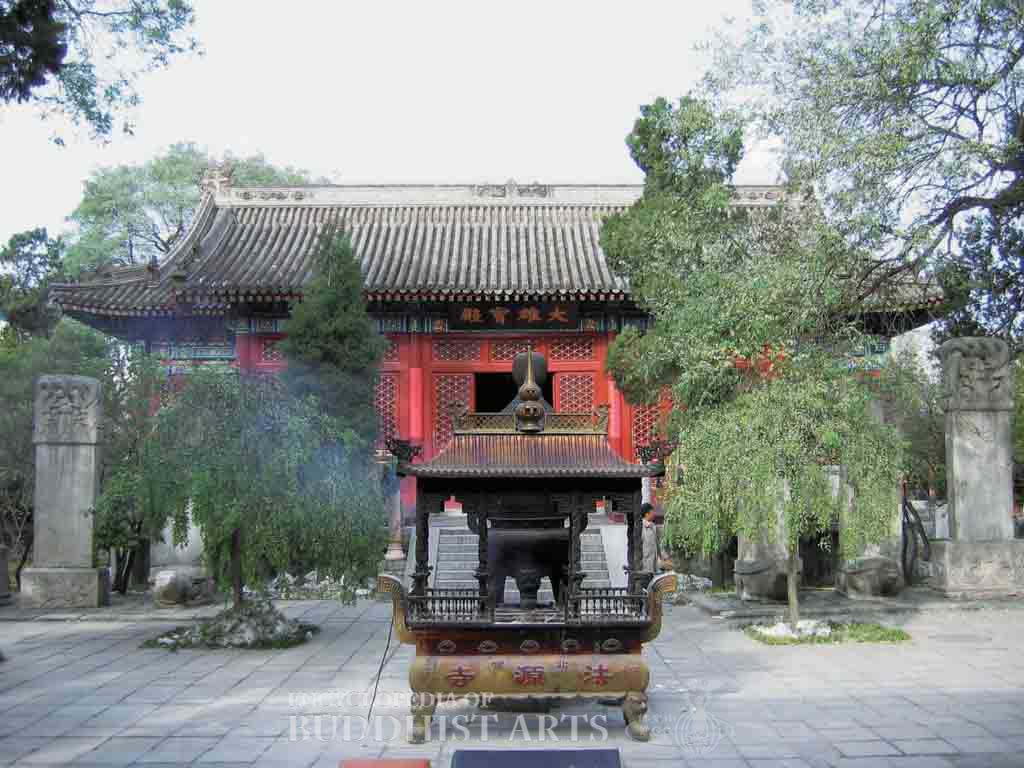
Fayuan Temple: Great Hero Hall
Fayuan Temple
CHINA, Beijing
The temple was built to commemorate the soldiers who died in a war during the Tang dynasty (618–907). Construction started in 645 on imperial orders and was completed in 696. In 1057, during the Liao dynasty, it was destroyed by an earthquake and later rebuilt. The existing buildings were constructed in the Ming dynasty (1368–1644) and repaired in the Qing dynasty (1644–1911). It was listed as a National Cultural Heritage Site in 2001.
The temple faces south and occupies 1.8 ha. It consists of six courtyards with the main buildings along the central axis: main temple gate, bell and drum towers, Heavenly King Hall, Great Hero Hall, Avalokitesvara Hall, Vairocana Hall, Great Compassion Platform, and the sutra repository.
The five-bay wide Great Hero Hall has a three-bay wide porch at the front. Golden dragons and imperial seals decorate the space beneath the eaves. A Ming dynasty Avatamsaka Triad of Vairocana Buddha with Manjusri and Samantabhadra Bodhisattvas is enshrined within the hall. They are made of wood and lacquered in gold.
The Vairocana Hall houses bronze statues of the Five Dhyani Buddhas. The statues were made during the Ming dynasty and are 5.65 m high. They are arranged into three tiers: on the upper tier there is Vairocana Buddha, the Buddhas of the Four Directions are in the middle, while in the bottom tier there is a throne decorated with a thousand lotus petals. A small Buddha image is engraved upon each petal.
Within the temple, there is the Xuanzang Memorial Hall, which exhibits his skull relic, some of his writings and personal items. There is also a Chinese Buddhist College and a Chinese Buddhist Artifacts Museum.
For more details, go to the Encyclopedia of Buddhist Arts: Architecture A-F, page 294.
Cite this article:
author = Hsingyun and Youheng and Johnson, Peter and Mankuang and Lancaster, Lewis,
booktitle = {Encyclopedia of Buddhist Arts: Architecture A-F},
pages = 294,
title = {{Fayuan Temple}},
volume = 1,
year = {2016}}