
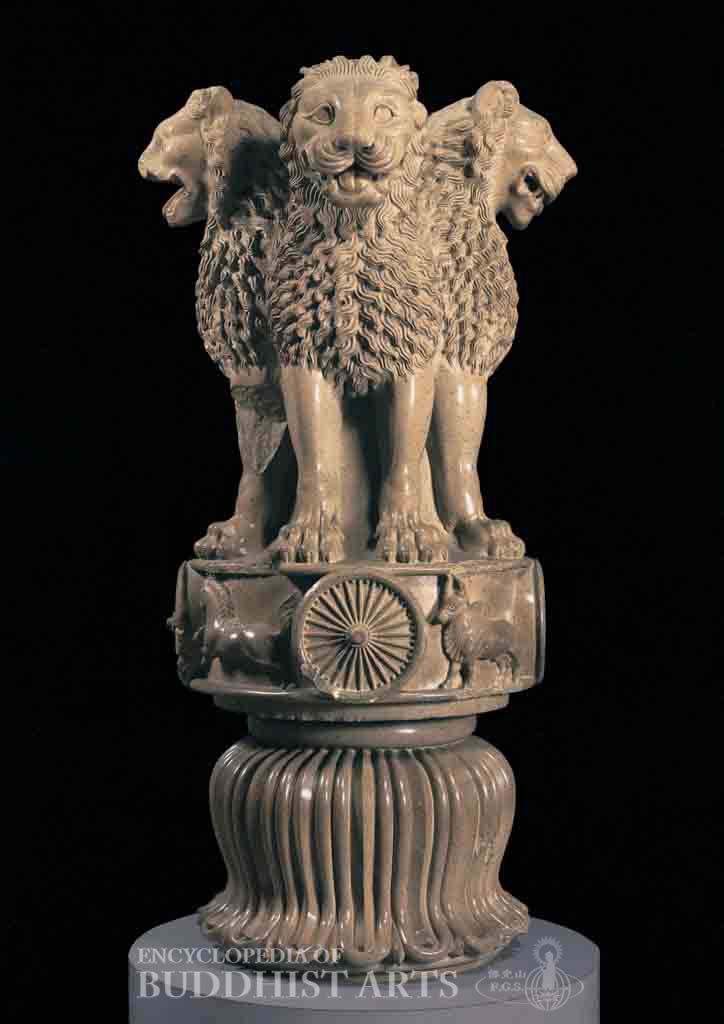
Sarnath: Lion Capital of an Asoka Pillar
Sandstone
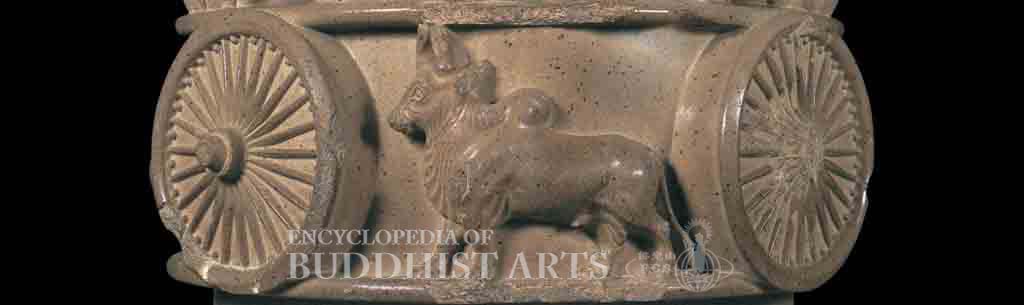
Sarnath: Lion Capital of an Asoka Pillar - Bull
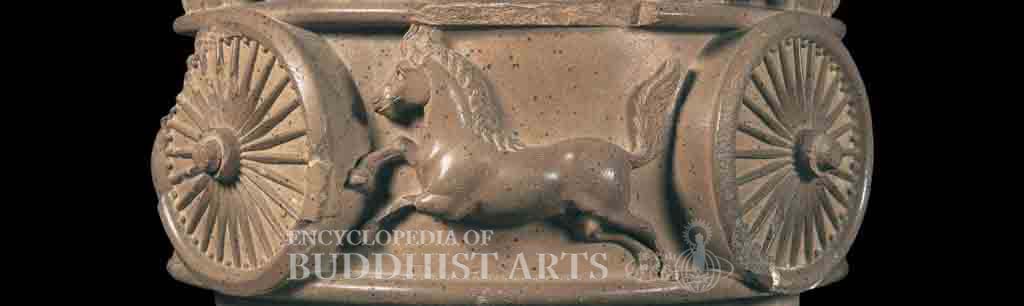
Sarnath: Lion Capital of an Asoka Pillar - Horse
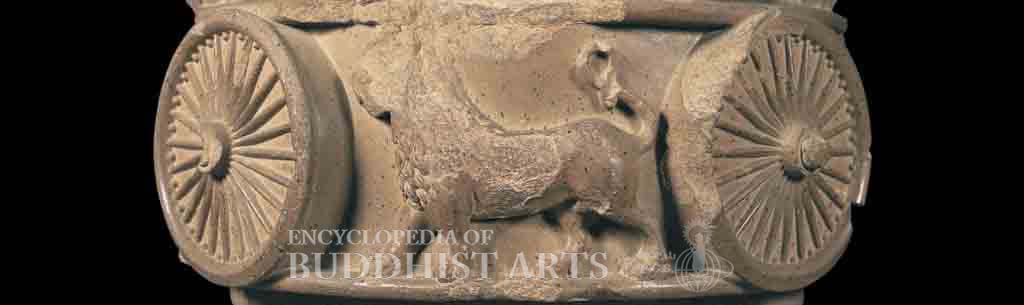
Sarnath: Lion Capital of an Asoka Pillar - Lion
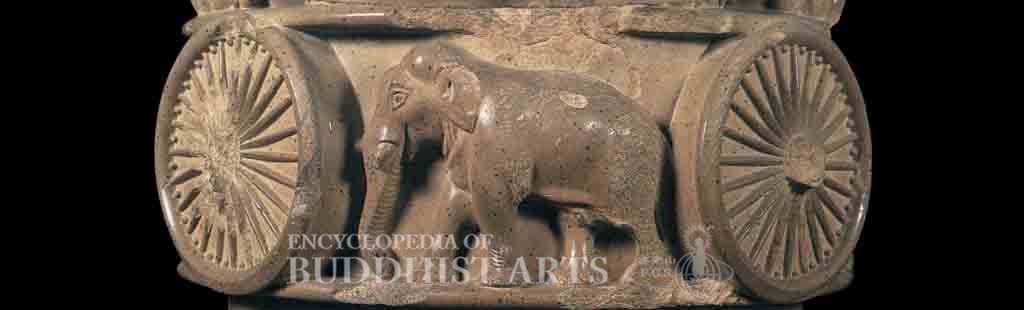
Sarnath: Lion Capital of an Asoka Pillar - Elephant
Sarnath: Lion Capital of an Asoka Pillar
INDIA, Uttar Pradesh, Varanasi
This lion capital was unearthed in 1904 from Sarnath. The Asoka Pillar was originally erected next to the Dhamekh Stupa under the decree of King Asoka (reigned circa 269–232 BCE). The shaft of the pillar, which is still on site, is inscribed with the king’s edict as well as inscriptions from the Kushan (circa 1st–3rd century) and Gupta (circa 320–550) empires. It is considered to be the finest among Asoka Pillars and has been extremely well preserved. Its surmounting lion and wheel symbol were chosen to become the national emblem of India in 1950, while the 24-spoke Ashoka Wheel had already been placed at the center of the flag in 1947.
The pillar is made from highly polished sandstone quarried in the Chunar region near Varanasi. It was mentioned in the Great Tang Records on the Western Regions by Chinese Master Xuanzang. The base of the capital is bell-shaped with sixteen inverted lotus petals. A round platform is located at the top of the base that is decorated on the sides with four sacred animals, namely the bull, horse, lion, and elephant. The stone pillar symbolizes the center of the universe while the four sacred animals upon it are variously interpreted. They may represent the four directions, the lion signifying the north, the elephant the east, the bull the west, and the horse the south. An alternative explanation is that they recall key moments in the Buddha’s journey to enlightenment. The elephant represents the conception, in reference to Queen Maya’s dream of a white elephant that entered her womb. The bull represents the birth of the Buddha during the month of Vaisakha (April to May), under the zodiacal sign of Taurus. The horse represents Kanthaka, on which Prince Siddhartha rode away in order to renounce his worldly life. The Lion represents the attainment of Buddhahood.
Each animal is separated by the Dharma wheel, which signifies the turning of the Dharma wheel. The style of the animals is rather similar to artwork from the Indus Valley Civilization. Four freestanding lions on the platform at the top sit back to back from each other, facing outwards toward the four directions, and symbolize Asoka’s universal dominion as a cakravartin, the wheel-turning king.
The four lions are vividly depicted with almond-shaped eyes and mustaches represented by three curved lines. The manes of the lions are shaped like flames and are divided into numerous small tufts. The front legs are muscular with powerful-looking paws. Originally there was a Dharma wheel, estimated to measure 83 cm in diameter, above the lions. The wheel unfortunately has been mostly lost although fragments survive. The ambitious vision displayed by this unique artwork exhibits a certain grandeur and magnificence compared with other Asoka pillars that only have a single animal.
For more details, go to the Encyclopedia of Buddhist Arts: Sculpture N-Sr, page 975.
Cite this article:
author = Hsingyun and Youheng and Lovelock, Yann and Chou, Yuan and Huntington, Susan and Edson, Gary and Neather, Robert,
booktitle = {Encyclopedia of Buddhist Arts: Sculpture N-Sr},
pages = 975,
title = {{Sarnath: Lion Capital of an Asoka Pillar}},
volume = 12,
year = {2016}}