
Standing Buddha
Bronze
Standing Buddha
LAOS
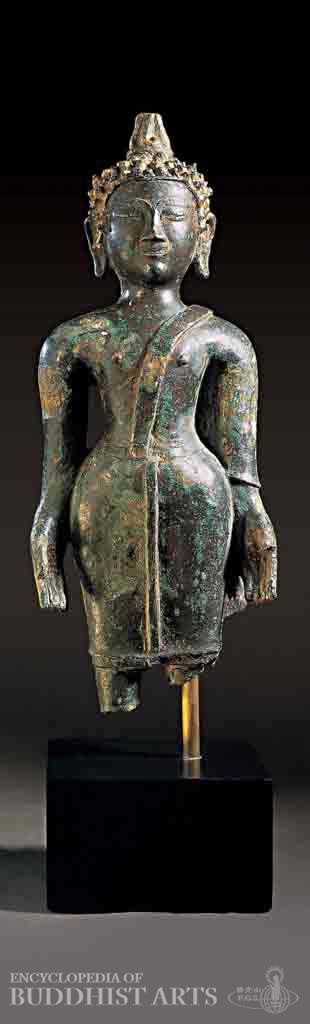
Some of this statue’s characteristics are similar to those found on pieces from the 14th and 15th centuries excavated at U Thong and Ayutthaya in Thailand despite its Laotian origin. The most noticeable features are the pointed curls on the head and the usnisa’s flame ornament. The upper body is disproportionately shorter and the waist is narrower than the rest of the body. Both forearms are sculpted with a curving outline rarely observed on statues, and the left palm turns outward seemingly to display the varada (wish-granting) mudra. The facial features are unique to the region. A light monastic robe molds itself to the body and is distinguished largely by the strap-like hem over the left shoulder.
For more details, go to the Encyclopedia of Buddhist Arts: Sculpture St-Z, page 1146.
Cite this article:
author = Hsingyun and Youheng and Lovelock, Yann and Chou, Yuan and Huntington, Susan and Edson, Gary and Neather, Robert,
booktitle = {Encyclopedia of Buddhist Arts: Sculpture St-Z},
pages = 1146,
title = {{Standing Buddha}},
volume = 13,
year = {2016}}