
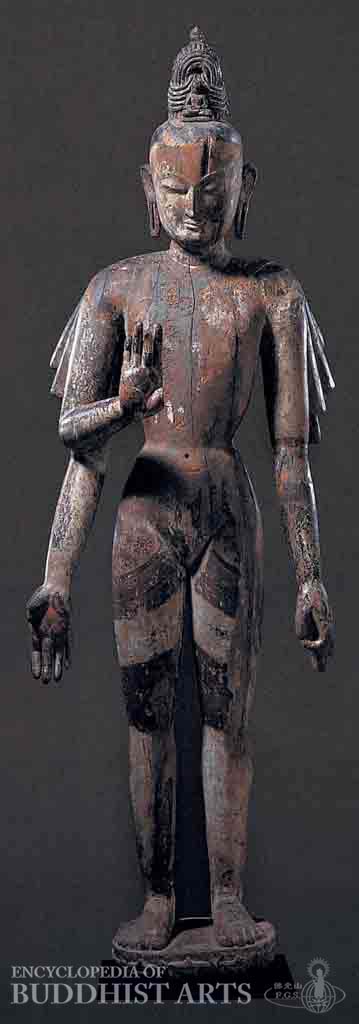
Eight-Armed Amoghapasa Avalokitesvara
Wood
Eight-Armed Amoghapasa Avalokitesvara
NEPAL
Amoghapasa, meaning “unfailing noose” is so named because the Bodhisattva made a vow never to fail in using the “noose of compassion” to catch and rescue all sentient beings from suffering. This manifestation is especially popular in Nepalese Buddhism.
The Bodhisattva’s elaborate topknot is formed from twisted braids and is fronted by a Buddha image, beneath which the simply carved features look down benignly. Signs of spiritual status include elongated and hollowed earlobes and three lines on the neck. The figure stands on a small lotus pedestal and was once eight-armed, but five are broken. One of the two hands on the left is raised in abhaya (fearlessness) mudra and the other hangs down in varada (wish-granting) mudra. It is possible that the remaining hand on the right, held downwards with thumb and forefinger touching, once held the noose from which the Bodhisattva is named. There are few carved indications of clothing, but traces of paint that clearly show patterns and fold lines suggest that it was mainly represented in this manner.
For more details, go to the Encyclopedia of Buddhist Arts: Sculpture A-F, page 310.
Cite this article:
author = Hsingyun and Youheng and Lovelock, Yann and Chou, Yuan and Huntington, Susan and Edson, Gary and Neather, Robert,
booktitle = {Encyclopedia of Buddhist Arts: Sculpture A-F},
pages = 310,
title = {{Eight-Armed Amoghapasa Avalokitesvara}},
volume = 10,
year = {2016}}