
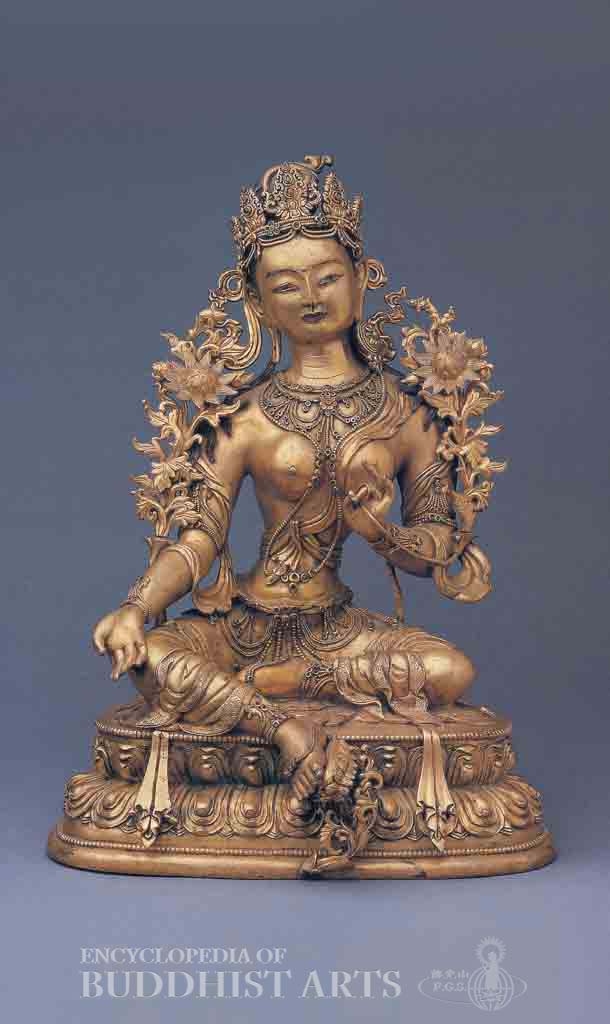
Green Tara
Gilt copper alloy
Green Tara
CHINA; Qing dynasty
The figure sits upon a double lotus throne in the relaxation posture, the head tilted to one side. The figure’s right hand is placed on the right knee in the varada (wish-granting) mudra, while the left hand forms a mudra. The left hand also clasps one of the two lotus stalks that rises to shoulder height on either side. Tara wears a five-leaf crown and an abundance of jewelry, all studded with semi-precious stones. A wispy stole wounds around the figure’s arms and waist, while a single earring is still in place. The hair has been painted and the tresses fall to drape upon the shoulders. Due to the facial features, the sculpture is believed to be an imitation of Tibetan sculptures by Chinese artists, created during the mid-17th century.
For more details, go to the Encyclopedia of Buddhist Arts: Sculpture G-M, page 378.
Cite this article:
author = Hsingyun and Youheng and Lovelock, Yann and Chou, Yuan and Huntington, Susan and Edson, Gary and Neather, Robert,
booktitle = {Encyclopedia of Buddhist Arts: Sculpture G-M},
pages = 378,
title = {{Green Tara}},
volume = 11,
year = {2016}}