
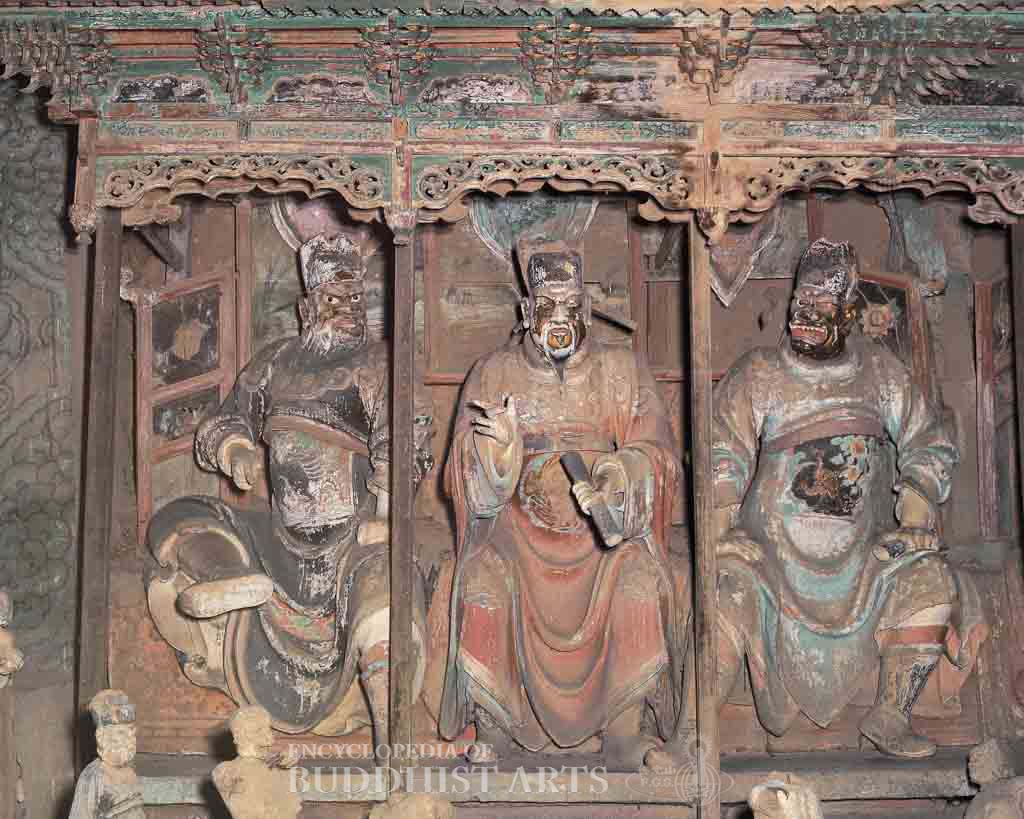
Shuanglin Temple Ksitigarbha Hall: Ten Kings of Hell
Clay

Shuanglin Temple Ksitigarbha Hall: Ten Kings of Hell - Yama (detail)

Shuanglin Temple Ksitigarbha Hall: Ten Kings of Hell - Yama (detail)

Shuanglin Temple Ksitigarbha Hall: Ten Kings of Hell - Yama (detail)

Shuanglin Temple Ksitigarbha Hall: Ten Kings of Hell - Yama (detail)
Shuanglin Temple Ksitigarbha Hall: Ten Kings of Hell
CHINA, Shanxi, Jinzhong; Ming dynasty
These figure are located on either side of Ksitigarbha and along the north and south walls of the Ksitigarbha Hall. They measure from 130 cm to 135 cm in height. The task of the Ten Kings is to judge the deeds of those brought before them at death. Their connection with Ksitigarbha is explained by the vow of not attaining enlightenment until all the hells are emptied. The bearded figures are clothed as officials and sit with legs apart, gesticulating or carrying symbols of office. Each king is seated within his own niche in an arcade-like structure similar to that in the Arhat Hall. This particular method of presentation was popular during the Song (960–1279) and Yuan (1271–1368) dynasties but was seldom used during the Ming (1368–1644) and Qing (1644–1911) dynasties. Each figure is differentiated by expression, headgear, posture, and especially by the richly decorated robes they wear. The crowns are fixed to their heads by a large ornate nail.
For more details, go to the Encyclopedia of Buddhist Arts: Sculpture N-Sr, page 1079.
Cite this article:
author = Hsingyun and Youheng and Lovelock, Yann and Chou, Yuan and Huntington, Susan and Edson, Gary and Neather, Robert,
booktitle = {Encyclopedia of Buddhist Arts: Sculpture N-Sr},
pages = 1079,
title = {{Shuanglin Temple Ksitigarbha Hall: Ten Kings of Hell}},
volume = 12,
year = {2016}}