
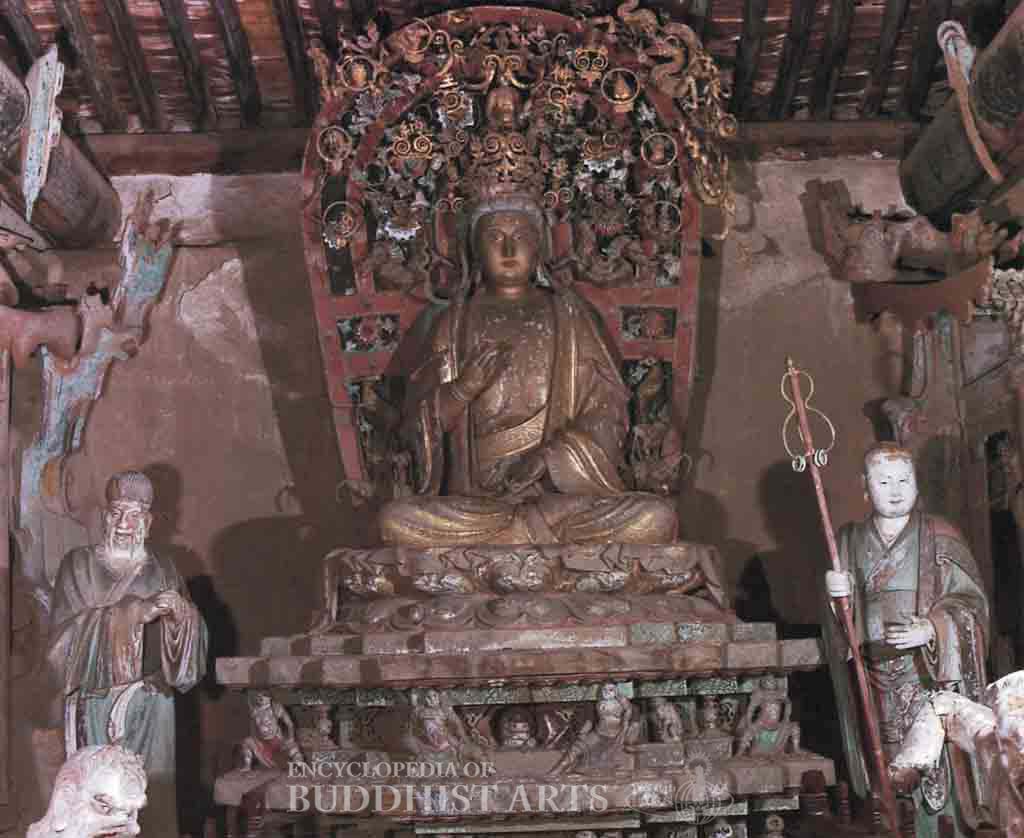
Shuanglin Temple Ksitigarbha Hall: Ksitigarbha Bodhisattva and Attendants
Clay
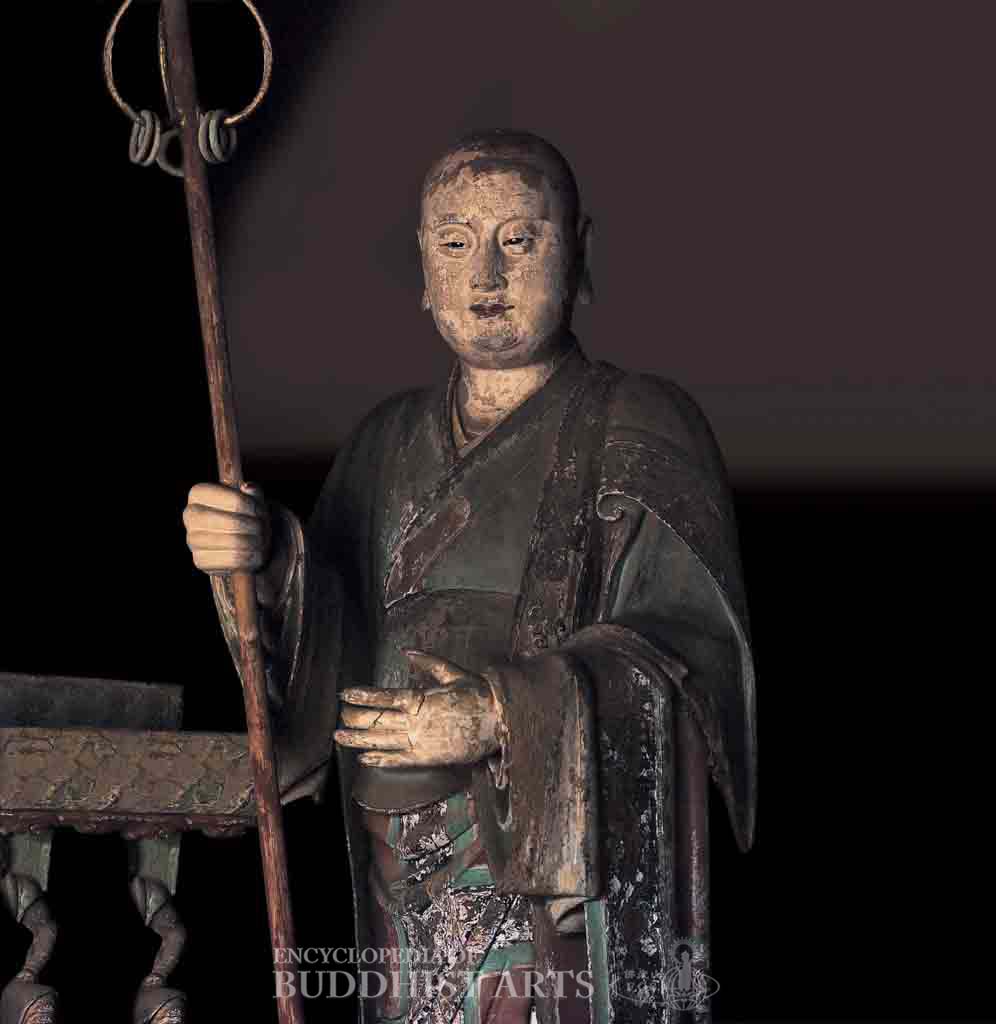
Shuanglin Temple Ksitigarbha Hall: Ksitigarbha Bodhisattva and Attendants - Daoming; H: 154 cm
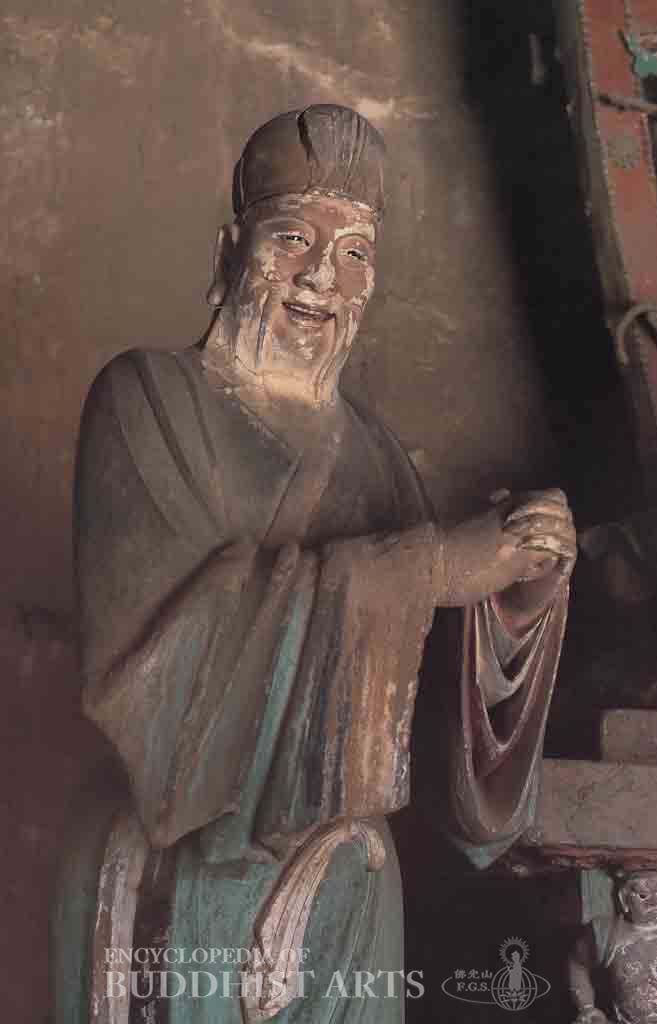
Shuanglin Temple Ksitigarbha Hall: Ksitigarbha Bodhisattva and Attendants - Mingong; H: 150 cm
Shuanglin Temple Ksitigarbha Hall: Ksitigarbha Bodhisattva and Attendants
CHINA, Shanxi, Jinzhong; Ming dynasty
This statue of Ksitigarbha is flanked by the monk Daoming on the right and by the layman Mingong on the left. Their relationship with the Bodhisattva is explained in the Pure Regulations of Baizhang. Some 1500 years after the Buddha passed into parinirvana, Ksitigarbha traveled to Jiuhuashan in Anhui, where he accepted some offerings from a local named Mingong. When Mingong’s son was ordained under Ksitigarbha, he assumed the monastic name of Daoming.
Ksitigarbha sits in full lotus position on a double lotus throne that is supported on a double Sumeru stand. Warriors support the two levels of the stand and a lion has made his lair between them. The Bodhisattva’s ornate headdress blends with the mandorla, which is decorated with dragons, the eight auspicious symbols, and trellised blossoms. A seated Buddha is located above the crown. Young Daoming carries a monk’s staff, while the smiling Mingong joins his hands in polite greeting.
For more details, go to the Encyclopedia of Buddhist Arts: Sculpture N-Sr, page 1078.
Cite this article:
author = Hsingyun and Youheng and Lovelock, Yann and Chou, Yuan and Huntington, Susan and Edson, Gary and Neather, Robert,
booktitle = {Encyclopedia of Buddhist Arts: Sculpture N-Sr},
pages = 1078,
title = {{Shuanglin Temple Ksitigarbha Hall: Ksitigarbha Bodhisattva and Attendants}},
volume = 12,
year = {2016}}