
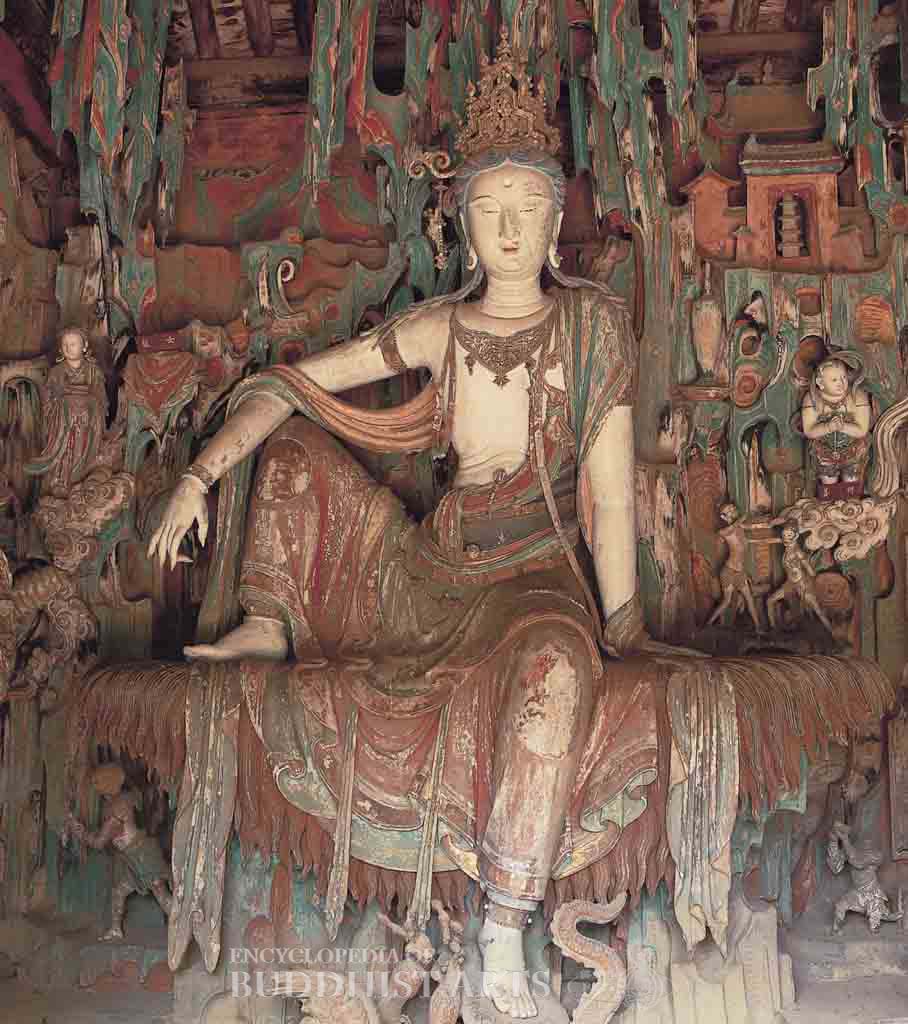
Shuanglin Temple Thousand Buddha Hall: Water-Moon Avalokitesvara
Clay
Shuanglin Temple Thousand Buddha Hall: Water-Moon Avalokitesvara
CHINA, Shanxi, Jinzhong; Ming dynasty
The Bodhisattva is in the iconographical form known as the Water-Moon Avalokitesvara. The figure, the main statue of the hall, is seated in a variation of the relaxation posture by a lake. The left leg overhangs the rock and the right arm rests on the raised knee. Ornaments of the ornate crown hang down one side of the head. The figure wears jewelry, and is draped with stoles that wind about the body and fall to the rock below. The left foot rests upon a lotus leaf with a dragon surging beneath it.
A scene from the “Gandavyuha Chapter” of the Avatamsaka Sutra describes the young Sudhana visiting the Bodhisattva at Potalaka Mountain. There he found Avalokitesvara on a plateau on the west side of the mountain that was rich with springs, ponds, and streams. The Bodhisattva was sitting on a diamond boulder in a clearing in a forest, expounding a doctrine concerning the salvation of all sentient beings to a group of enlightened beings seated on various jewel rocks. Sudhana is depicted as a young figure with palms joined in reverence. The setting is quite similar to the description in the sutra.
For more details, go to the Encyclopedia of Buddhist Arts: Sculpture N-Sr, page 1086.
Cite this article:
author = Hsingyun and Youheng and Lovelock, Yann and Chou, Yuan and Huntington, Susan and Edson, Gary and Neather, Robert,
booktitle = {Encyclopedia of Buddhist Arts: Sculpture N-Sr},
pages = 1086,
title = {{Shuanglin Temple Thousand Buddha Hall: Water-Moon Avalokitesvara}},
volume = 12,
year = {2016}}