
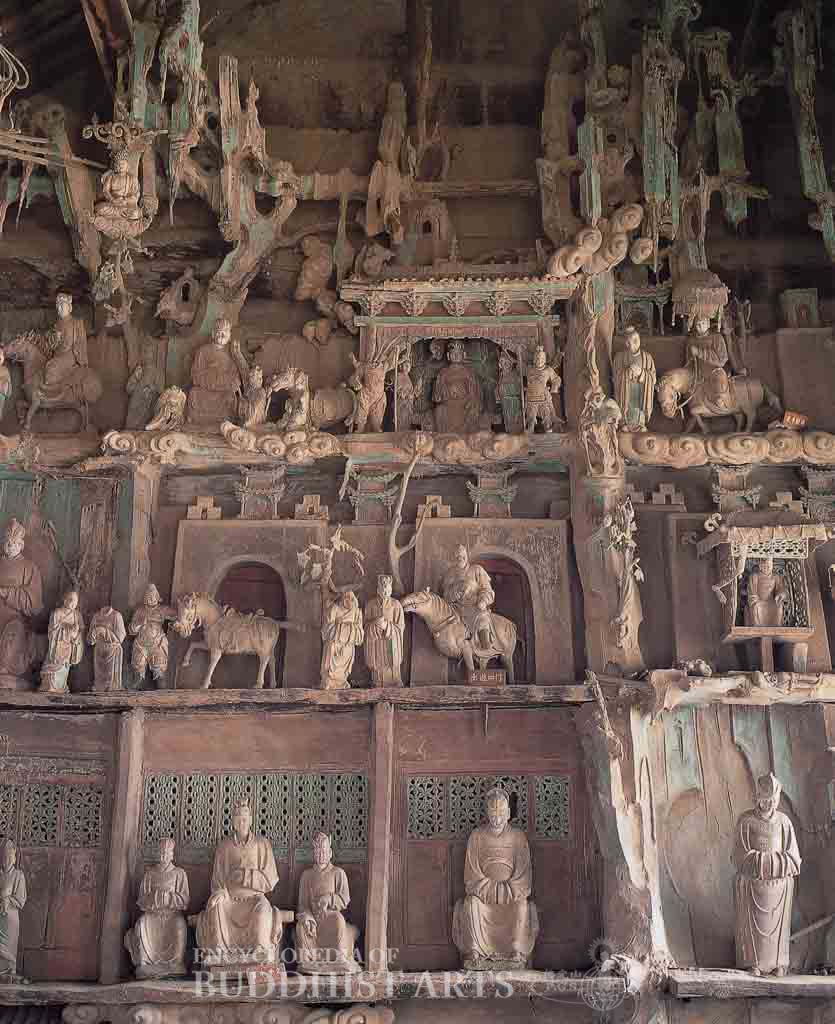
Shuanglin Temple Sakyamuni Hall: Life of the Buddha
Clay
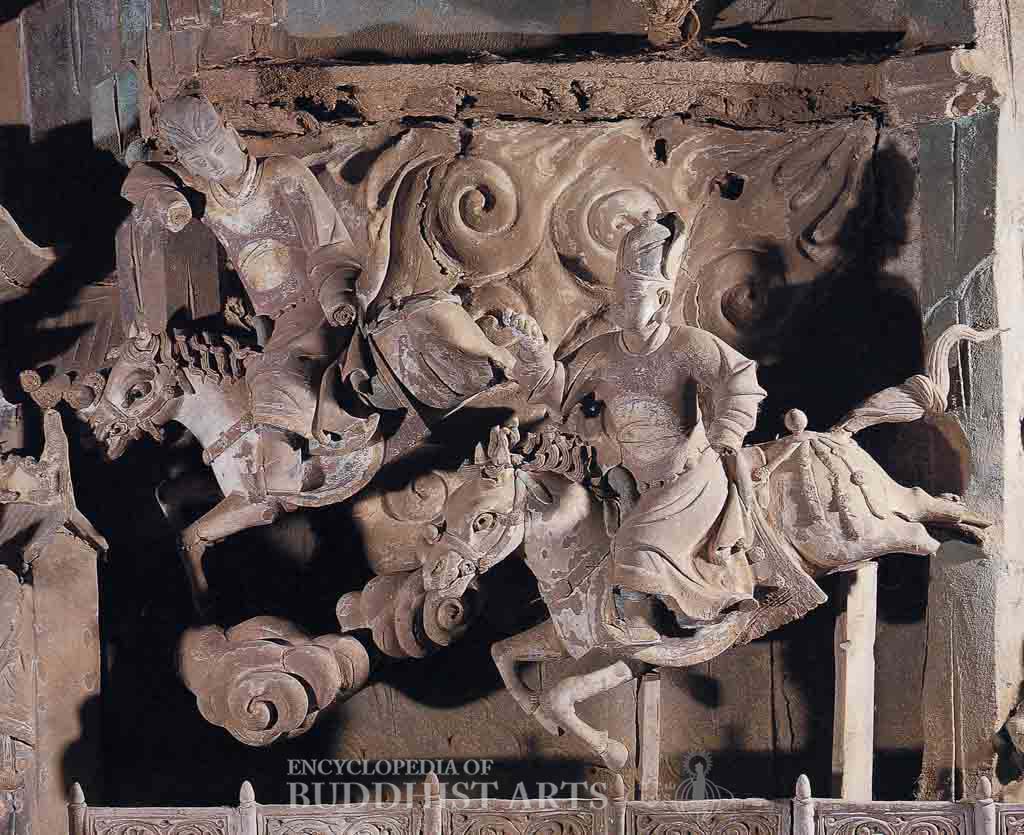
Shuanglin Temple Sakyamuni Hall: Life of the Buddha - Education of Prince Siddhartha
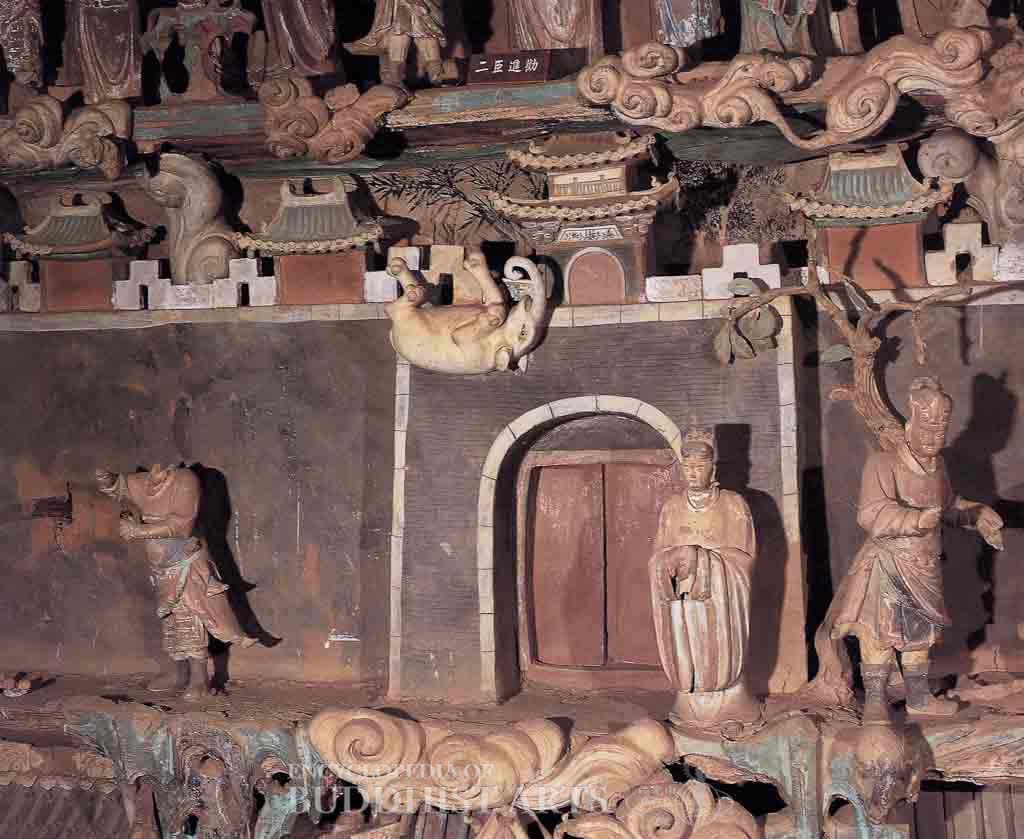
Shuanglin Temple Sakyamuni Hall: Life of the Buddha - Queen Maya’s Dream
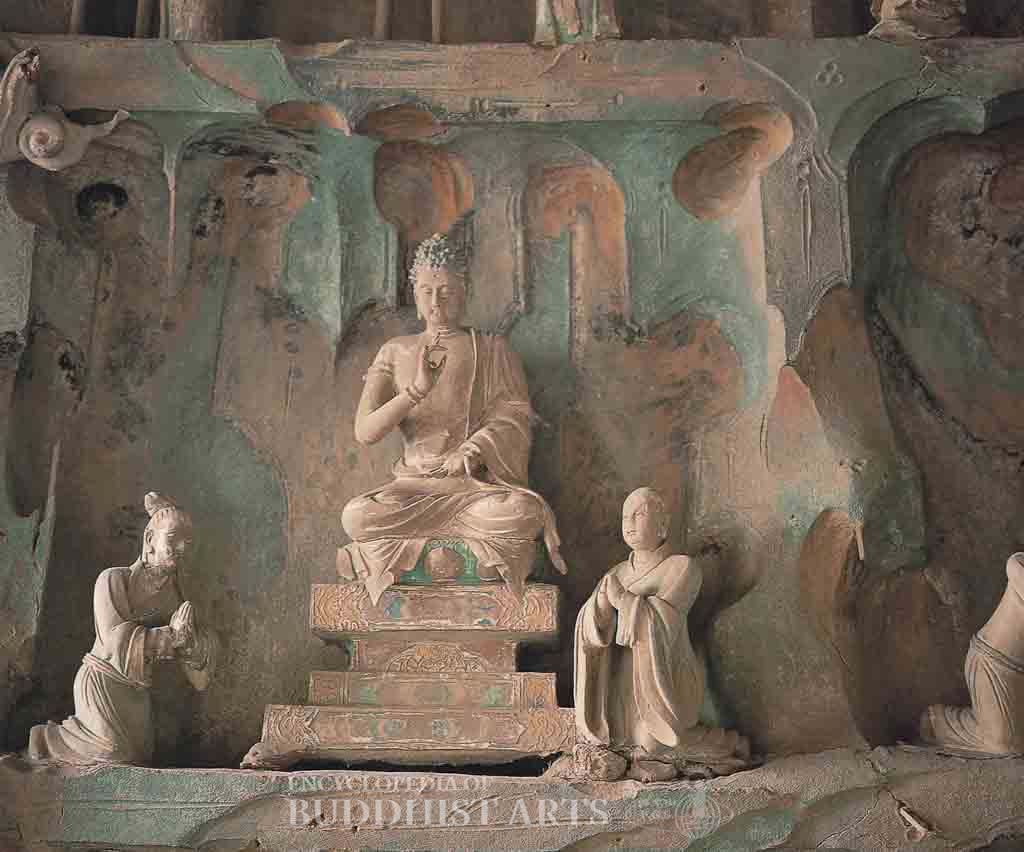
Shuanglin Temple Sakyamuni Hall: Life of the Buddha - Teaching at Sakra’s Cave
Shuanglin Temple Sakyamuni Hall: Life of the Buddha
CHINA, Shanxi, Jinzhong; Ming dynasty
These sculptures are located inside Sakyamuni Hall and occupy the north, east and west walls. They are separated into four registers with the first three around 93 cm high and the forth 200 cm high. They depict incidents from the Life of the Buddha, and are separated into 48 sections partitioned by clouds. There are over two hundreds figures in the composition, each 20 cm to 40 cm high. Green is the dominant color with some details in vermilion and mineral yellow.
All the characters are dressed in Chinese style and the Chinese inspired background makes interpretation of the scenes difficult at times. The figures are listed as including the prophecy of Dipamkara Buddha, the future Buddha teaching in Tusita Heaven and Queen Maya’s Dream. The latter scene includes the detail of the white elephant that Queen Maya dreams of, which tumbles down the palace gates from the teaching scene above. The series continues with Prince Siddhartha’s birth, the presentation of the baby at a temple with the deity rising to greet him, Asita’s prophecy of his future, the Prince’s education in the art of horse-riding and his first experience of meditation during the plowing ceremony. His young adulthood includes winning the hand of Yasodhara, the Four Encounters, and the Great Departure on horseback from the city gates.
The Buddha’s religious quest includes ascetic practice, and Mara’s unsuccessful assault before his enlightenment. The first turning of the Dharma wheel, the teaching of the deities in Sakra’s Cave, the conversion of the Kasyapa Brothers by overcoming a fire naga, and finally his return to visit his father in Kapilavastu concludes the Buddha’s life depictions in the Hall.
For more details, go to the Encyclopedia of Buddhist Arts: Sculpture N-Sr, page 1081.
Cite this article:
author = Hsingyun and Youheng and Lovelock, Yann and Chou, Yuan and Huntington, Susan and Edson, Gary and Neather, Robert,
booktitle = {Encyclopedia of Buddhist Arts: Sculpture N-Sr},
pages = 1081,
title = {{Shuanglin Temple Sakyamuni Hall: Life of the Buddha}},
volume = 12,
year = {2016}}