

Dazu Rock Carvings Baodingshan Great Buddha Bay Niche 30: Ox Herding
Stone
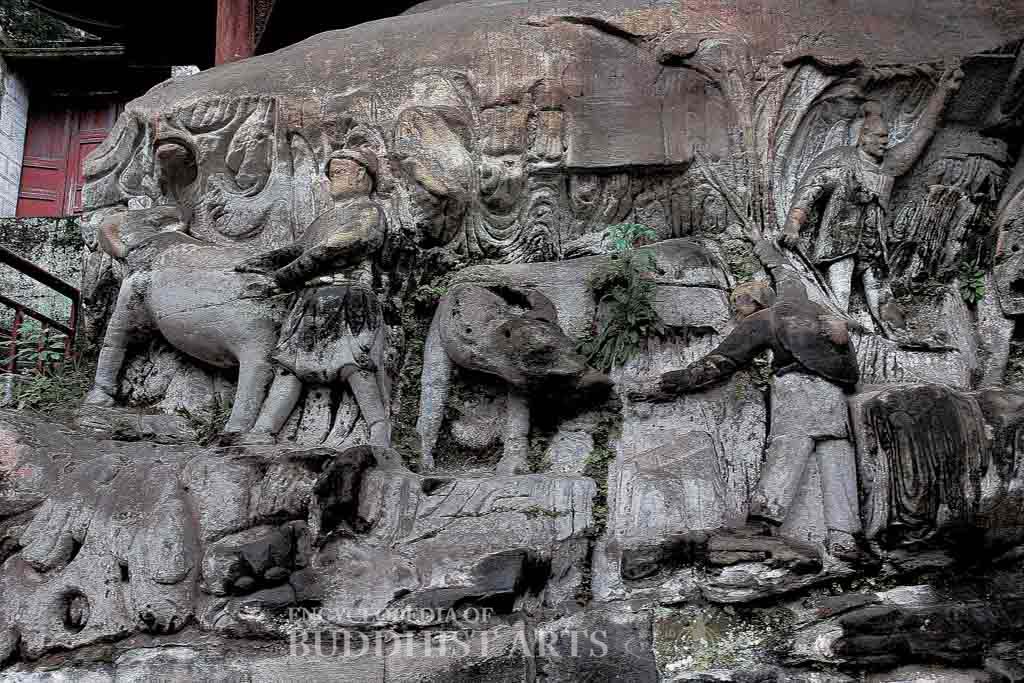
Dazu Rock Carvings Baodingshan Great Buddha Bay Niche 30: Ox Herding - Before Herding and Initial Adjustment
Dazu Rock Carvings Baodingshan Great Buddha Bay Niche 30: Ox Herding
CHINA, Chongqing, Dazu; Southern Song dynasty
This 4.55 m high by 27 m long carving is located on the western section of the south cliff. Unlike many of the other carvings at Baodingshan, it is unpainted. According to the inscription, these carvings are based on the Ox Herding Verses, written by Yang Jie, a magistrate of Runzhou with the honor of the purple robe and golden fish bag. Yang Jie, also known as Wuwei, was well-versed in Buddhism, visited many monasteries, and authored the Collection of Wuwei.
There are ten scenes in total. From east to west they are: Before Herding, Initial Adjustment, Being Controlled, Looking Back, Tamed, Unhindered, Act Freely, Both Forgotten, Solitary, and Both Extinguished. Ox herding is used as a metaphor to help a practitioner understand the stages of Chan practice. The ox represents the mind, and the herder is the practitioner. The carving implies that through Buddhist practice, the mind, like the ox, can be tamed through diligent effort.
Most of the figures in this set of carvings are life-sized. The herder is depicted in various positions including strolling beside the ox, talking, playing a flute, and sleeping. The ox is shown licking its hooves, drinking, and kneeling down as if resting.
For more details, go to the Encyclopedia of Buddhist Arts: Caves A-E, page 266.
Cite this article:
author = Hsingyun and Youheng and Johnson, Peter and Mankuang and Huntington, Susan and Edson, Gary and Neather, Robert,
booktitle = {Encyclopedia of Buddhist Arts: Caves A-E},
pages = 266,
title = {{Dazu Rock Carvings Baodingshan Great Buddha Bay Niche 30: Ox Herding}},
volume = 5,
year = {2016}}