
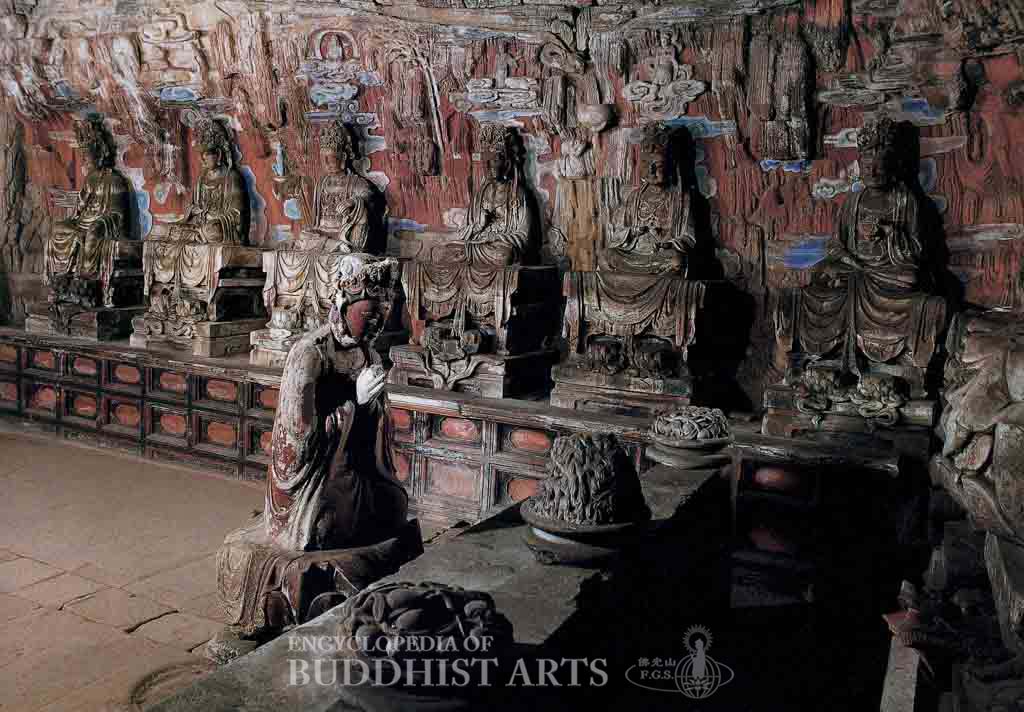
Dazu Rock Carvings Baodingshan Great Buddha Bay Cave 29: East Wall and Kneeling Bodhisattva

Dazu Rock Carvings Baodingshan Great Buddha Bay Cave 29
Dazu Rock Carvings Baodingshan Great Buddha Bay Cave 29
CHINA, Chongqing, Dazu
This cave is located on the western section of the south cliff, and is the largest in the Baodingshan region at 9.55 m in width, 6.02 m in height, and 12.13 m in depth. The entrance faces north, with a narrow outside opening that widens in towards the cave, forming a funnel-shaped corridor, 3.9 m in length. There are inscriptions and poems written by visitors from different dynasties on both walls of the corridor. A horizontal line of inscription which reads “a place for repaying kindness and attaining perfect enlightenment” is engraved at the top of the west wall. The statues within the cave are arranged according to a scene from the Sutra of Perfect Enlightenment, which describes the Twelve Perfect Enlightenment Bodhisattvas who attained perfect enlightenment, including Manjusri and Samantabhadra Bodhisattvas. In the sutra, the Bodhisattvas take turns making inquiries to the Buddha about the Dharma, to which he provides insightful responses.
A triad of Buddha sculptures is installed before the back wall of the cave, with a kneeling Bodhisattva facing them. Six Bodhisattvas are on each of the other side walls: on the east wall, from right to left, are Samantabhadra, Vajragarbha, Pure Wisdom, Sound Discernment, Universal Enlightenment, and Foremost in Virtue and Goodness Bodhisattvas. On the west wall, from left to right, are Manjusri, Universal Vision, Maitreya, Unhindered Power and Virtue, Purifier of All Karmic Hindrances, and Perfect Enlightenment Bodhisattvas. Each of the Bodhisattvas wears a tall headdress, a monastic robe, and ornaments. Some of them form a mudra with their hands, while others hold various items. Two lotuses are carved on the bases of their thrones, and a long, continuous shelf runs below and in front of the sculptures.
A monk holding a round bowl is depicted between Vajragarbha and Pure Wisdom Bodhisattvas. A dragon is carved just above the bowl, and a gutter drips water from the dragon’s mouth into it. The stone wall under the bowl is hollowed out and linked to an underground ditch in the cave, leading the water to a stream outside. This arrangement enables the dripping water to be heard, but prevents the viewer from seeing where it goes after leaving the dragon’s mouth. Other carvings on the walls include mountains, rocks, bamboo, trees, clouds, and mist, giving the cave a sacred, heavenly atmosphere.
For more details, go to the Encyclopedia of Buddhist Arts: Caves A-E, page 237.
Cite this article:
author = Hsingyun and Youheng and Johnson, Peter and Mankuang and Huntington, Susan and Edson, Gary and Neather, Robert,
booktitle = {Encyclopedia of Buddhist Arts: Caves A-E},
pages = 237,
title = {{Dazu Rock Carvings Baodingshan Great Buddha Bay Cave 29}},
volume = 5,
year = {2016}}