
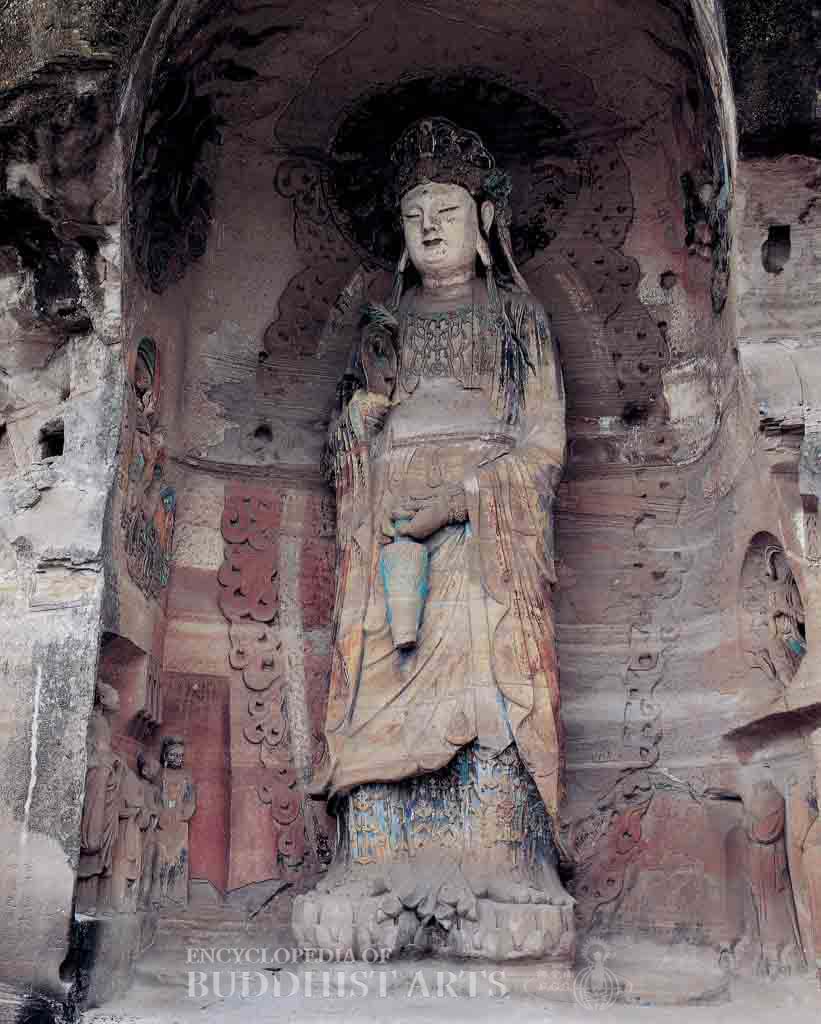
Anyue Yuanjue Caves: Cave 7 - Avalokitesvara Holding a Vase
Anyue Yuanjue Caves
CHINA, Sichuan, Ziyang
The Anyue Yuanjue (Perfect Enlightenment) Caves are located on the northern and southern slopes of Yunjushan (Cloud Dwelling Mountain), southeast of Anyue county. Altogether, the site contains 1,933 sculptures distributed among 22 caves and niches in the 75 m long northern section and 81 caves and niches in the 111 m long southern section. The first carvings at the site were likely done during the Tang dynasty (618–907), but these carvings are no longer extant and only some of the niches remain, with the oldest being Niche 71, dated to 732. The majority of the remaining carvings were created during the Five Dynasties (907–960) and the Song dynasty (960–1279). Notable sculptures at the site include Sakyamuni Buddha, the Seven Buddhas of the Past, the Buddhas of the Past, Present, and Future, Thousand-Armed Avalokitesvara Bodhisattva, Avalokitesvara Holding a Vase, Padmapani Avalokitesvara, Wisdom Kings, Vaisravana, the Sixteen Arhats, illustration of the hells, and Daoist figures. The caves were listed as a National Cultural Heritage Site in 2006.
The caves and niches from the Five Dynasties are small with flat ceilings, and tend to be slightly deeper than the Tang dynasty caves. The sculptures are mostly combinations of Buddhas and Bodhisattvas, individual images of Bodhisattvas or Heavenly Kings, or illustrations of the hells. The Buddhas are mostly depicted with curled hair tied up in a high topknot, while the Bodhisattvas wear tall openwork headdresses. The faces of the figures are not as rounded as in Tang dynasty sculptures, and the folds in their robes are detailed with arching lines.
Larger caves, such as the Yuanjue Cave from which the complex derives its name, were created during the Song dynasty. The Yuanjue Cave is located in the northern region and is 4.75 m wide, 4.5 m high, and 10 m deep. It contains three Buddha sculptures on the back wall, and freestanding statues of the Twelve Perfect Enlightenment Bodhisattvas along the two side walls. Although the heads have suffered damage, the delicate sculpting and elaborate decoration of these statues are still evident. According to an inscription just outside the cave, it was constructed in 1044 by a person named Feng Jun. Interestingly, the inscription uses concepts from Confucianism to explain the idea of “perfect enlightenment” in Buddhism, showing the integration of Confucianism and Buddhism in the region at the time.
Other representative caves from the Song dynasty include Caves 7, 10, and 14 in the northern region of the site, all of which are relatively tall caves with heights of over 6 m. Cave 7, which measures 4.7 m wide, 7.3 m high, and 3.5 m deep, features a standing sculpture of Avalokitesvara holding a vase and a willow branch. Figures sculpted on the side walls include the Naga Girl, Sudhana, apsaras, and four donor figures. An inscription beside the sculptures states that they were restored in 1153. Cave 10 depicts the scene of Sakyamuni Buddha holding a flower and his disciple Mahakasyapa responding with a smile, a rare theme in rock carvings. Cave 14 features a 6.8 m high Padmapani Avalokitesvara holding a lotus. According to an inscription, the cave was commissioned by Yang Zhengqing, and was constructed from 1099 to 1108 during the Northern Song dynasty.
The sculptures in the southern section of the site are simpler. Notable images include a Buddha Pentad, Thousand Buddhas, and the Buddhas of the Past, Present, and Future. Based on inscriptions, the small niches were likely constructed during the early to middle period of the Northern Song dynasty. There are also a few Daoist niches at the site, reflecting the religious pluralism of the Tang and Song dynasties.
For more details, go to the Encyclopedia of Buddhist Arts: Caves A-E, page 82.
Cite this article:
author = Hsingyun and Youheng and Johnson, Peter and Mankuang and Huntington, Susan and Edson, Gary and Neather, Robert,
booktitle = {Encyclopedia of Buddhist Arts: Caves A-E},
pages = 82,
title = {{Anyue Yuanjue Caves}},
volume = 5,
year = {2016}}