
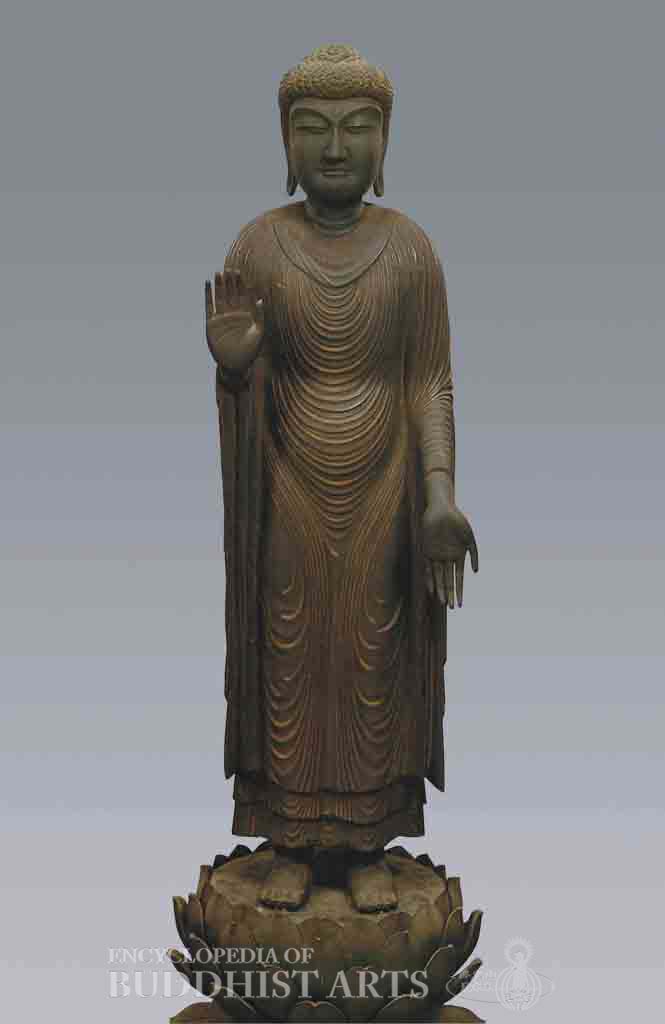
Jorakuji Temple: Sakyamuni Buddha
Wood
Jorakuji Temple: Sakyamuni Buddha
JAPAN, Kyoto; Kamakura period
This 13th century statue was modeled after the Udayana-style Sakyamuni statue in Kyoto’s Seiryoji Temple. The style became popular after the Heian period (794–1185). It is listed as an Important Cultural Property.
The figure is distinguished by the tight, conch-shell curls and by the style of the monastic robe. The robe fits tightly at the neck and has descending concentric folds that divide to a Y-shape outlining the legs. The statue is carved from several pieces of wood, with pale red paint and gold dust outlining the folds of the robe. The eyes are inset with semi-precious stone and X-rays suggest that there are jewels hidden within the statue.
For more details, go to the Encyclopedia of Buddhist Arts: Sculpture G-M, page 509.
Cite this article:
Hsingyun, et al. "Jorakuji Temple: Sakyamuni Buddha." Encyclopedia of Buddhist Arts: Sculpture G-M, vol. 11, 2016, pp. 509.
Hsingyun, Youheng, Yann Lovelock, Yuan Chou, Susan Huntington, Gary Edson, and Robert Neather. 2016. "Jorakuji Temple: Sakyamuni Buddha" In Encyclopedia of Buddhist Arts: Sculpture G-M, 11:509.
Hsingyun, Youheng, Lovelock, Y., Chou, Y., Huntington, S., Edson, G., & Neather, R.. (2016). Jorakuji Temple: Sakyamuni Buddha. In Encyclopedia of Buddhist Arts: Sculpture G-M (Vol. 11, pp. 509).
@misc{Hsingyun2016,
author = Hsingyun and Youheng and Lovelock, Yann and Chou, Yuan and Huntington, Susan and Edson, Gary and Neather, Robert,
booktitle = {Encyclopedia of Buddhist Arts: Sculpture G-M},
pages = 509,
title = {{Jorakuji Temple: Sakyamuni Buddha}},
volume = 11,
year = {2016}}
author = Hsingyun and Youheng and Lovelock, Yann and Chou, Yuan and Huntington, Susan and Edson, Gary and Neather, Robert,
booktitle = {Encyclopedia of Buddhist Arts: Sculpture G-M},
pages = 509,
title = {{Jorakuji Temple: Sakyamuni Buddha}},
volume = 11,
year = {2016}}