
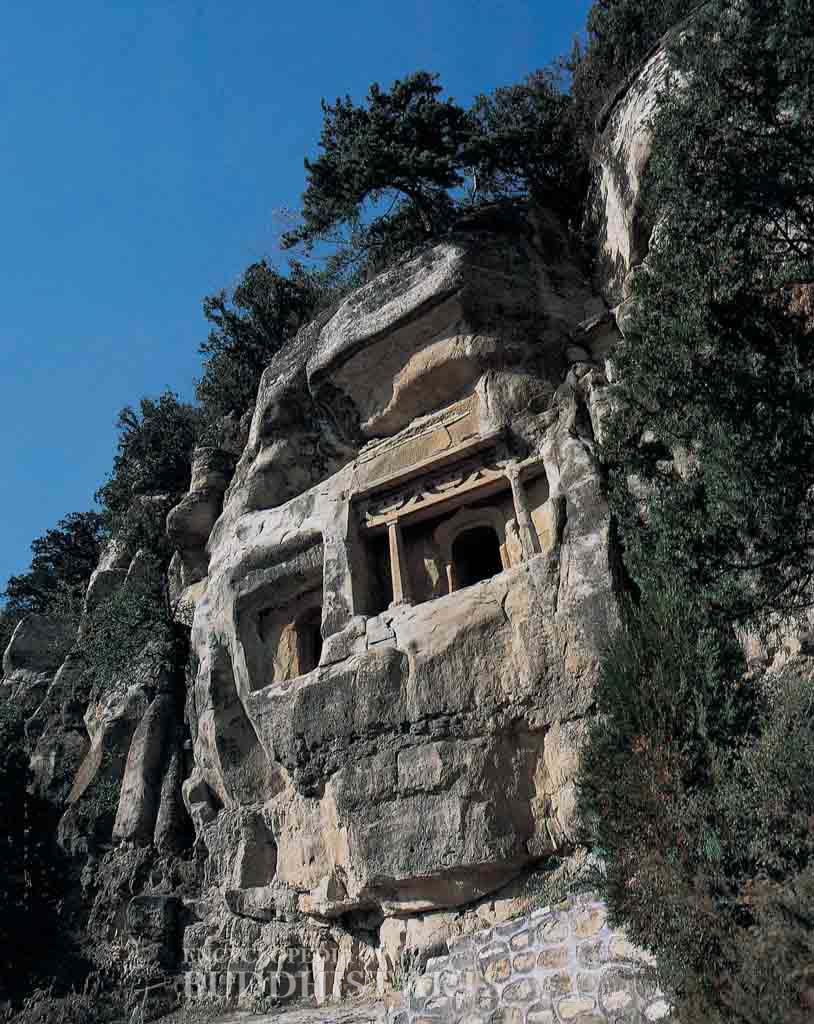
Tianlongshan Caves 16 and 17
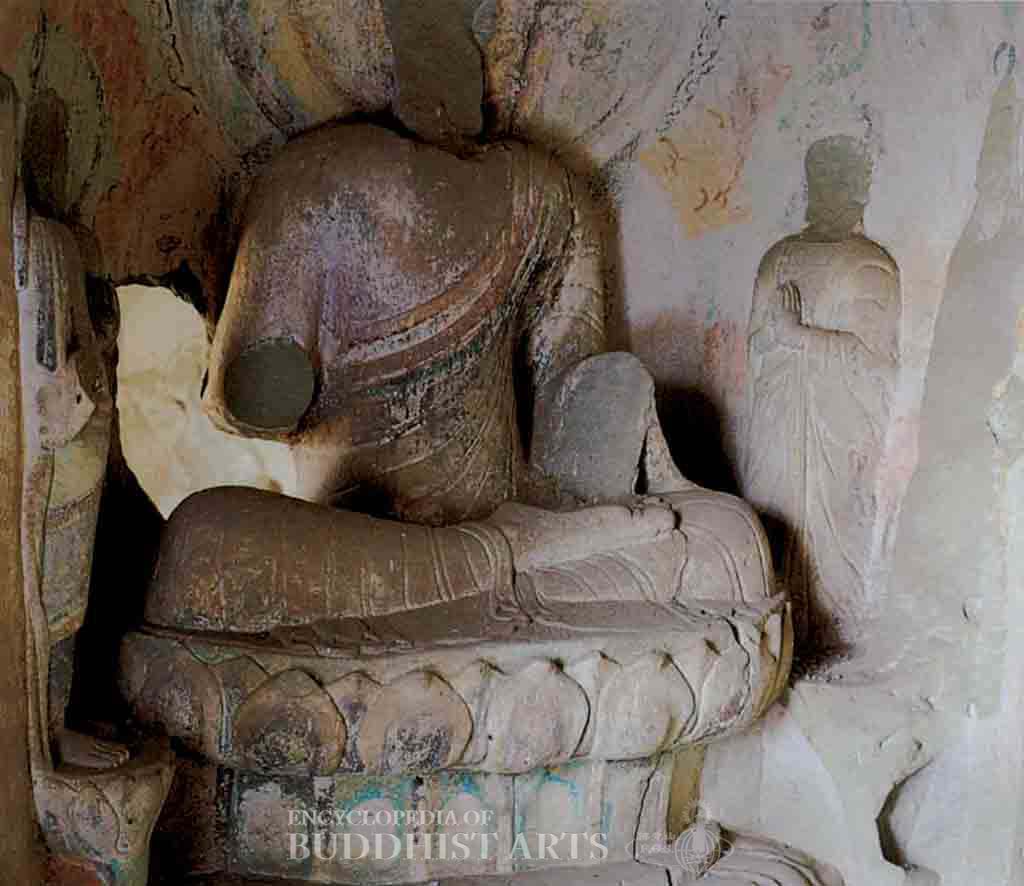
Tianlongshan Caves 16 and 17: Cave 16 - Buddha Niche (west wall)
Tianlongshan Caves 16 and 17
CHINA, Shanxi, Taiyuan
Twin Caves 16 and 17 are situated in the center of Tianlongshan’s west peak, facing south.
Cave 16 was constructed in 560 of the Northern Qi dynasty (550–577), equipped with a portico and a main chamber. The portico has two octagonal columns with a tripartite bracket set above the column capital that supports the architrave. A double-layer doorway leads into the main chamber. An octagonal column is found on each side of the doorway, the capitals of which support a lintel and architrave decorated with lotuses and phoenixes. The statues of Heavenly Kings on either side of the doorway are no longer extant.
The main chamber is 2.8 m high, 2.9 m to 3.3 m wide, and 2.7 m to 2.8 m deep, and has low platforms on all walls. The niches on the back (north), east, and west walls are each sculpted with a Buddha, two disciples, and two Bodhisattvas, all of which are missing heads. In addition, the entire Bodhisattva statue to the right of the main statue on the east wall has been removed. The main figures on the three walls wear fitted monastic robes. The platform on the back wall has an incense burner, twin lions, and musicians. Musicians also adorn the east and west walls. The front wall has no carvings but originally contained a mural, which was smeared over with a layer of lime by later generations. Faintly visible, a painting above the doorway depicts a Buddha with two disciples and two Bodhisattvas. The Buddha is flanked by two rows of figures, and the wall on both sides of the doorway is illustrated with three additional rows of figures.
Cave 17 was constructed during the Tang dynasty (618–907) and includes a portico and main chamber. The back wall of the portico has a doorway that was flanked by two warrior statues, both of which have been removed. The main chamber is 2.12 m high, 1.81 m to 2.03 m wide, and 2.19 m deep. Low platforms adorn the back, east, and west walls. The back wall is sculpted with one Buddha and two Bodhisattvas, while the east and west walls each display one Buddha and four Bodhisattvas. The heads of the three main statues have been removed, but the torsos wearing monastic robes remain. The three walls and the statues, have been recolored by later generations. There are no carvings on the front wall or the ceiling.
For more details, go to the Encyclopedia of Buddhist Arts: Caves T-Z, page 1453.
Cite this article:
author = Hsingyun and Youheng and Johnson, Peter and Mankuang and Huntington, Susan and Edson, Gary and Neather, Robert,
booktitle = {Encyclopedia of Buddhist Arts: Caves T-Z},
pages = 1453,
title = {{Tianlongshan Caves 16 and 17}},
volume = 9,
year = {2016}}