
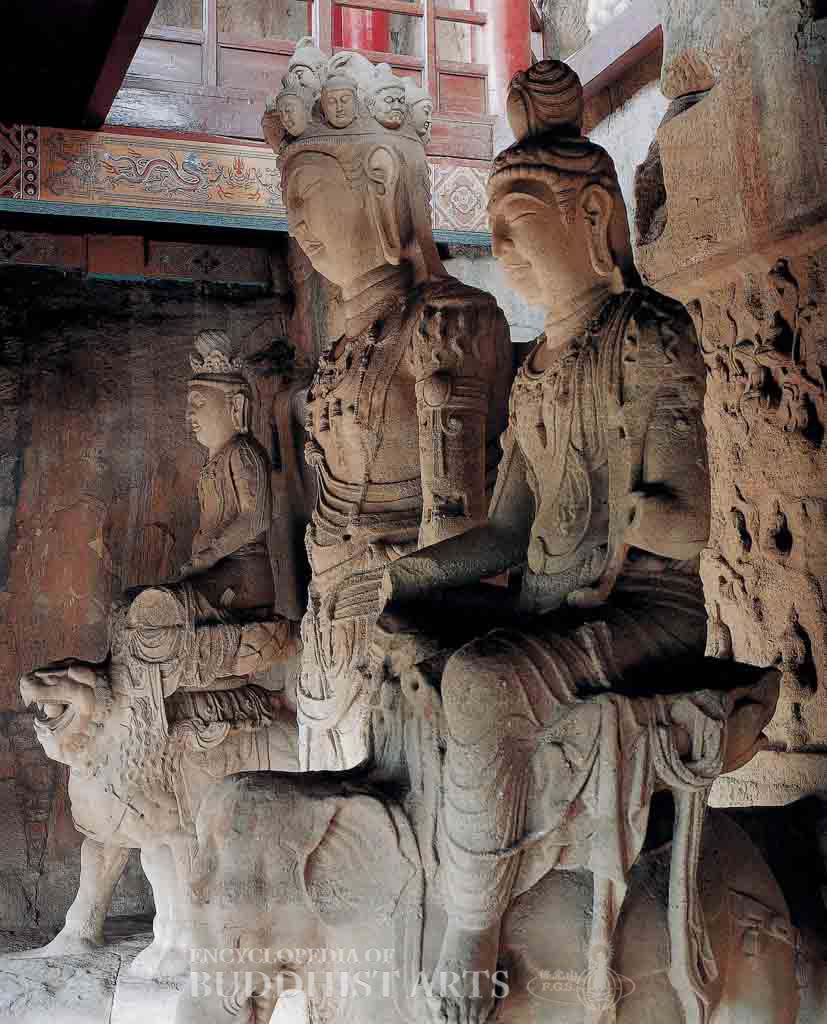
Tianlongshan Cave 9: Eleven-Headed Avalokitesvara, Manjusri, and Samantabhadra
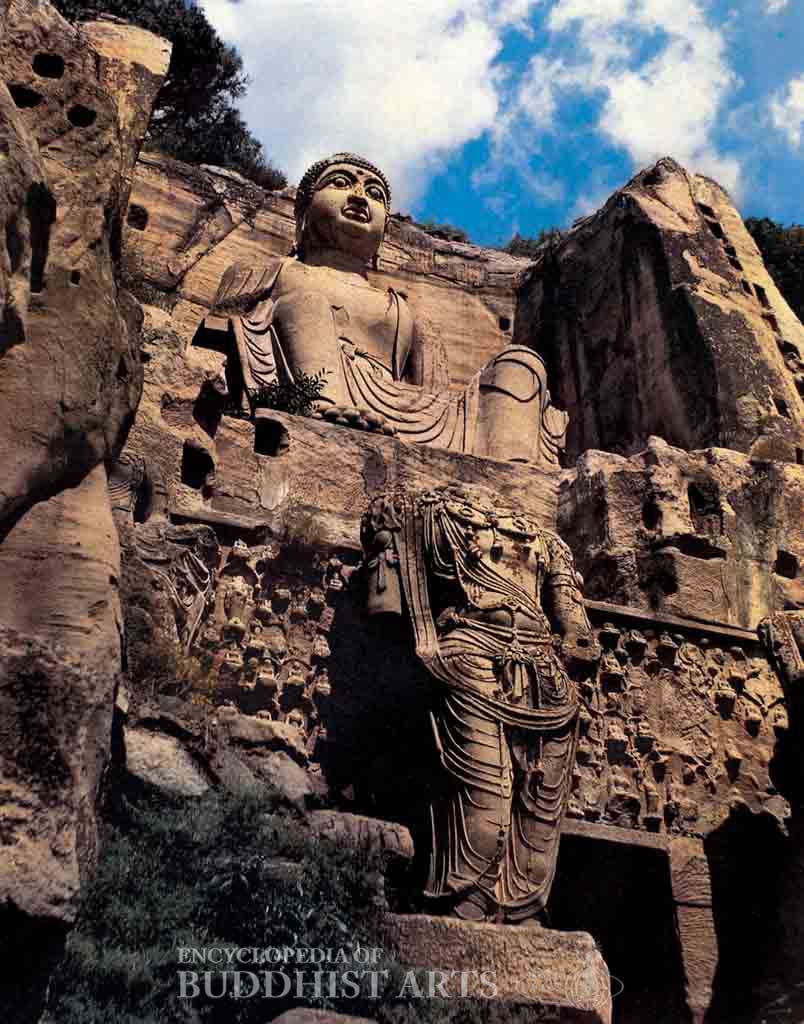
Tianlongshan Cave 9 (prior to reconstruction)
Tianlongshan Cave 9
CHINA, Shanxi, Taiyuan
Cave 9, located on the east side of Tianlongshan’s west peak, was constructed during the Tang dynasty (618–907). This south-facing cave consists of a huge niche carved into the cliff face and divided into two tiers. A huge pavilion was constructed in front of the niche. The pavilion was destroyed in the 1940s but reconstructed in 1984. The lower tier protrudes farther than the upper tier. A huge Maitreya Buddha statue is sculpted at the back of the 7.7 m high upper niche.
The Buddha niche on the lower tier is 7.9 m high, 9 m wide, and 4.7 m deep. A standing statue of an Eleven-Headed Avalokitesvara is sculpted in the center, flanked by Manjusri and Samantabhadra Bodhisattvas on the right and left respectively. Originally ruined, the heads of the three statues were restored in 1984. Avalokitesvara has an overall height of 5.5 m and an oval face. The figure wears a lavishly decorated necklace as well as armlets above the damaged lower arms, while the shoulders are draped with a stringed bead ornament and a stole. The long lower garment fits the body snugly. Avalokitesvara stands on a lotus pedestal with the left leg straight and the right leg bent.
Samantabhadra Bodhisattva is situated on a tall throne atop an elephant to the right of Avalokitesvara. With an overall height of 3.95 m, Samantabhadra wears a necklace and a sagging stole across both shoulders. The arms are damaged, and the right leg rests across the elephant while the left is lowered. In the 1990s, the head of a Bodhisattva sculpture was found outside Cave 9, in the valley between the east and west peaks. The round face with crescent eyebrows has a similar appearance to the photograph of Samantabhadra’s head taken in the 1920s, except that the mouth and lower jaw are damaged. Measuring 4.3 m in height, Manjusri Bodhisattva is situated on the left of Avalokitesvara on a tall throne atop a lion. The design and attire are similar to those of Samantabhadra. While the left hand touches the knee, the right is damaged. The figure sits cross-legged on a double lotus throne supported on the lion’s back.
For more details, go to the Encyclopedia of Buddhist Arts: Caves T-Z, page 1450.
Cite this article:
author = Hsingyun and Youheng and Johnson, Peter and Mankuang and Huntington, Susan and Edson, Gary and Neather, Robert,
booktitle = {Encyclopedia of Buddhist Arts: Caves T-Z},
pages = 1450,
title = {{Tianlongshan Cave 9}},
volume = 9,
year = {2016}}