
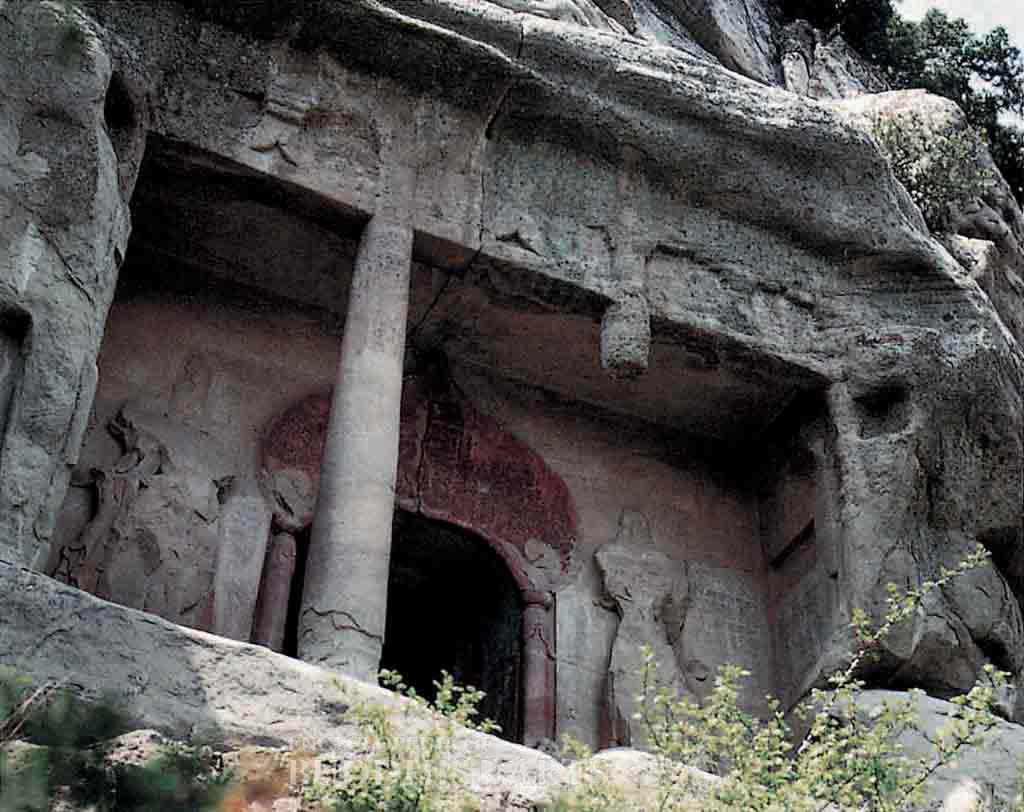
Tianlongshan Cave 8
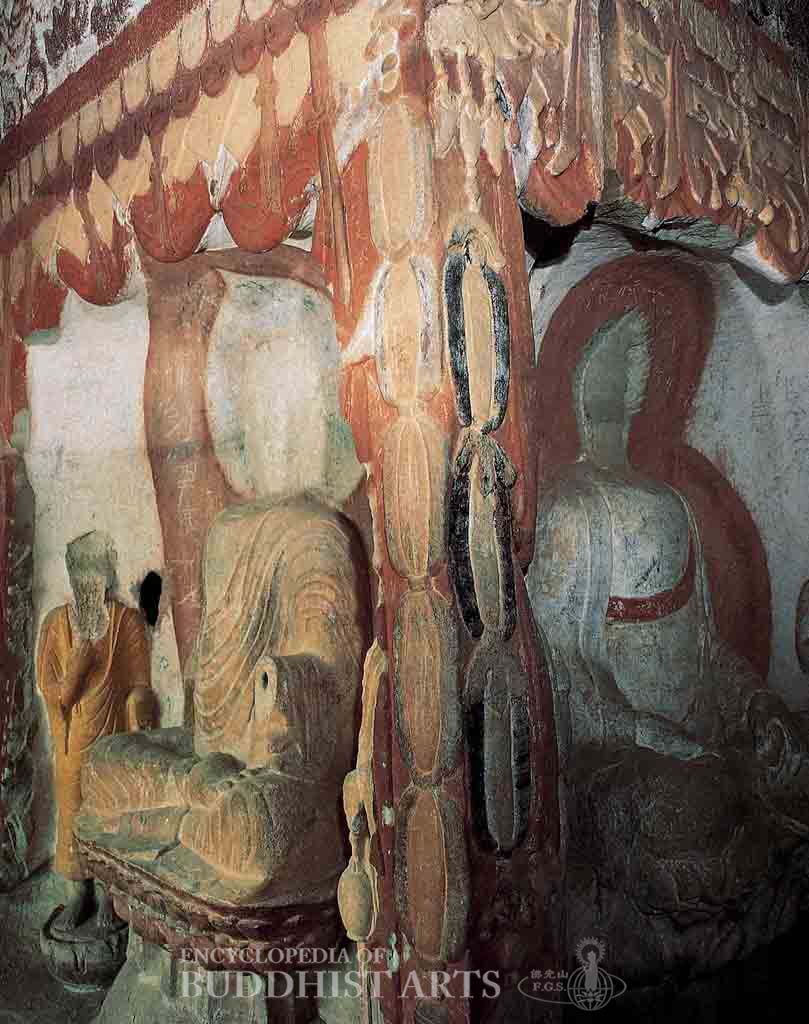
Tianlongshan Cave 8: Seated Buddhas (central pillar, east and south sides)
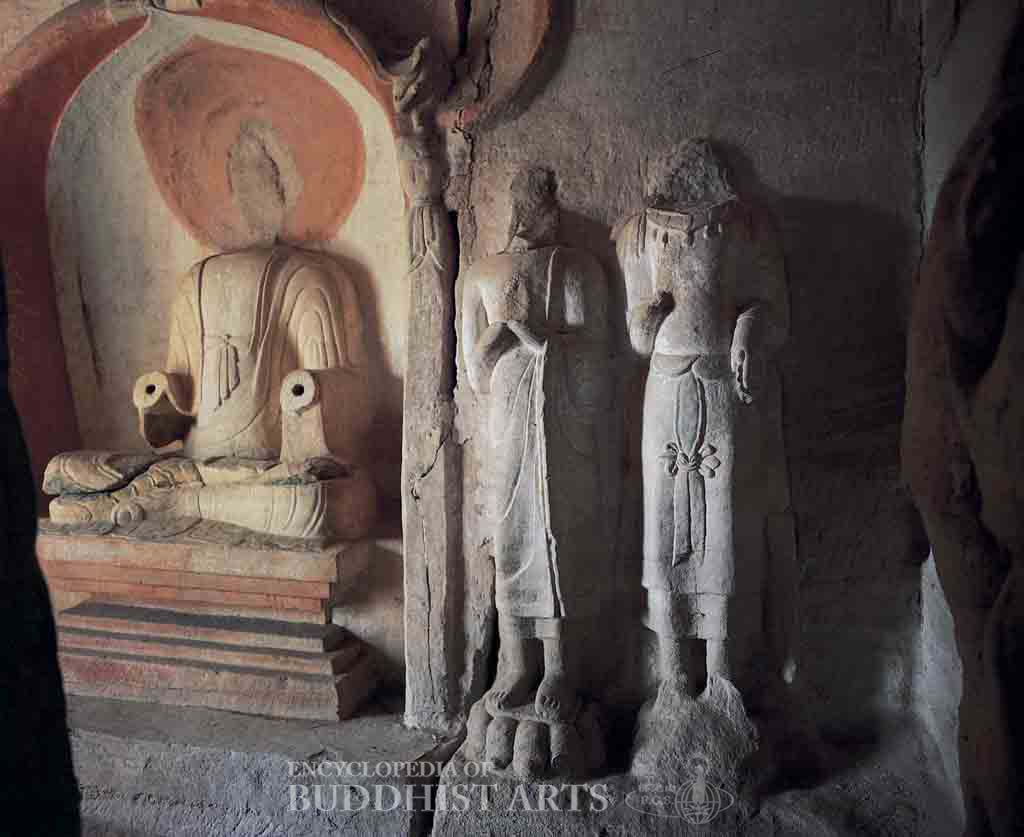
Tianlongshan Cave 8: Buddha, Disciple, and Bodhisattva (west wall)
Tianlongshan Cave 8
CHINA, Shanxi, Taiyuan
Cave 8 is situated on the east peak of Tianlongshan and faces southwest. It is the largest cave at the site, constructed in 584 during the Sui dynasty, and consists of a portico and a main chamber. The portico is 3.05 m to 3.55 m high, 4.26 m wide, and 1.7 m deep, with inverted V-shaped bracket sets on the architrave between the column capitals. The center of the back wall has a double-layer doorway with an arched outer door flanked by squatting lions on the door columns. The column capitals, decorated with bundled curtains, support a lintel and arched architrave adorned with a pair of phoenixes on the ends. Two warriors that flanked the doorway have been removed. A 2.2 m high stele with a construction year of 584 is found on the east wall of the portico. The inscriptions are worn, but suggest that the content was recorded by Zhao Shaozu of the Qing dynasty, documenting the history of how the Founding Marquess Liu Rui of Zhending (present day Hebei), Governor Liu Shou, Governor Xia Houjin, and General Hou Xiaoda commissioned the sculpture.
The main chamber has a truncated pyramidal ceiling and a T-shaped central pillar, with a canopied niche on each side sculpted with a Buddha and two disciples. The main statues on the south, north, and east sides wear loose monastic robes over both shoulders, while the robe of the principal statue on the west side crosses only the left shoulder. The heads of most of the main statues have been removed, but that of the figure on the west side has been recovered and is now in the Osaka Municipal Museum of Art in Japan. Heads of the disciples on three sides of the central pillar have been severely damaged, but the torsos remain in good condition.
Niches on the back (north), east, and west walls are sculpted with a Buddha, two disciples, and two Bodhisattvas. The sculptures on the west wall are relatively well-preserved. The main statue sitting cross-legged on a Sumeru throne in the niche on the west wall has damage to the head, both arms, and the right knee. The statue wears an inner robe with a sash and a loose monastic robe. The bottom of the garment is short and wraps both legs tightly while revealing the feet. Parts of the disciples’ and Bodhisattvas’ heads and arms are damaged, but the torsos are relatively well-preserved. In general, these cave statues from the Sui dynasty have strong builds and simple appearances. The clothing is clearly and evenly incised, and the bodies of the figures stand upright with little curvature or decoration.
For more details, go to the Encyclopedia of Buddhist Arts: Caves T-Z, page 1446.
Cite this article:
author = Hsingyun and Youheng and Johnson, Peter and Mankuang and Huntington, Susan and Edson, Gary and Neather, Robert,
booktitle = {Encyclopedia of Buddhist Arts: Caves T-Z},
pages = 1446,
title = {{Tianlongshan Cave 8}},
volume = 9,
year = {2016}}