
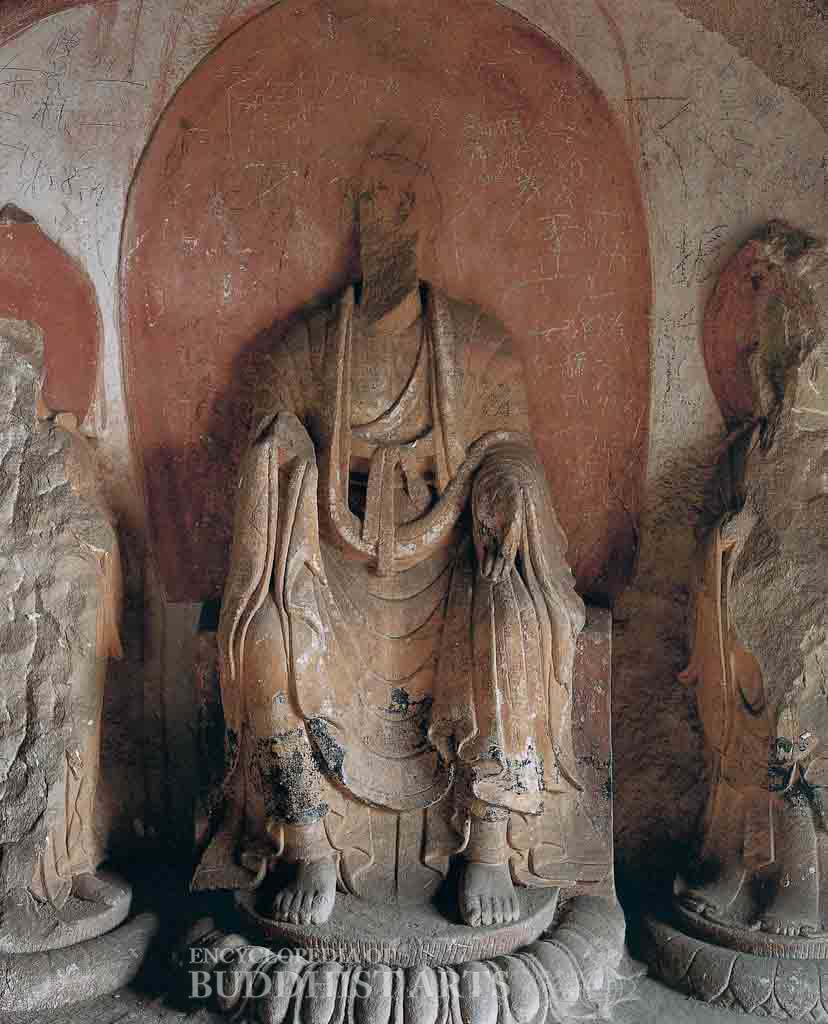
Tianlongshan Cave 3: Seated Buddha (east wall)
Tianlongshan Cave 3
CHINA, Shanxi, Taiyuan
Cave 3 is located on the east side of the east peak of Tianlongshan. It was constructed during the Eastern Wei dynasty (534–550), around the same time as the similar Cave 2. Both caves originally had steles, but these no longer exist. The arched entrance of Cave 3 faces south, flanked with two columns that have been damaged from weathering, especially the bottom parts. The lotus column capitals support a lintel, and the top door frame is sculpted with phoenixes. With a truncated pyramidal ceiling, the square cave measures 2.6 m high, 2.5 m wide, and 2.4 m deep.
An arched niche, sculpted with a Buddha and two Bodhisattvas within it, adorns the center of the back (north) wall. The main Buddha statue, with head and hands missing, wears a loose monastic robe, the pleats of which are clearly incised. The hem of the garment hangs in front of the throne while the Buddha sits in full lotus position on a Sumeru throne with the right foot revealed. The two attendent Bodhisattvas, whose heads, faces, and arms are missing, stand on inverted lotus pedestals. Two disciple figures originally stood outside the niche, but are now missing.
The arched niches on the east and west walls were each sculpted with a Buddha and two Bodhisattvas. A 90 cm high Buddha seated with legs pendent is the main statue on the east wall. The head and right hand have been severely damaged. Reliefs of a Bodhisattva in contemplation, Vimalakirti, and three figures making offerings are located outside and to the right of the niche. The main statue on the west wall sits with legs pendent and is flanked by Bodhisattvas on both sides. The figure on the left has only the head and right side of the body remaining. Reliefs of Manjusri Bodhisattva and figures making offerings are found to the left of the niche. Most of the figures have either been removed or are severely damaged.
Just outside the entrance there were two reliefs of figures making offerings on the west side but both have been removed. Each of the four slopes of the ceiling inside contained an apsara and two twelve-petaled lotuses. The apsaras have all been removed, however, and the cave repainted by later generations.
For more details, go to the Encyclopedia of Buddhist Arts: Caves T-Z, page 1442.
Cite this article:
author = Hsingyun and Youheng and Johnson, Peter and Mankuang and Huntington, Susan and Edson, Gary and Neather, Robert,
booktitle = {Encyclopedia of Buddhist Arts: Caves T-Z},
pages = 1442,
title = {{Tianlongshan Cave 3}},
volume = 9,
year = {2016}}