
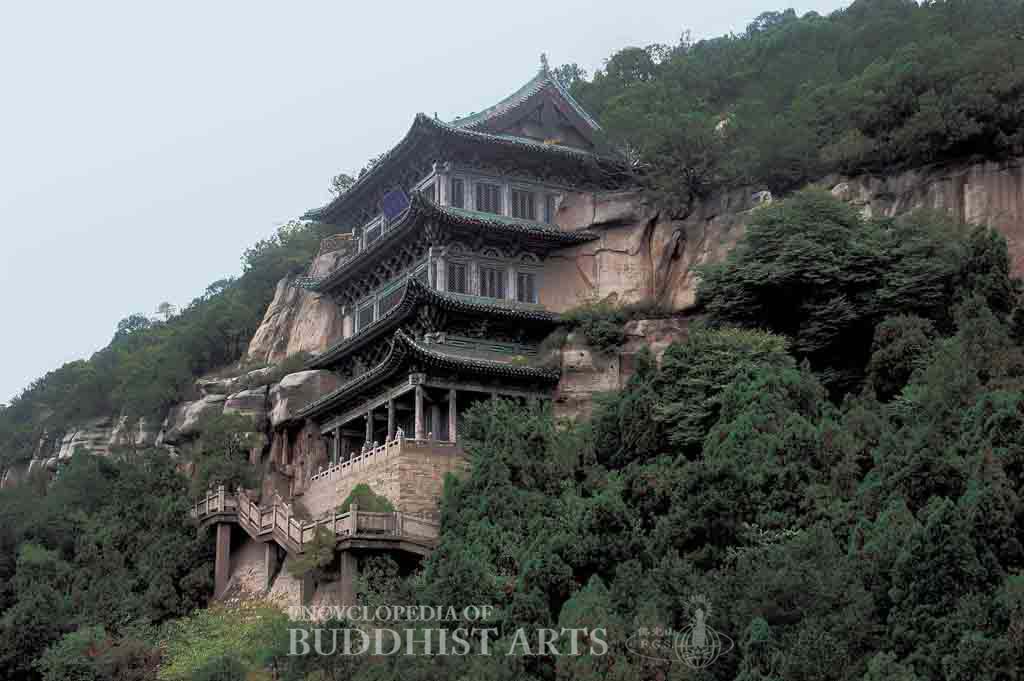
Tianlongshan Caves
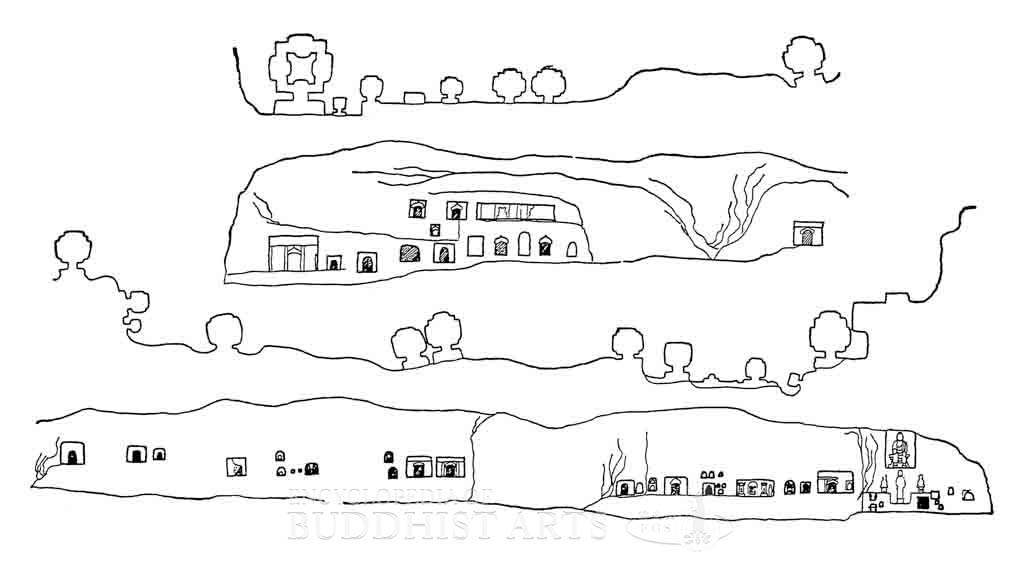
Tianlongshan Caves (elevation drawing)
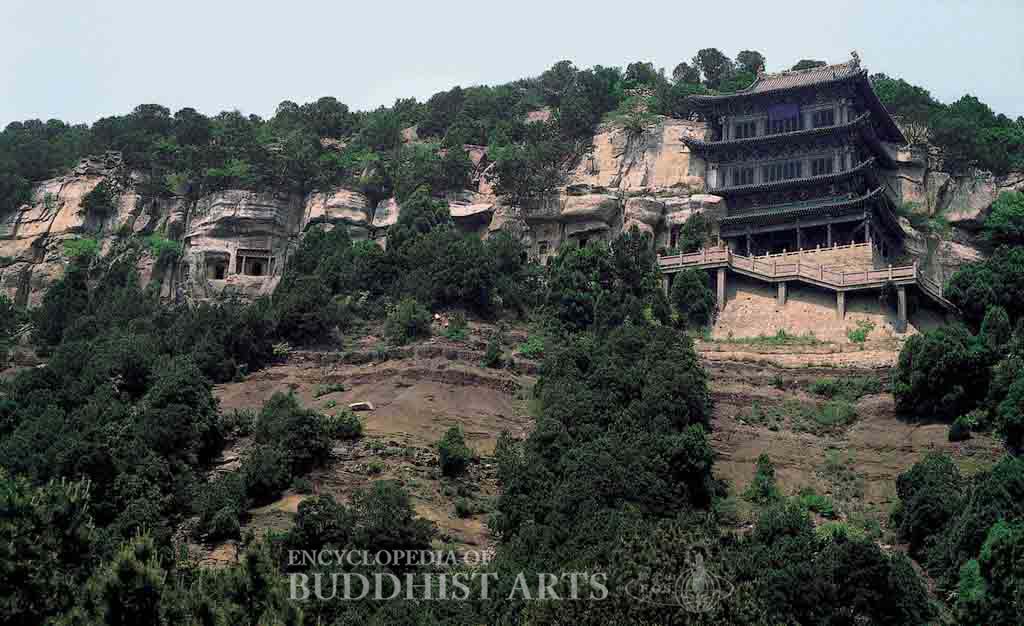
Tianlongshan Caves
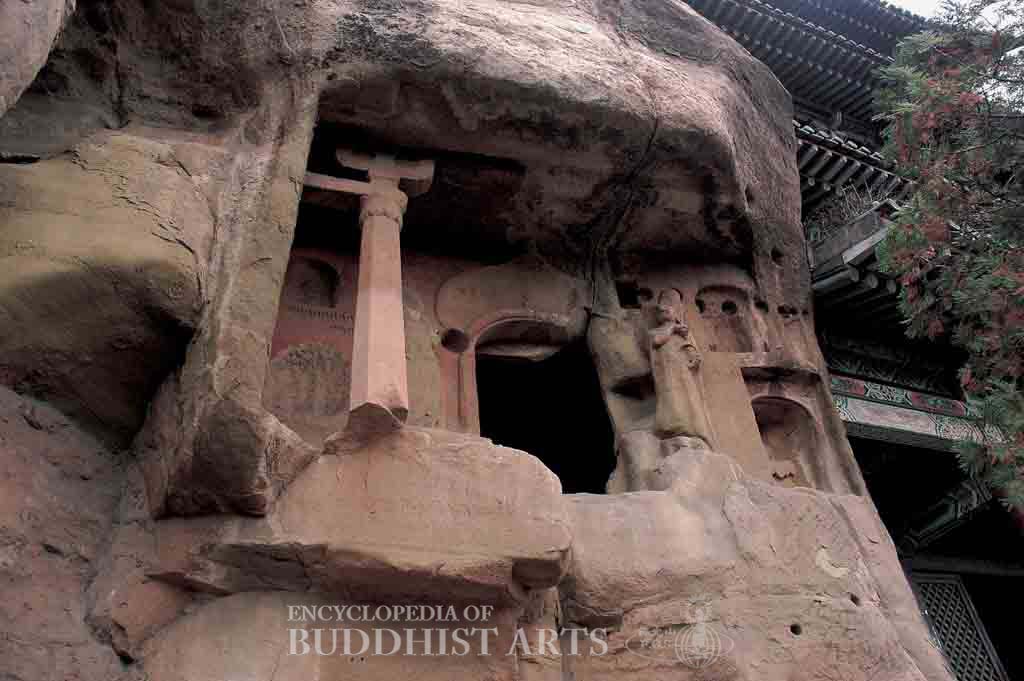
Tianlongshan Caves: Cave 10
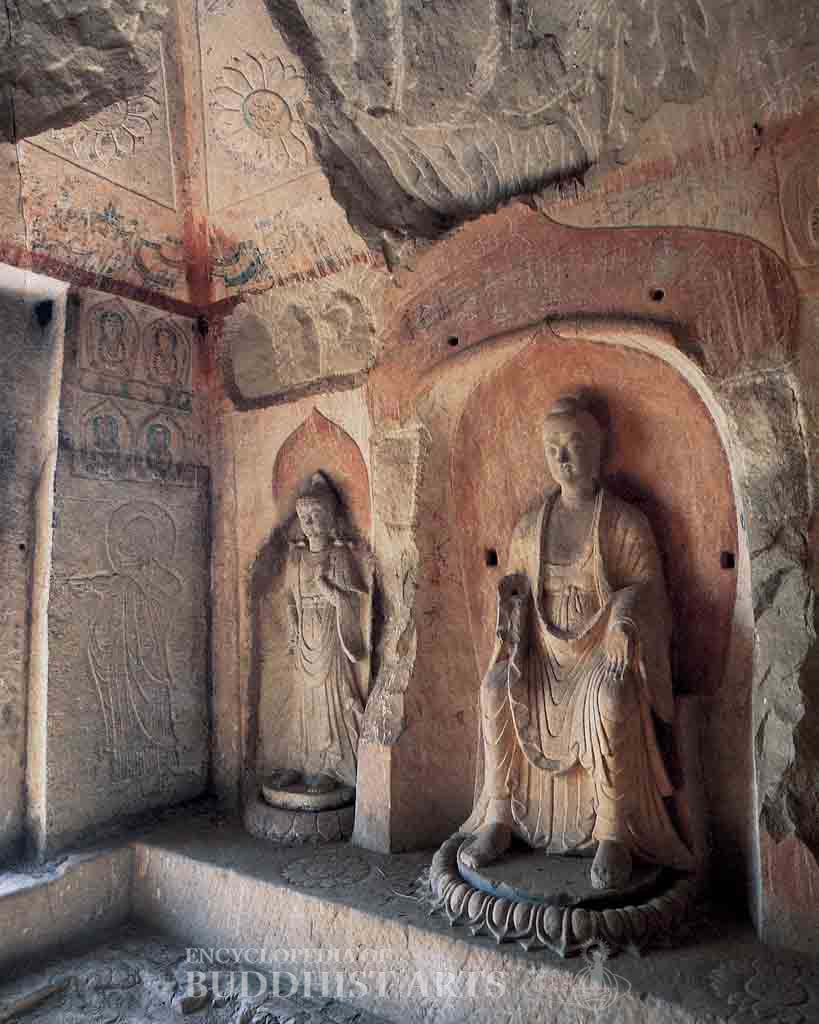
Tianlongshan Caves: Cave 2 - Buddha and Left Bodhisattva
Tianlongshan Caves
CHINA, Shanxi, Taiyuan
These caves are located on Tianlongshan (Heavenly Dragon Moutain), which is about 36 km southwest of Taiyuan, Shanxi. They include both the main group of caves and a set of Thousand Buddha Caves at the foot of the mountain. The Tianlongshan Caves were listed as a National Cultural Heritage Site in 1996.
The main group consists of 25 caves scattered among the cliffs at the base of the east and west peaks. Caves 9 and 13 contain cliff sculptures. The east peak is divided into two tiers, with four unnumbered caves on the upper tier and Caves 1 to 8 on the lower tier. The west peak includes Caves 9 to 21. Most of the caves face south; exceptions include Cave 11, which faces east, and Caves 19 and 20, which face west. The four Thousand Buddha Caves at the foot of Tianlongshan are aligned east-west on the cliff wall on the north side of the valley.
The oldest structures in Tianlongshan are the Twin Caves 2 and 3 on the east peak, believed by scholars to have been constructed during the Eastern Wei dynasty (534–550). These caves are square and have truncated pyramidal ceilings. Both caves contain three niches, each featuring a Buddha and two Bodhisattvas. Caves 1, 10, and 16 were constructed during the Northern Qi dynasty (550–577). They have porticos and the stele found there records the details of their construction. These caves also contain niches on the walls. The bases of the niches depict incense burners, lions, Heavenly Kings, and heavenly musicians. Aside from the niche, which has two Buddhas seated together, the remaining niches show a Buddha, two disciples, and two Bodhisattvas.
Cave 8 on the east peak is the largest at Tianlongshan. The structure has a portico, and the entrance was once flanked with two standing warriors, which have since been removed. The interior is shaped like a central pillar cave. There are canopied niches on all four sides of the pillar, each sculpted with a Buddha and two disciples. The north, east, and west walls each contain a niche sculpted with a Buddha flanked by two attending disciples inside, and two Bodhisattvas outside it.
The remaining 15 caves were constructed during the Tang dynasty (618–907), most dating between the years 684 and 756. Caves constructed during this period are typically smaller in scale but exquisitely sculpted. The floor plans are usually oval with platforms set up on the surrounding walls. Among these, Cave 9 has the largest cliff sculpture on Tianlongshan, divided into two tiers. The upper tier contains Maitreya Buddha, who is seated with legs pendent, while the lower tier holds an Eleven-Headed Avalokitesvara, along with Manjusri and Samantabhadra Bodhisattvas.
For more details, go to the Encyclopedia of Buddhist Arts: Caves T-Z, page 1438.
Cite this article:
author = Hsingyun and Youheng and Johnson, Peter and Mankuang and Huntington, Susan and Edson, Gary and Neather, Robert,
booktitle = {Encyclopedia of Buddhist Arts: Caves T-Z},
pages = 1438,
title = {{Tianlongshan Caves}},
volume = 9,
year = {2016}}