
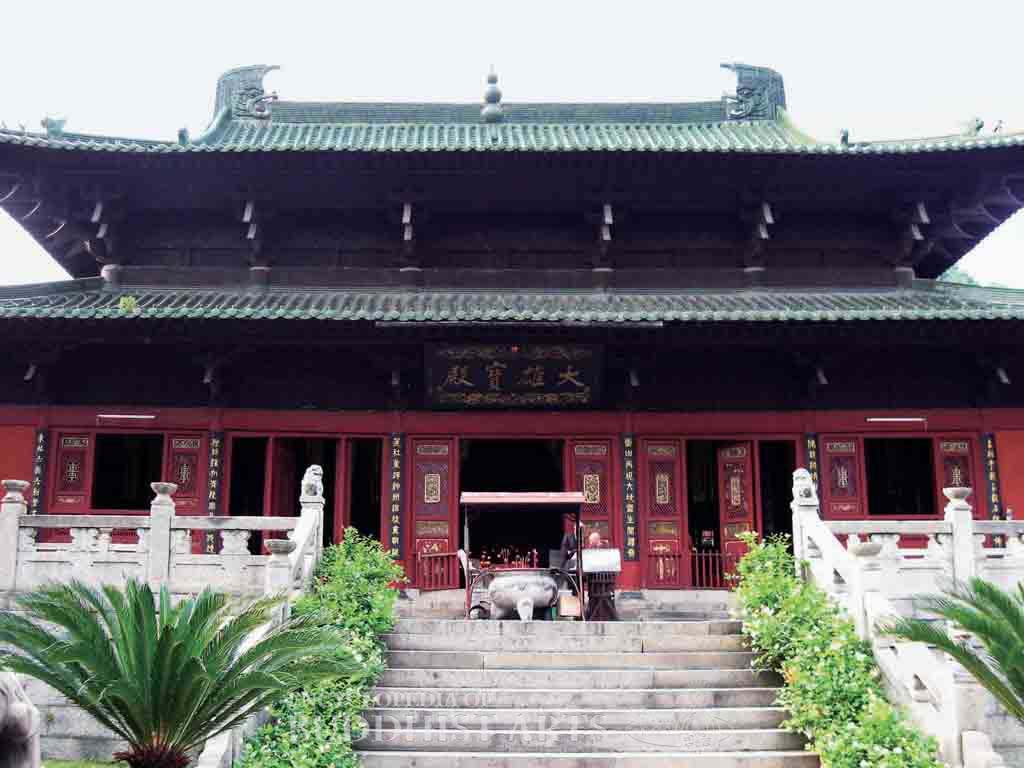
Donglin Temple: Great Hero Hall
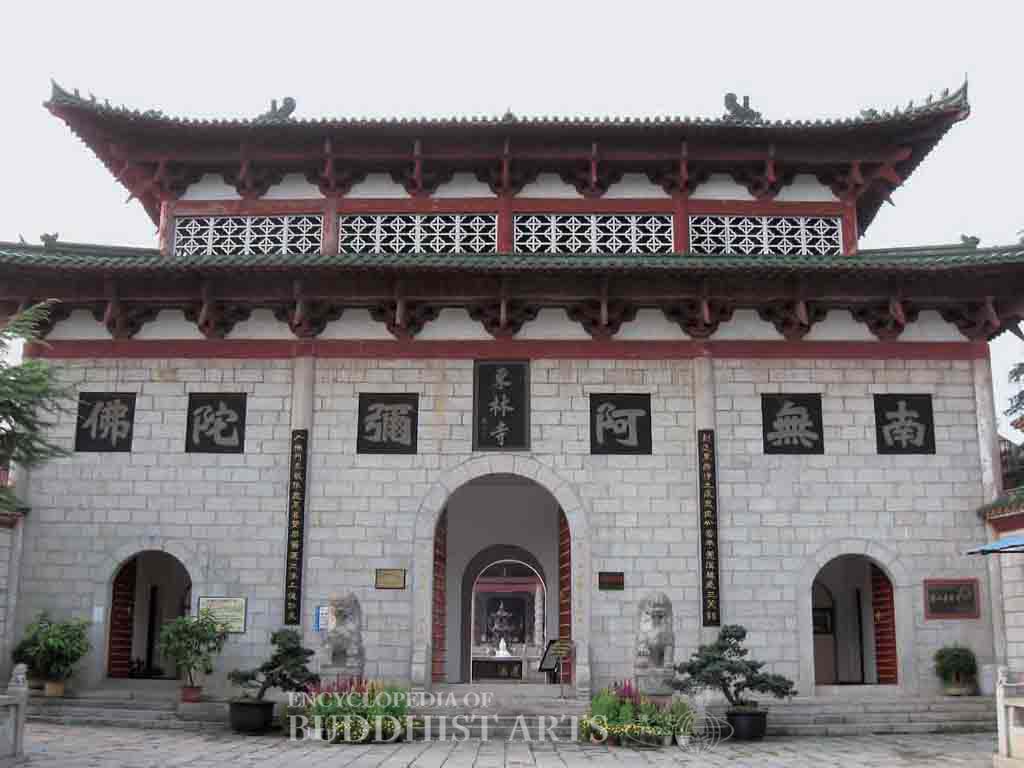
Donglin Temple: Main Temple Gate
Donglin Temple
CHINA, Jiangxi, Jiujiang
Donglin means Eastern Forest. The temple is located at the northwest foot of Lushan (Cottage Mountain). It was established by Master Huiyuan in 386 during the Eastern Jin dynasty. Master Huiyuan founded the White Lotus Society, which propagated Pure Land Buddhism. He was later recognized as the First Patriarch of the Pure Land school. The temple flourished during the Tang dynasty (618–907), when it contained more than 300 structures and housed over 10,000 fascicles of sutras. During the Song dynasty (960–1279) the temple temporarily converted to the Vinaya school. In the Yuan dynasty (1271–1368) the temple reverted back to the Pure Land school. It has been destroyed and rebuilt a number of times. The current buildings were constructed after 1978. It was listed as a key Buddhist temple in the Han region of China in 1983.
The principal buildings include the main temple gate, Heavenly King Hall, Great Hero Hall, East and West Arhat Halls, sutra repository, Patriarch Hall, and chanting hall. Additionally, there is the Courtyard of Master Huiyuan’s Stupa to the west of the temple, and the Shangfang Pagoda on the other side of the mountain.
The Great Hero Hall is the main building of the temple. It has a double-eave hip-and-gable roof and is 19 m high. Statues of Sakyamuni Buddha, Amitabha Buddha, and the Medicine Buddha are enshrined within the hall. The Patriarch Hall was once known as the Image Hall of Master Huiyuan or the Hall of Eighteen Sages.
The temple houses valuable artifacts, such as the remains of a stele by the Tang calligrapher Liu Gongquan, a 1337 re-engraved stele by the Tang calligrapher Li Yong, Tang dynasty stone statues of Dharma protecting warriors, and sutra pillars.
For more details, go to the Encyclopedia of Buddhist Arts: Architecture A-F, page 251.
Cite this article:
author = Hsingyun and Youheng and Johnson, Peter and Mankuang and Lancaster, Lewis,
booktitle = {Encyclopedia of Buddhist Arts: Architecture A-F},
pages = 251,
title = {{Donglin Temple}},
volume = 1,
year = {2016}}