
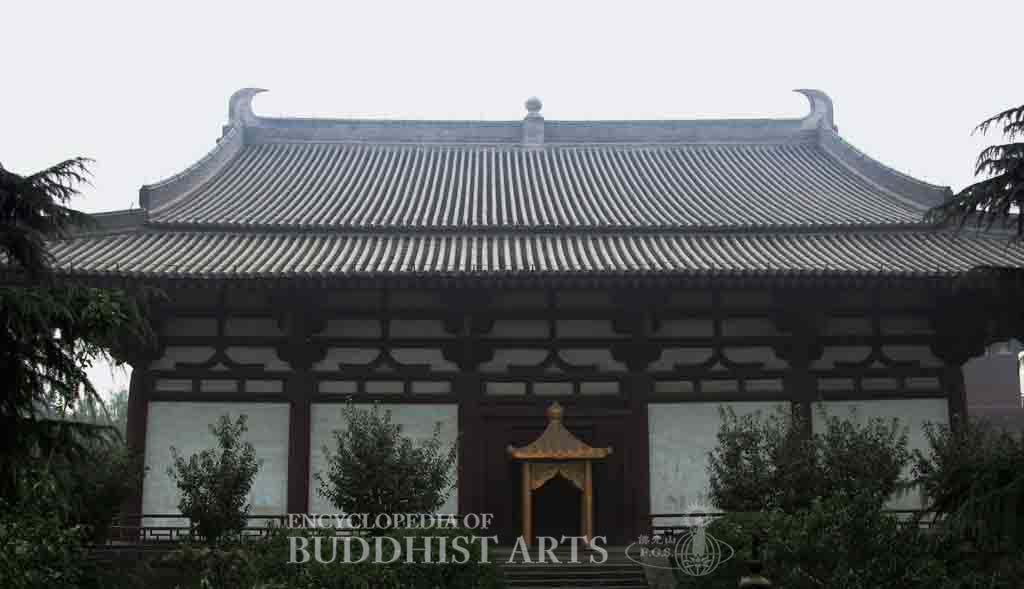
Qinglong Temple: Huiguo-Kukai Memorial Hall
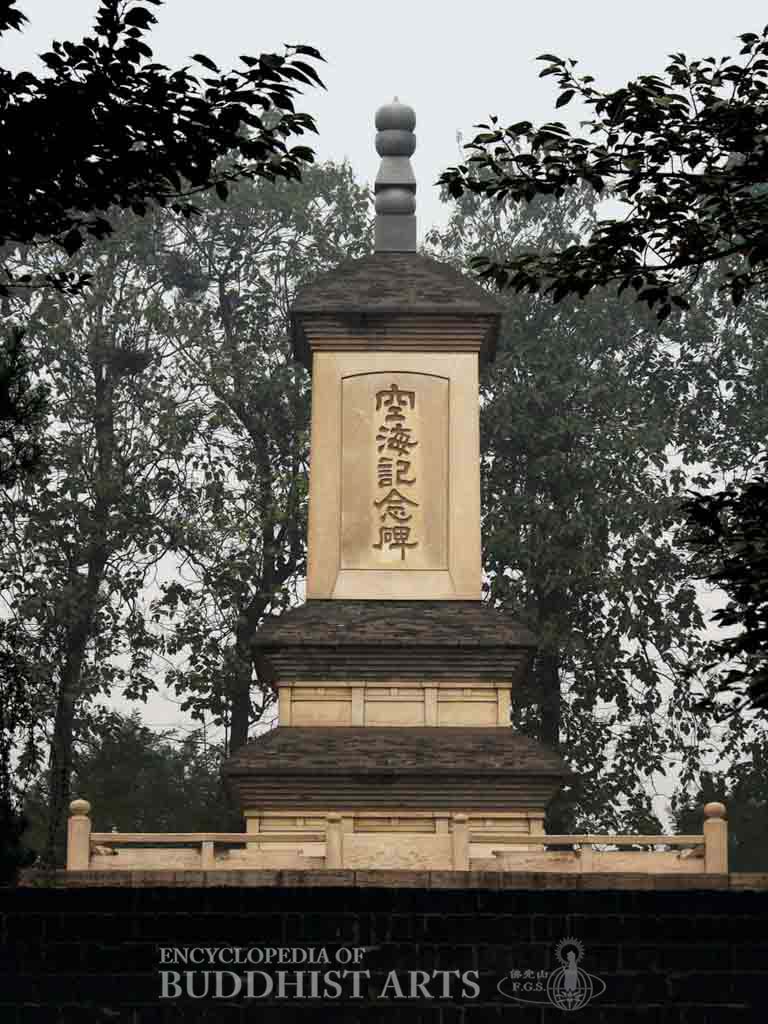
Qinglong Temple: Kukai Memorial Stele
Qinglong Temple
CHINA, Shaanxi, Xi’an
The temple is located in the southern suburbs of Xi’an. The temple was established in 582 during the Sui dynasty. It was destroyed during the Buddhist persecution in 845 but was repaired the following year. During the High Tang period (712–756), the temple became the center of Vajrayana Buddhism. Japanese Master Kukai studied under Master Huiguo here and had an important influence on Buddhism outside China. After 1086 during the Song dynasty, the temple was completely destroyed. In 1973 Chinese archaeologists started excavating the site. As part of the ancient city of Chang’an, the temple was listed as a National Cultural Heritage Site in 1996.
The original temple occupied 13 ha but only remnants of the walls are left. Archaeologists have discovered the remains of two connecting courtyards, a wooden pagoda, halls, corridors, a main temple gate, and a kiln. One of the excavated halls is more than 28 m long and 21 m wide. It has a five-by-four bay structure, which was built with the two columns omitted. Large amounts of building materials, such as bricks, tiles, and tile caps, have been excavated along with gilt bronze Buddha statues, silver Buddha statuettes, a tri-color glazed pottery Buddha, stone carvings, stone lanterns, and sutra pillars.
In 1982 the Kukai Memorial Stele was inaugurated at the site. In addition, the Huiguo-Kukai Memorial Hall was built according to the original layout of one of the halls.
For more details, go to the Encyclopedia of Buddhist Arts: Architecture M-S, page 877.
Cite this article:
author = Hsingyun and Youheng and Johnson, Peter and Mankuang and Lancaster, Lewis,
booktitle = {Encyclopedia of Buddhist Arts: Architecture M-S},
pages = 877,
title = {{Qinglong Temple}},
volume = 3,
year = {2016}}