
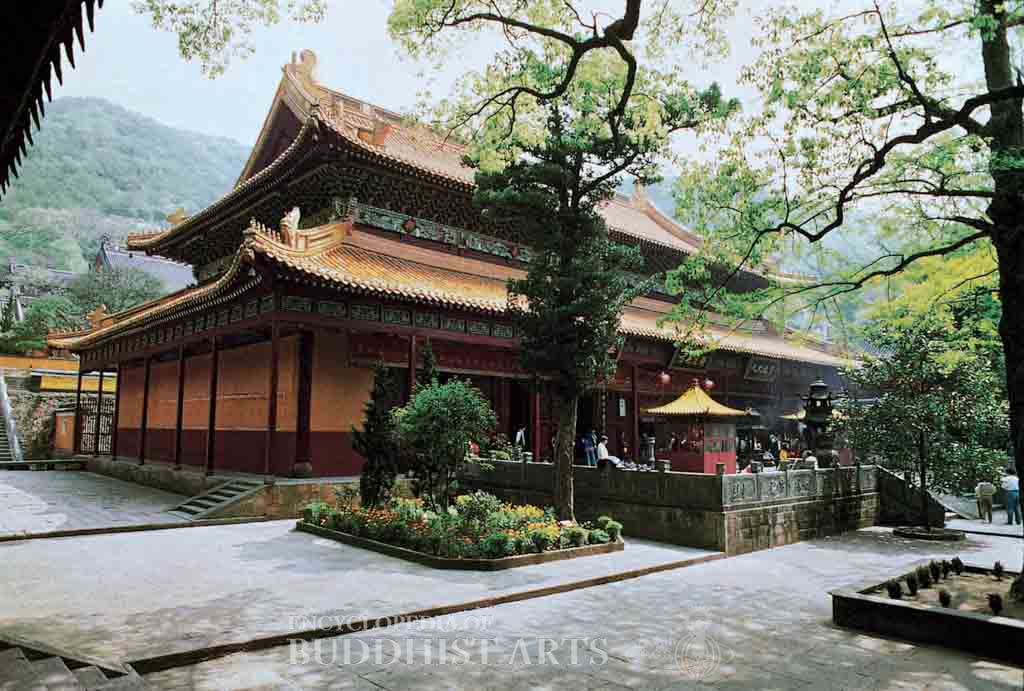
Putuoshan Fayu Temple: Perfect Understanding Hall
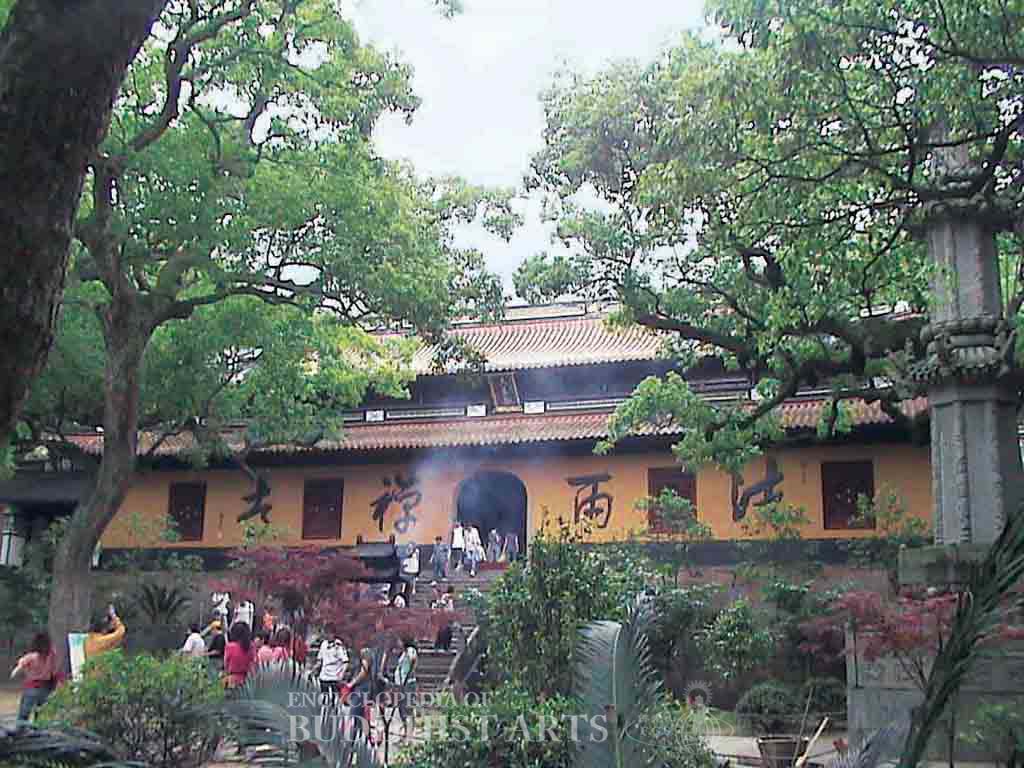
Putuoshan Fayu Temple: Heavenly King Hall
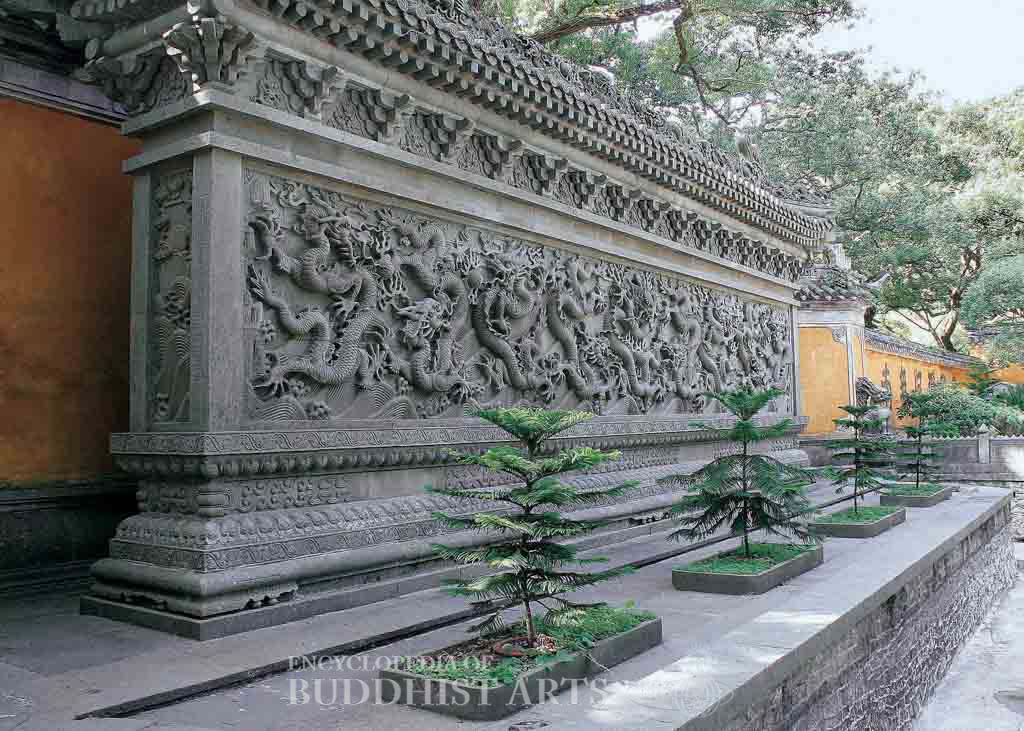
Putuoshan Fayu Temple: Screen Wall
Putuoshan Fayu Temple
CHINA, Zhejiang, Zhoushan
Fayu means Dharma Rain, although it is also known as the Rear Temple. It is situated on Putuoshan and is one of the Three Major Temples there. The temple was established in 1580 during the Ming dynasty. In 1699, Qing dynasty Emperor Kangxi (reigned 1661–1722) granted funding for repairs and also ordered the imperial palace at Nanjing, Hall of Nine Dragons, to be moved to the temple. The newly relocated building was named Perfect Understanding Hall. In 1893, Master Yinguang arrived at the temple and stayed at the sutra repository for more than 20 years. The temple was listed as a National Cultural Heritage Site in 2006.
The temple covers 3.3 ha and was built to fit in with its environment. The main buildings along the central axis are built upon six terraces and include the Heavenly King Hall, Jade Buddha Hall, Perfect Understanding Hall, Imperial Stele Hall, Great Hero Hall, and the sutra repository. The Heavenly King Hall has a double-eave hip-and-gable roof. It has side doors and functions as a secondary temple gate. The seven-bay wide Perfect Understanding Hall is approximately 22 m high. It has a double-eave hip-and-gable roof and is covered in yellow glazed tiles. The gradient of the roof is gentle, which is markedly different from those of the south. The hall houses a statue of Avalokitesvara Bodhisattva, with statues of the Eighteen Arhats lined up along either side. The ceiling in the center features nine dragons, which once belonged in the Ming dynasty (1368–1644) imperial palace. In front of the hall there is a platform with balustrades on the south, east, and west sides. The balustrades contain panels which are engraved with 24 stories depicting filial piety. Made from Taihu stone, they are considered to be some of the finest stone engravings from the Ming dynasty. The imperial path, featuring carvings of dragons and clouds, is located at the center of the platform.
For more details, go to the Encyclopedia of Buddhist Arts: Architecture M-S, page 857.
Cite this article:
author = Hsingyun and Youheng and Johnson, Peter and Mankuang and Lancaster, Lewis,
booktitle = {Encyclopedia of Buddhist Arts: Architecture M-S},
pages = 857,
title = {{Putuoshan Fayu Temple}},
volume = 3,
year = {2016}}