

Guangsheng Upper Temple: Vairocana Hall

Guangsheng Upper Temple: Vairocana Hall - Lattice Doors
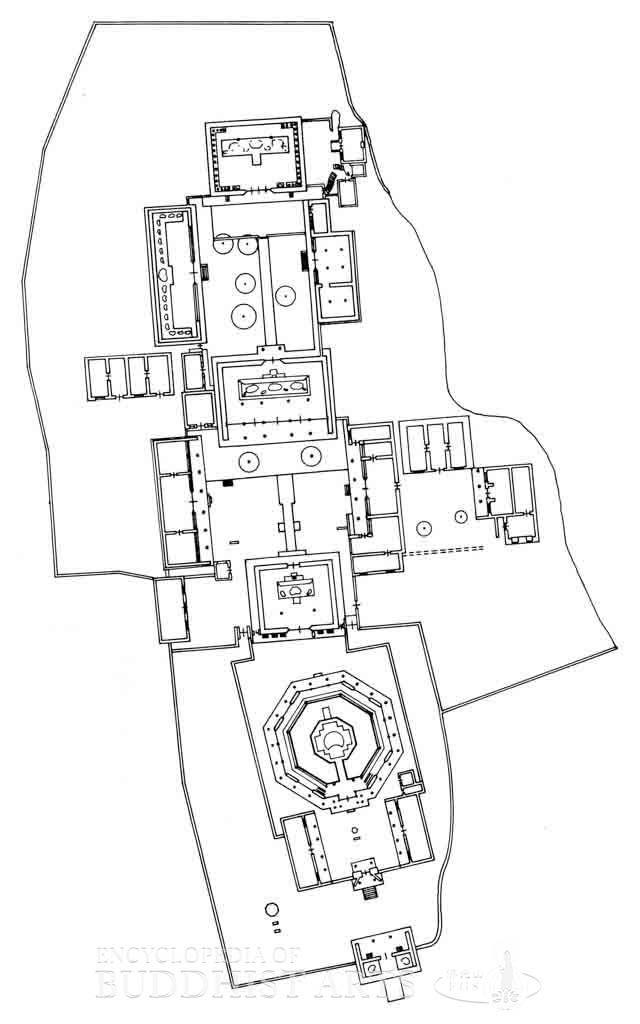
Guangsheng Upper Temple (site layout)
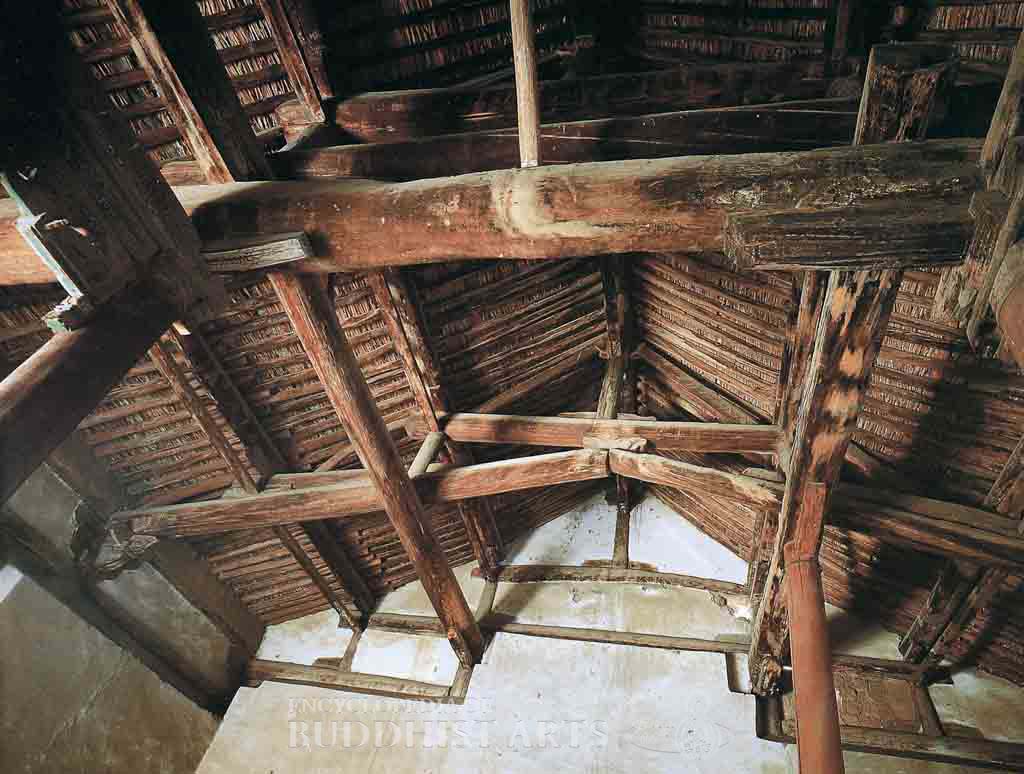
Guangsheng Lower Temple: Front Hall (interior)
Guangsheng Temple
CHINA, Shanxi, Linfen
The temple is divided into three sections: the Upper Temple, the Lower Temple, and the Water God Temple. According to the records, its construction began in 147 during the Eastern Han dynasty. It was rebuilt in 769 during the Tang dynasty and given its present name. The temple was destroyed by an earthquake in 1303 during the Yuan dynasty and reconstruction started in 1305. During the Ming (1368–1644) and Qing (1644–1911) dynasties, it underwent repair and reconstruction several times. Apart from the Upper Temple’s Feihong Pagoda and Great Hero Hall, which were reconstructed in the Ming dynasty, the rest of the buildings date back to the Yuan dynasty (1271–1368). It was listed as a National Cultural Heritage Site in 1961.
The Upper Temple is located on the mountain peak and faces south. Beginning in the south there are the main temple gate, Suspended Flower Gate, Feihong Pagoda, Amitabha Hall, Great Hero Hall, Vairocana Hall, Avalokitesvara Hall, and Ksitigarbha Hall. The five-by-four bay Amitabha Hall has a single-eave hip-and-gable roof. The hall contains statues of Amitabha Buddha and two attending Bodhisattvas, Avalokitesvara and Mahasthamaprapta. The Great Hero Hall is five bays wide and holds a statue of Sakyamuni Buddha accompanied by the Bodhisattvas Manjusri and Samantabhadra. Eighteen Arhats in cast iron line the side walls.
The five-by-four bay Vairocana Hall has a single-eave hip roof, with a rather short main ridge. At the front, the central bay consists of delicately carved lattice windows and doors. The altar holds three Buddhas and four Bodhisattvas. The east and west walls, as well as the third bays on the north and south walls are covered in wooden niches, in which the Thirty-Five Buddhas are enshrined. There is a mural of Sakyamuni Buddha on the central bay and two bays of the north wall, each flanked by six Perfect Enlightenment Bodhisattvas.
The Lower Temple is located at the foot of the mountain and was built to integrate with the terrain. The buildings include the main temple gate, front hall, Great Hero Hall, and side halls. The five-by-three bay front hall has a single-eave overhanging gable roof. The interior columns are distributed at the front and back of the central bay and not erected in the side bays. The framework of the roof is in the form of an inverted V-shape.
The seven-by-four bay Great Hero Hall has a single-eave overhanging gable roof. The Buddhas of the Past, Present, and Future are enshrined within the hall and are flanked by Manjusri and Samantabhadra Bodhisattvas. The murals have all been removed apart from that of the Fifty-Three Visits of Sudhana located on the upper corner of the gable.
The Shuishen Shrine is located in the southwest section of the Lower Temple. The main building of the Shuishen Shrine is the Mingyingwang Hall, which dates back to the Yuan dynasty. The murals within the hall were painted in 1324 and their themes are a combination of real life and historical stories.
For more details, go to the Encyclopedia of Buddhist Arts: Architecture G-L, page 395.
Cite this article:
author = Hsingyun and Youheng and Johnson, Peter and Mankuang and Lancaster, Lewis,
booktitle = {Encyclopedia of Buddhist Arts: Architecture G-L},
pages = 395,
title = {{Guangsheng Temple}},
volume = 2,
year = {2016}}