
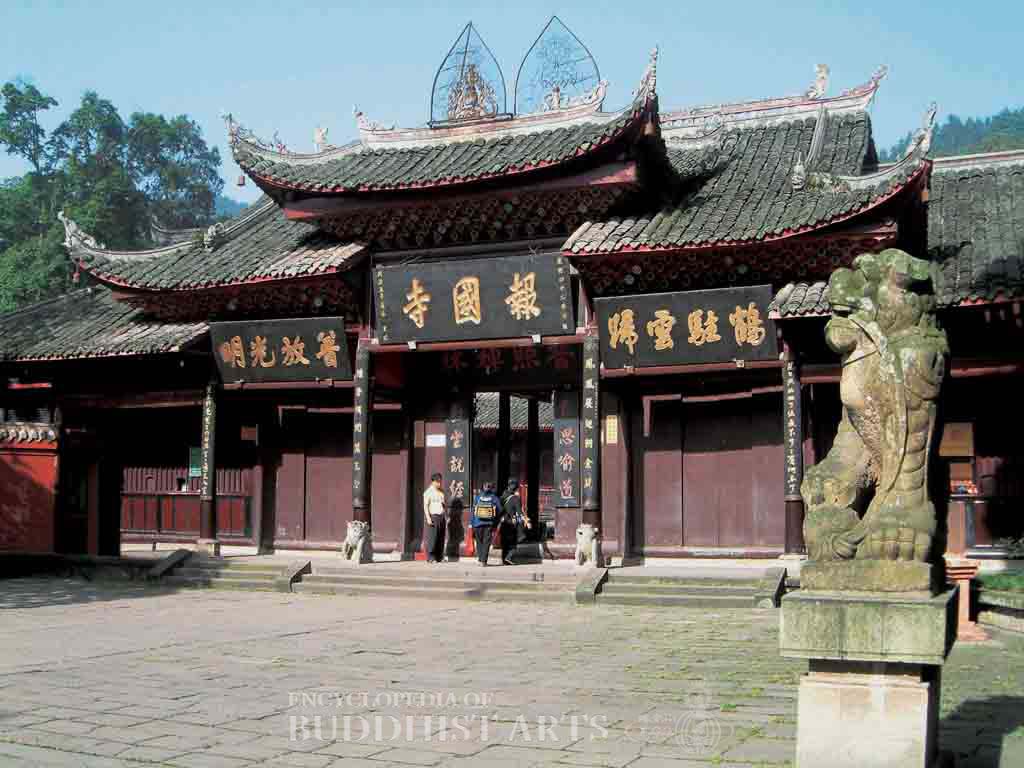
Emeishan Baoguo Temple: Main Temple Gate
Emeishan Baoguo Temple
CHINA, Sichuan, Leshan
Baoguo literally means Repay the Nation. It is the first Buddhist temple encountered upon entering Emeishan (Delicate Eyebrow Mountain). It was established during the rule of Emperor Wanli (reigned 1573–1620) of the Ming dynasty. The temple was destroyed at the end of the Ming dynasty (1368–1644), and was moved to its current location during the rule of Emperor Shunzhi (reigned 1644–1661) of the Qing dynasty. The temple was expanded in 1866. It was listed as a key Buddhist temple in the Han region of China in 1983. As part of Emeishan, it was listed as a UNESCO World Heritage Site in 1996.
The temple was built according to the contours of the mountain and occupies 4 ha. The buildings along the central axis are the main temple gate, Maitreya Hall, Great Hero Hall, Hall of the Seven Buddhas, and the sutra repository. The five-bay wide main temple gate was rebuilt in 1986 and has doorways in the three central bays. The eaves are extended and are on two different levels. There are also additional eaves over the central bay. The corners of the roof are pointed and turn upwards.
The Great Hero Hall houses a statue of Sakyamuni Buddha with the Eighteen Arhats lined up along either side. The Hall of the Seven Buddhas contains the Seven Buddhas of the Past: Vipasyin, Sikhin, Visvabhu, Sakyamuni, Krakucchanda, Kanakamuni, and Kasyapa. They were sculpted during the rule of Emperor Guangxu (reigned 1875–1908) of the Qing dynasty. Behind them stands a 2.4 m porcelain Buddha made in Jingdezhen in 1415 during the Ming dynasty. The figure’s robe is decorated with thousands of Buddha images. A large bell, dated to 1564 and measuring 2.8 m in height and 12.5 t in weight, is located outside the temple.
For more details, go to the Encyclopedia of Buddhist Arts: Architecture A-F, page 267.
Cite this article:
author = Hsingyun and Youheng and Johnson, Peter and Mankuang and Lancaster, Lewis,
booktitle = {Encyclopedia of Buddhist Arts: Architecture A-F},
pages = 267,
title = {{Emeishan Baoguo Temple}},
volume = 1,
year = {2016}}