
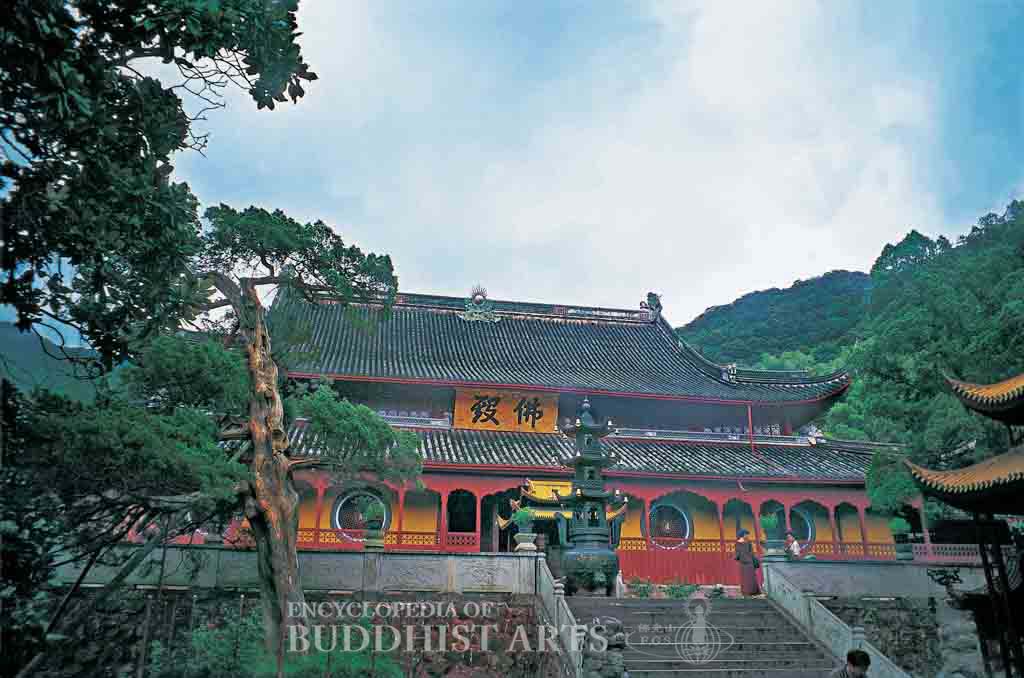
Tiantong Temple: Buddha Hall
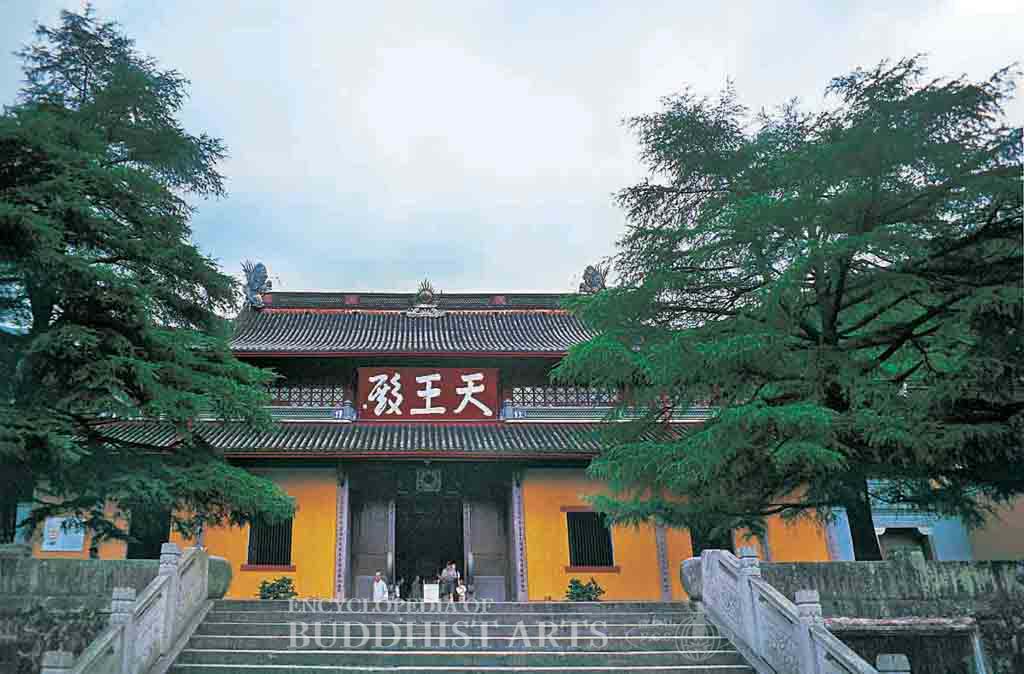
Tiantong Temple: Heavenly King Hall
Tiantong Temple
CHINA, Zhejiang, Ningbo
Tiantong means Heavenly Child. It is located at the foot of Taibaishan (Great White Mountain). It was founded as a simple grass hut in 300 during the Western Jin dynasty by monk Yixing. In 757 during the Tang dynasty, Chan Master Faxuan moved it to its current location. The Japanese monk Dogen stayed at the monastery during the Southern Song dynasty (1127–1279) and, when he returned to Japan, he established the Soto school. He recognized this temple as being one of the school’s ancestral temples. It was listed as a National Cultural Heritage Site in 2006.
The temple faces south and was built along a mountain slope. The layout of the buildings dates back to the late Ming dynasty (1368–1644), but the buildings were reconstructed and repaired during the Qing dynasty (1644–1911). Along the central axis there are the Seven Buddha Pagoda, Heavenly King Hall, Buddha Hall, Dharma Hall, and the Arhat Hall. Running along either side of the central axis there are the bell tower, Imperial Study Building, Imperial Stele Pavilion, Sangharama Hall, and the Patriarch Hall.
The seven-bay wide Heavenly King Hall has a double-eave hip-and-gable roof. There is a portico covering the central bay on the northern side of the hall. The ceiling is decorated with fine carvings. At the center there is a statue of Maitreya Buddha, while on either side are the Four Heavenly Kings. A statue of Skanda Bodhisattva is enshrined at the back of the hall.
The Buddha Hall has a double-eave hip-and-gable roof. The seated statues of the Three Buddhas are enshrined inside, each measuring 9.4 m. Behind the Buddhas there is a sculpture of Avalokitesvara Bodhisattva. The sutra repository is located on the second story of the Dharma Hall. At the center there is a shrine with a gilt bronze statue of the Medicine Buddha. On the rafters there are more than ten horizontal inscribed boards written by famous people.
For more details, go to the Encyclopedia of Buddhist Arts: Architecture T-Z, page 1130.
Cite this article:
author = Hsingyun and Youheng and Johnson, Peter and Mankuang and Lancaster, Lewis,
booktitle = {Encyclopedia of Buddhist Arts: Architecture T-Z},
pages = 1130,
title = {{Tiantong Temple}},
volume = 4,
year = {2016}}