
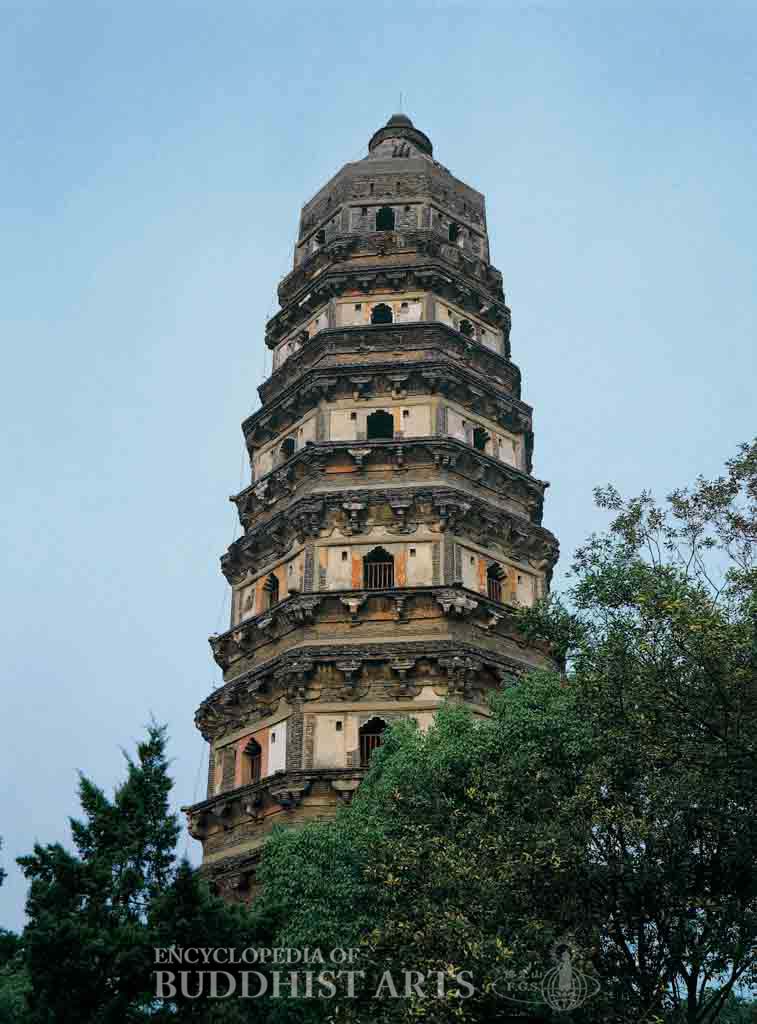
Yunyan Temple Pagoda
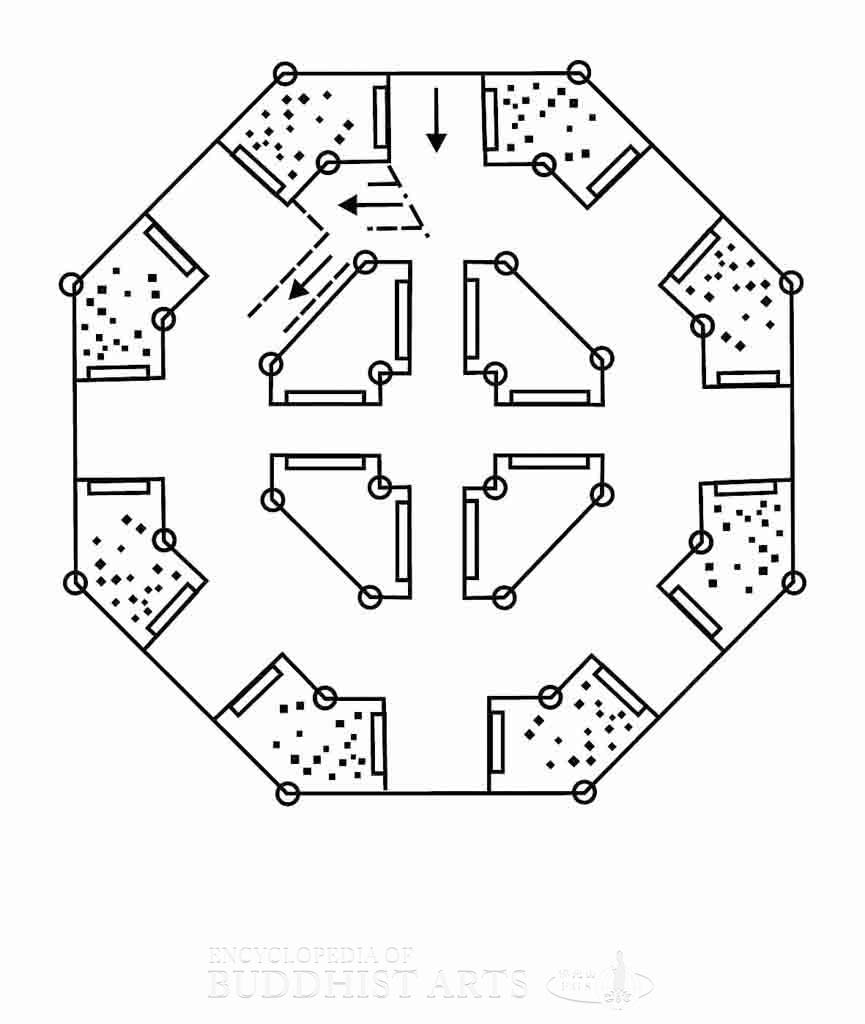
Yunyan Temple Pagoda (plan)
Yunyan Temple Pagoda
CHINA, Jiangsu, Suzhou
Yunyan means Cloud Cliff and it is commonly known as Huqiu (Tiger Hill) Pagoda. It was once part of Yunyan Temple, which no longer exists. The pagoda was built between 959 and 961 during the Northern Song dynasty. It is the first multi-story pagoda in China to have inner and outer walls; the earliest large octagonal pagoda; the first brick pagoda in imitation of a timber structure; as well as the first pagoda to have balustrades on each story. The pagoda has been damaged and repaired a number of times. It was in danger of collapsing until its restoration in 1957. Early in its history the structure started inclining in a northeasterly direction and became famous as a tilted pagoda. At present the apex leans 2.3 m away from the center. It was listed as a National Cultural Heritage Site in 1961.
The seven-story octagonal, brick, pagoda is 47.5 m high without the spire, which is no longer present. On every story, pilasters divide each side into three bays. There is a doorway in the central bay, while the side bays have vertical bar windows. Architraves link the rounded pilasters, while above them there are bracket sets supporting the eaves. Another set of brackets supports the following story, but the rafters and balustrades have long been destroyed. The pagoda body consists of inner and outer walls forming a corridor. A chamber is located at the center of each story, while wooden stairs are located between the walls. There are a large number of reliefs decorating the interior of the pagoda.
In 1957, while the pagoda was under restoration, various artifacts were discovered on the third story. These artifacts include a portable shrine with Avalokitesvara Bodhisattva, a bowl with lotus patterns, a mirror with seated Buddha, a Buddha Triad, a seated Buddha, and two Eleven-Headed Avalokitesvara Bodhisattvas. They date from the late Tang (618–907) to the Song (960–1279) dynasty and are now in the collection of Suzhou Museum.
For more details, go to the Encyclopedia of Buddhist Arts: Architecture T-Z, page 1385.
Cite this article:
author = Hsingyun and Youheng and Johnson, Peter and Mankuang and Lancaster, Lewis,
booktitle = {Encyclopedia of Buddhist Arts: Architecture T-Z},
pages = 1385,
title = {{Yunyan Temple Pagoda}},
volume = 4,
year = {2016}}