
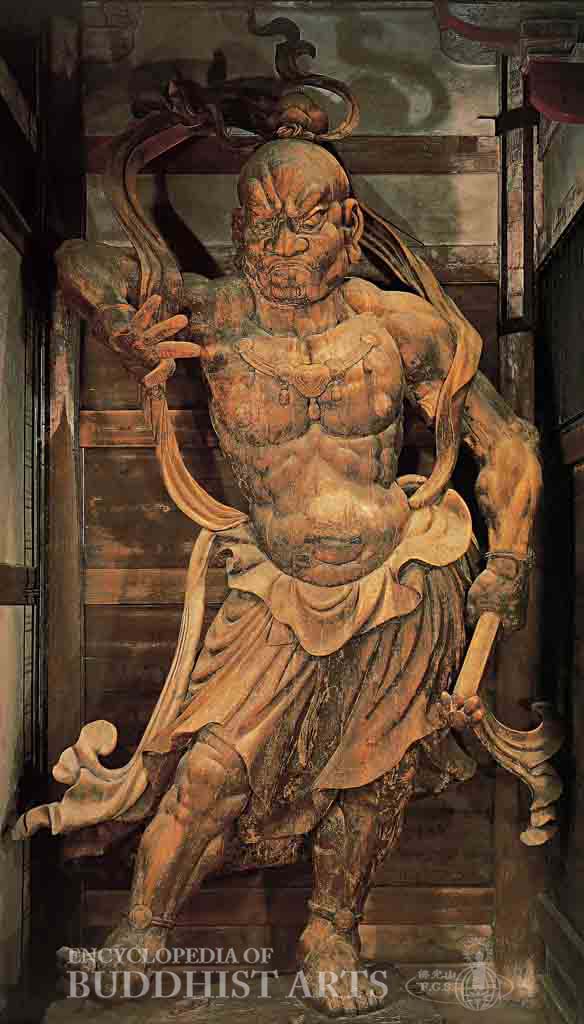
Todaiji Temple South Gate: Guhyapada
Cypress wood
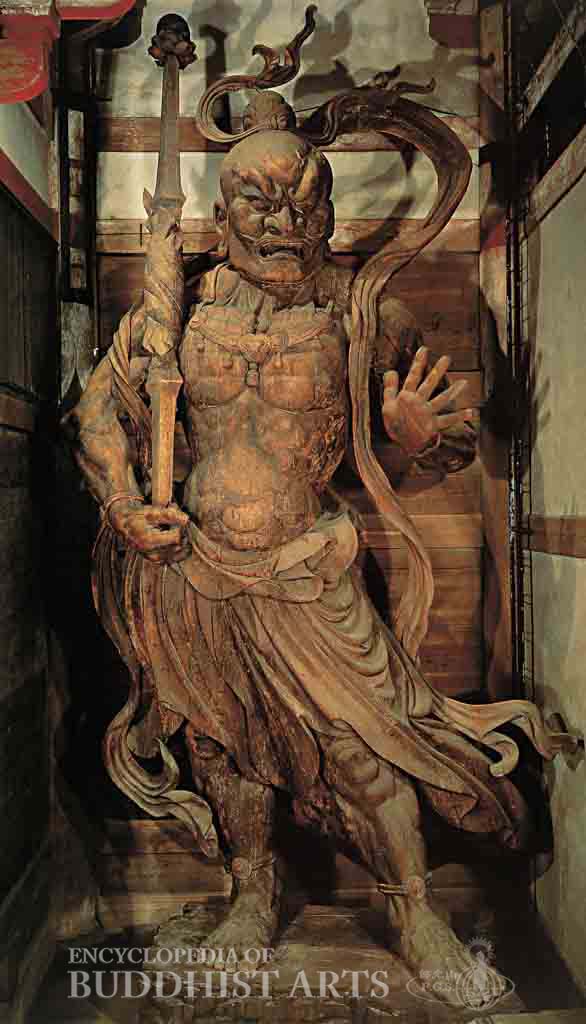
Todaiji Temple South Gate: Narayana
Todaiji Temple South Gate: Narayana and Guhyapada
JAPAN, Nara; Kamakura period
The two warrior guardians stand on either side of Todaiji Temple’s south gate. According to inscriptions found on the figures, the Kei school workshop spent a total of 69 days in their production, with Jokei and Tankei superintending work on the statue of Guhyapada, and Kaikei and Unkei on that of Narayana. They were assembled using squared framing as the core, surrounded by ten carved cypress blocks to form the trunk. The hair, face, and wrists were added and the compositions painted, although much of the color has now faded. This pair of figures was listed as a National Treasure in 1952.
The top-knotted guardians stand barefoot on stone plinths, wearing only skirts tucked about the waist. The figure to the east is Guhyapada, shown with facial muscles contracted and muscles bulging. The left hand holds a mace, while the right hand is upraised and bent at the elbow in a warding gesture. The flying skirts and stole enhance the sense of violent movement, as does the curve of the body with the weight on the left foot and the right slightly raised from the ground in the momentum of the turn. The figure of Narayana, to the west, is similar in many details but presents a mirror image. The wrathful guardian holds a vajra in his right hand and his weight is on the right foot. The two represent classic examples of realistic sculpture during the early Kamakura period (1185–1333).
For more details, go to the Encyclopedia of Buddhist Arts: Sculpture St-Z, page 1227.
Cite this article:
author = Hsingyun and Youheng and Lovelock, Yann and Chou, Yuan and Huntington, Susan and Edson, Gary and Neather, Robert,
booktitle = {Encyclopedia of Buddhist Arts: Sculpture St-Z},
pages = 1227,
title = {{Todaiji Temple South Gate: Narayana and Guhyapada}},
volume = 13,
year = {2016}}