
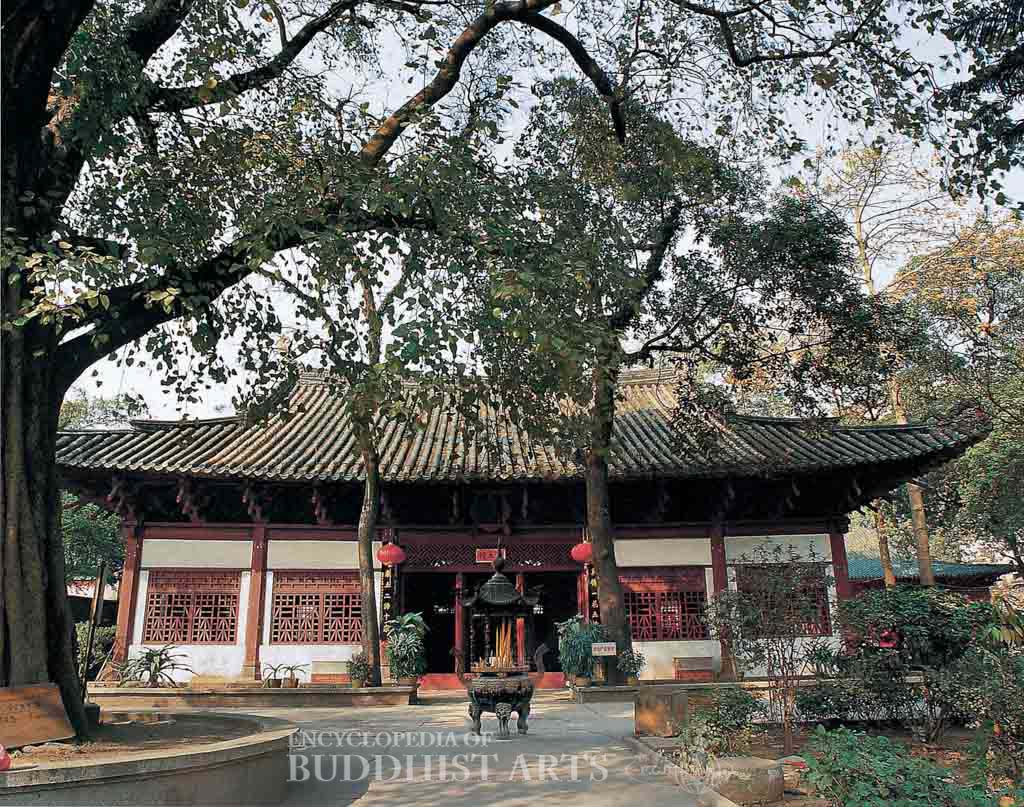
Guangxiao Temple: Sixth Patriarch Hall

Guangxiao Temple: Great Compassion Pillar
Guangxiao Temple
CHINA, Guangdong, Guangzhou
This is the oldest and largest temple in Guangzhou. It used to be a private residence of a royal family member during the Western Han dynasty (206 BCE–25 CE) and was later converted to a temple. The monk Dharmayasas from Kashmir built a Buddha hall here in 397. He utilized this place to translate sutras and teach the Dharma. Gunabhadra, an Indian monk, built an ordination platform here in 435.Huineng, the Sixth Patriarch of Chinese Chan Buddhism, was tonsured and ordained at this temple in 676 during the Tang dynasty. It was listed as a National Cultural Heritage Site in 1986.
The temple complex faces south and the extant buildings include the main temple gate, Heavenly King Hall, bell tower, drum tower, Great Hero Hall, and the Buried Hair Pagoda in which Huineng’s hair is interred. To the west there are the West Pagoda and the Great Compassion Pillar, while to the east there are the Sixth Patriarch Hall, Sangharama Hall, and the Bowl Washing Spring. Further to the east there are the stele passageway, Inkstone Washing Pool, and the East Iron Pagoda.
The Great Hero Hall is a good example of Lingnan (southern China) architecture. The Sixth Patriarch Hall has a single-eave hip-and-gable roof and contains a seated statue of Huineng. The Great Compassion Pillar was created in 826 during the Tang dynasty. It is made of limestone and has a total height of over 2 m. Engravings of warriors decorate its square base, while immediately above that there is an octagonal pillar base. The pillar is carved with the Great Compassion Dharani in small regular Chinese script, and it contains an inscription declaring the date and donor of the pillar. There are carvings of bracket sets underneath the eaves of the pillar, which is rare among the sutra pillars in Guangdong.
For more details, go to the Encyclopedia of Buddhist Arts: Architecture G-L, page 399.
Cite this article:
author = Hsingyun and Youheng and Johnson, Peter and Mankuang and Lancaster, Lewis,
booktitle = {Encyclopedia of Buddhist Arts: Architecture G-L},
pages = 399,
title = {{Guangxiao Temple}},
volume = 2,
year = {2016}}