

Songyue Temple Pagoda
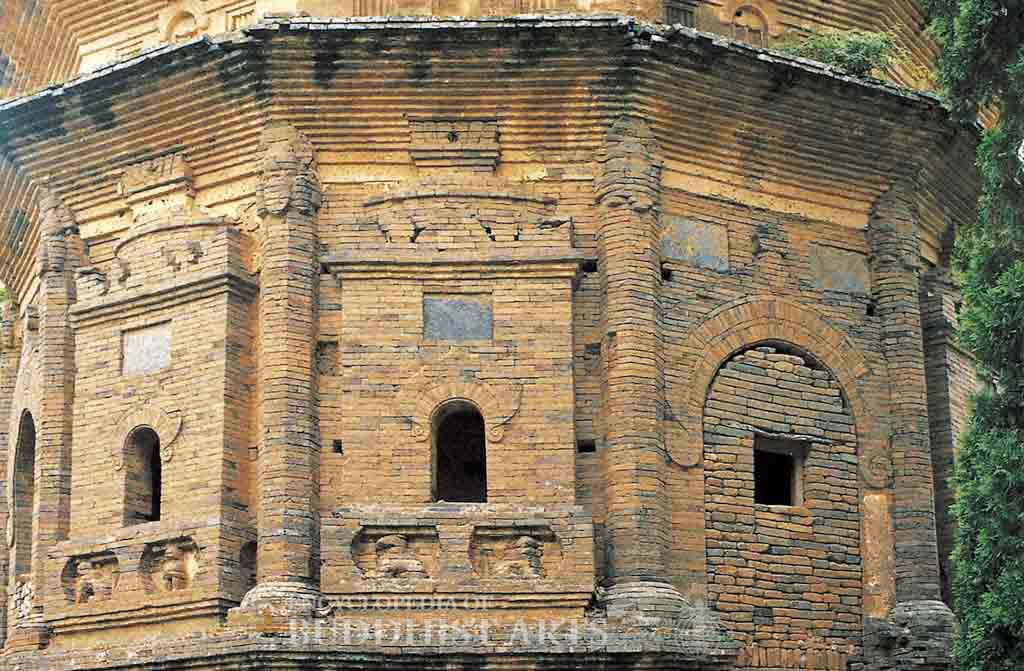
Songyue Temple Pagoda (detail)
Songyue Temple Pagoda
CHINA, Henan, Zhengzhou
This pagoda is located on Songshan (Song Mountain) and is China’s oldest existing multi-tier pagoda. The pagoda has 12 sides and is the only one of its kind still in existence in China. It was built in 523 during the Northern Wei dynasty. Apart from the pagoda, only the main temple gate and a few halls built during the Qing dynasty (1644–1911) remain. The pagoda was listed as a National Cultural Heritage Site in 1961.
The 15-tier, dodecagon, brick pagoda is 37 m high and has a base diameter of 10.6 m. The interior of the pagoda is completely hollow. The base is low, while the first tier is particularly high. It is separated by eaves into two sections. The lower section is undecorated with four doorways that lead to the central chamber. The four doorways extend into the upper section, where they become arched. The remaining eight sides have rectangular single story representations of pagodas, which have decorated lintels and square spires above. The small doorways have cloud patterns around their arches. Underneath there are two shallow relief carvings of lions. At each corner, there are pilasters decorated with pearls and downward turning lotuses at the top. The remaining tiers have eaves in the form of corbeling. A miniature door and two windows are featured on each side of each tier. The distance between the eaves shortens with height and the diameter becomes smaller, giving the pagoda a slight tapered curved shape. The spire is 4.7 m high and consists of an inverted lotus, upturned lotus, seven stacked rings, and a jewel.
The exterior of the pagoda was originally painted white, but the paint has mostly peeled off to reveal yellow bricks underneath. An underground palace was discovered during repair work in 1988. An inscription dated 733 during the Tang dynasty was discovered on the north wall, as well as more than 70 artifacts from the Tang dynasty (618–907). An 11 cm high red sandstone Buddha statue was found with an inscription on the back showing its date of construction as 523 during the Northern Wei dynasty, which also serves as a means of dating the pagoda.
For more details, go to the Encyclopedia of Buddhist Arts: Architecture M-S, page 1046.
Cite this article:
author = Hsingyun and Youheng and Johnson, Peter and Mankuang and Lancaster, Lewis,
booktitle = {Encyclopedia of Buddhist Arts: Architecture M-S},
pages = 1046,
title = {{Songyue Temple Pagoda}},
volume = 3,
year = {2016}}