
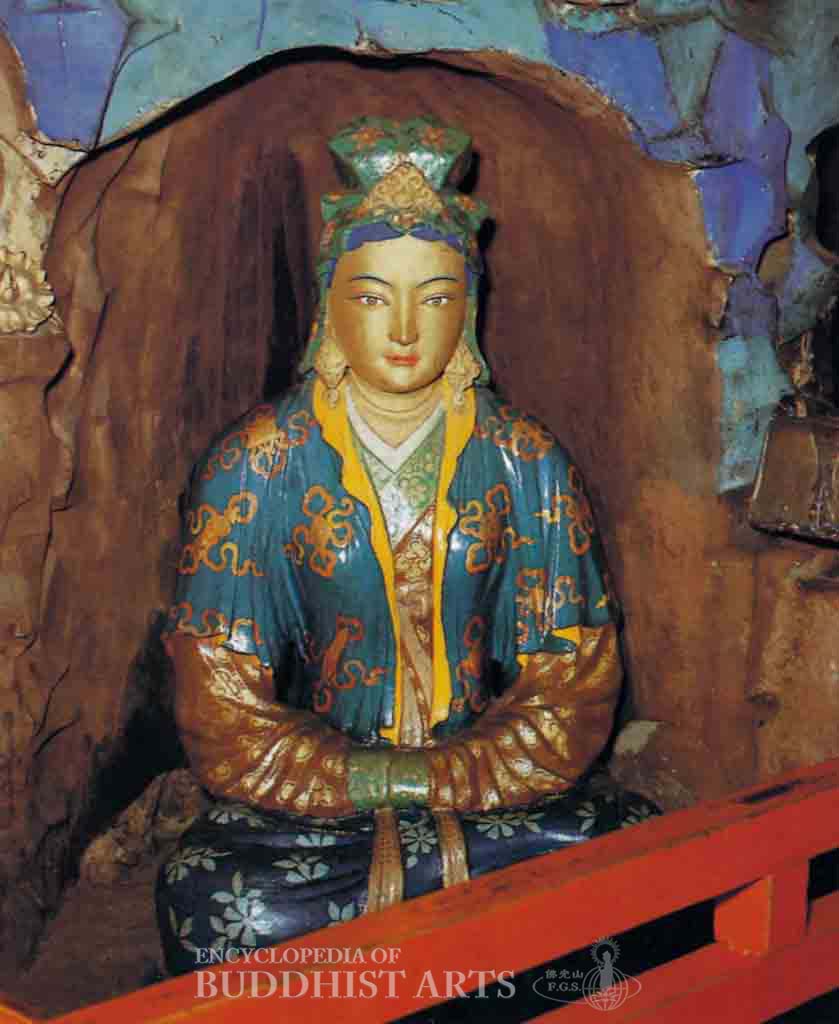
Princess Wencheng; Tibetan Empire
Clay
Princess Wencheng
CHINA; Tang dynasty
Princess Wencheng was a daughter of Emperor Taizong (reigned 626–649) of the Tang dynasty. She was known to be erudite, talented, and a devout Buddhist. The Princess went to Tibet in 641 under imperial order to marry the founder of the Tibetan Empire, Songtsan Gampo (reigned 629–650). She was subsequently involved in the site selection, design, and construction of Jokhang Temple and Ramoche Monastery, thereby imparting the Chinese Buddhist style on Tibetan architecture and art. A statue of Sakyamuni Buddha, with the height of a twelve-year-old, that she had brought still remains enshrined in Jokhang Temple today.
The princess’s generous dowry included large amounts of books, jewelry, textiles, and animals, as well as Buddhist artifacts and 360 fascicles of Buddhist scriptures which contributed greatly to the progression of Tibetan Buddhism. Also accompanying her were a number of maids, monks, and craftsmen. In later years, Princess Wencheng continued to import other materials for spinning and weaving, paper-making, wine-making, pottery, agriculture, and more. The advanced technology of the items she introduced helped to promote the economic and cultural development of the Tibetan Empire.
Princess Wencheng was highly respected by local people. Tibetans commemorate her legacy through various artistic forms such as folk songs, dramas, paintings, and sculptures. The Drak Lhalupuk Cave and Jokhang Temple each house sculptures of the princess, as well as a mural depicting her entry into Tibet.
For more details, go to the Encyclopedia of Buddhist Arts: People, page 212.
Cite this article:
author = Hsingyun and Youheng and Youlu and Pokorski, Stefanie and Yichao and Mankuang and Miaohsi,
booktitle = {Encyclopedia of Buddhist Arts: People },
pages = 212,
title = {{Princess Wencheng}},
volume = 19,
year = {2016}}