
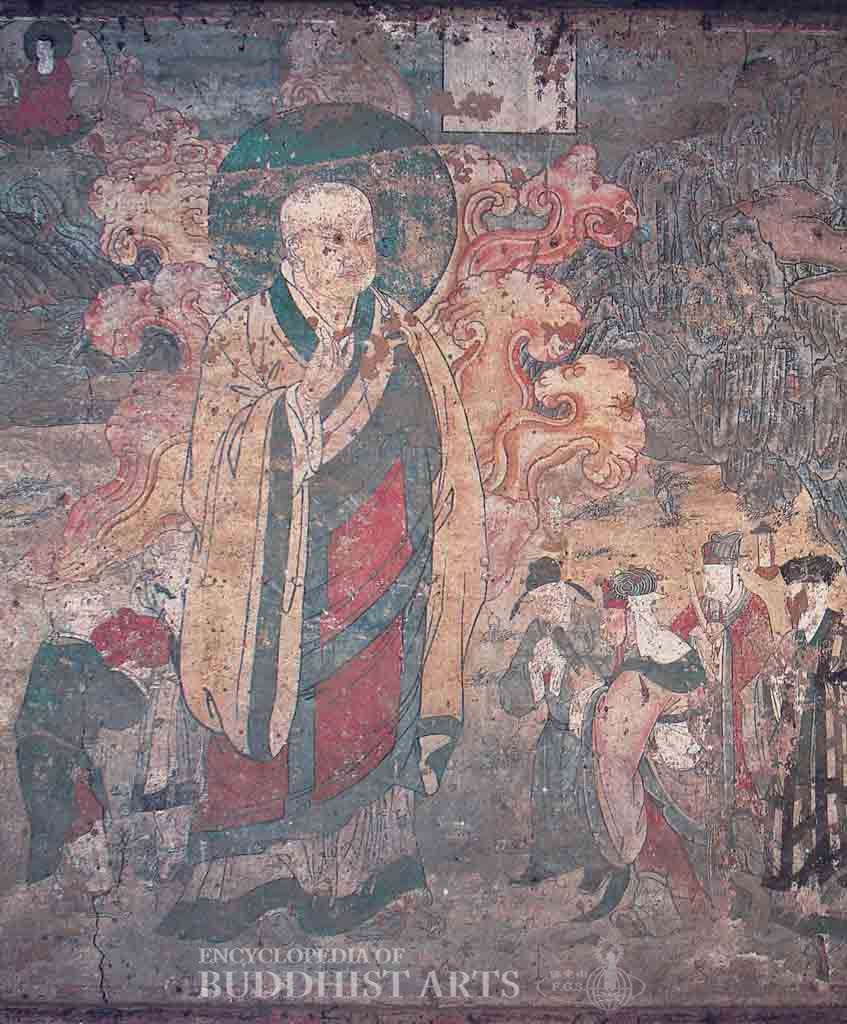
Dule Temple Avalokitesvara Pavilion: Sixteen Arhats - Pindola
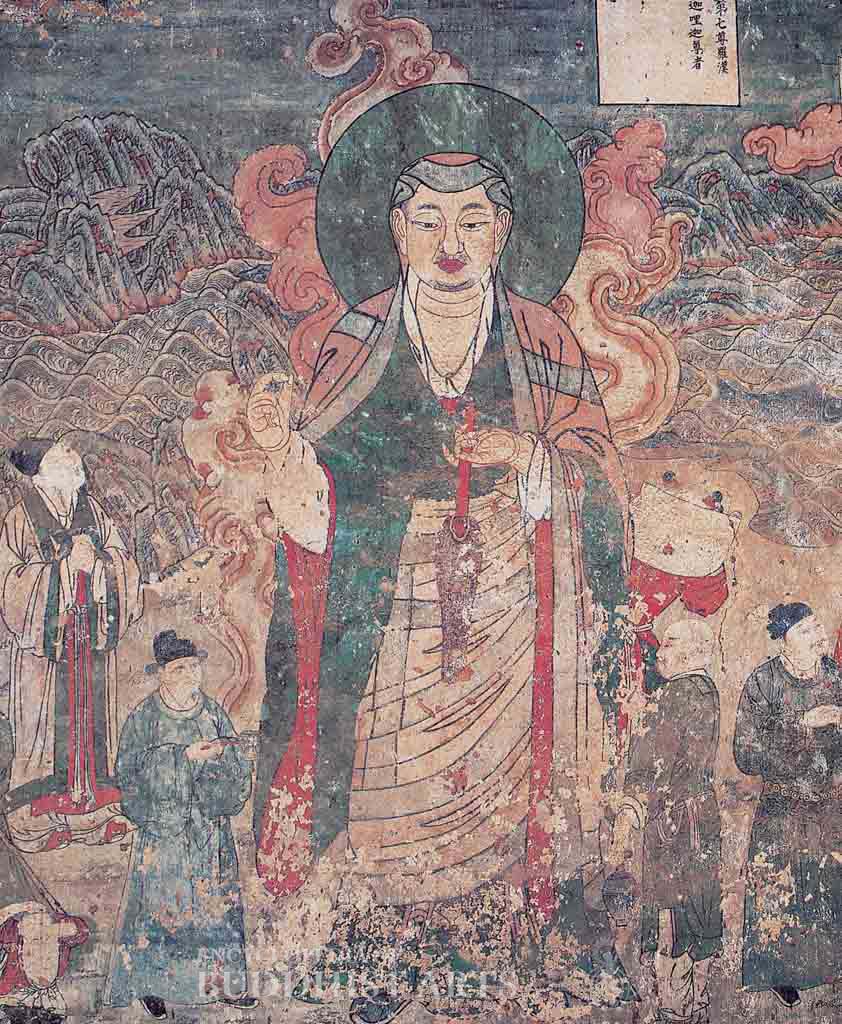
Dule Temple Avalokitesvara Pavilion: Sixteen Arhats - Kalika
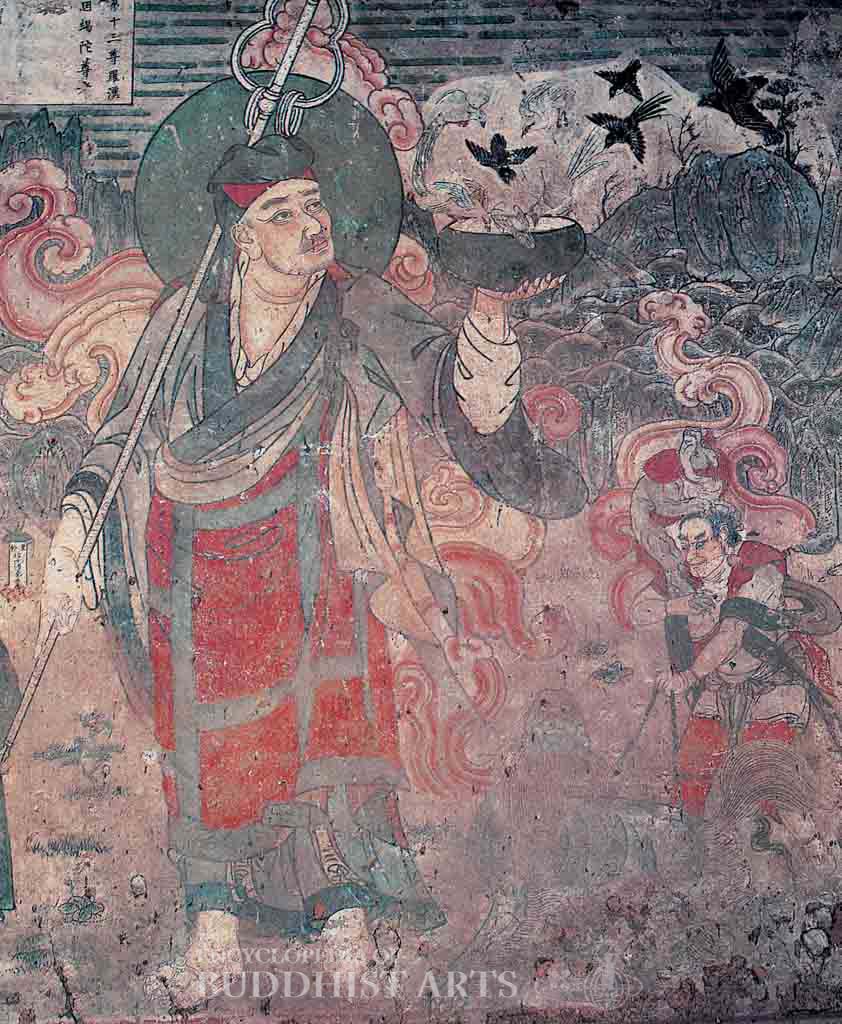
Dule Temple Avalokitesvara Pavilion: Sixteen Arhats - Angaja
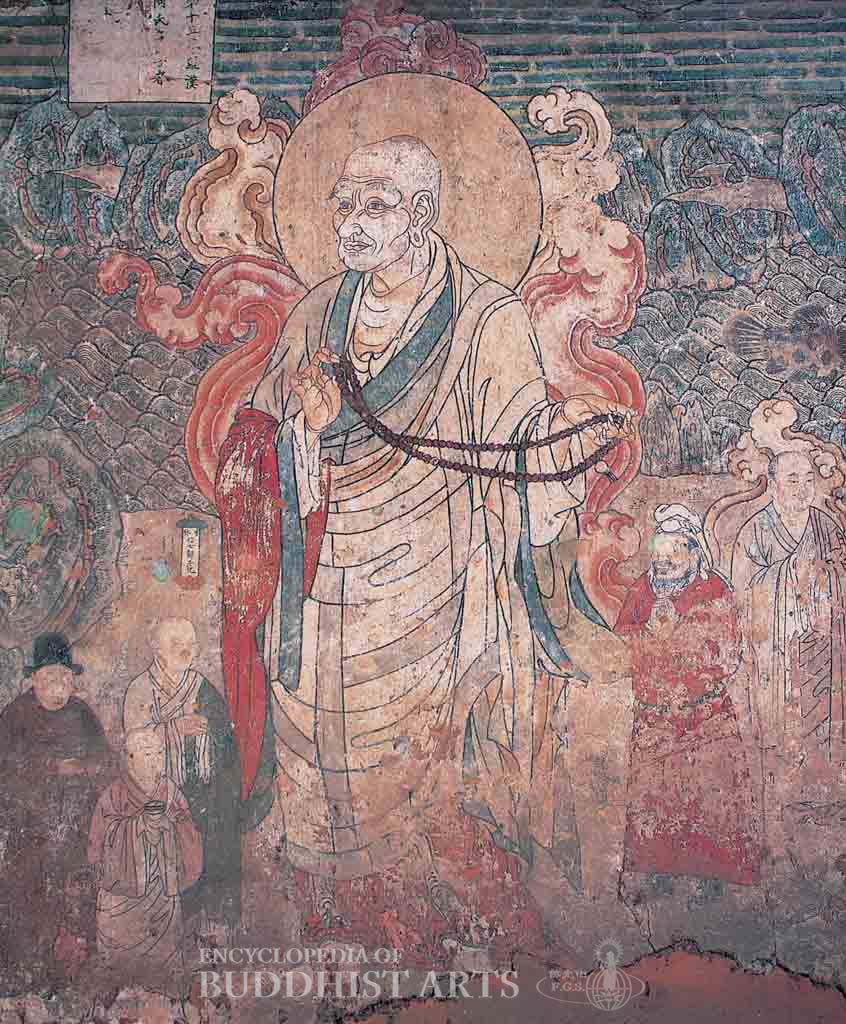
Dule Temple Avalokitesvara Pavilion: Sixteen Arhats - Ajita

Dule Temple Avalokitesvara Pavilion: Sixteen Arhats - Kalika (detail)
Dule Temple Avalokitesvara Pavilion: Sixteen Arhats
CHINA, Tianjin; Yuan dynasty
The Avalokitesvara Pavilion, built in 984, is one of the oldest wooden pavilions in China. In 1972, a mural was uncovered during a renovation. Created in the Yuan dynasty (1271–1368) and repainted during the Ming dynasty (1368–1644), it occupies an entire wall measuring 142.85 sq m. The mural contains images of the Sixteen Arhats and two Wisdom Kings, as well as some scenes of secular life and images of devotees who helped maintain and repair the mural and pavilion. Above the illustrations, the names of the Arhats and inscriptions written by devotees can be seen.
The Sixteen Arhats have colored nimbuses and are accompanied by smaller attendants and donors making offerings. Pindola is turned slightly to one side and forms a mudra with his right hand. Kalika faces directly towards the viewer, wearing a hood and holding a whisk. Angaja carries a monk’s staff and holds up a bowl full of food for birds to eat. Anjita has bright eyes that look off to one side. He holds prayer beads with both hands. Colored clouds are painted behind each of the Arhats. Hills, rivers, and clouds are shown in the background. This mural is primarily painted with “iron-wire” lines augmented with the occasional use of the more gentle “orchid-leaf” technique.
For more details, go to the Encyclopedia of Buddhist Arts: Painting A-H, page 206.
Cite this article:
author = Hsingyun and Youheng and Youlu and Wilson, Graham and Manho and Mankuang and Huntington, Susan,
booktitle = {Encyclopedia of Buddhist Arts: Painting A-H},
pages = 206,
title = {{Dule Temple Avalokitesvara Pavilion: Sixteen Arhats}},
volume = 14,
year = {2016}}