
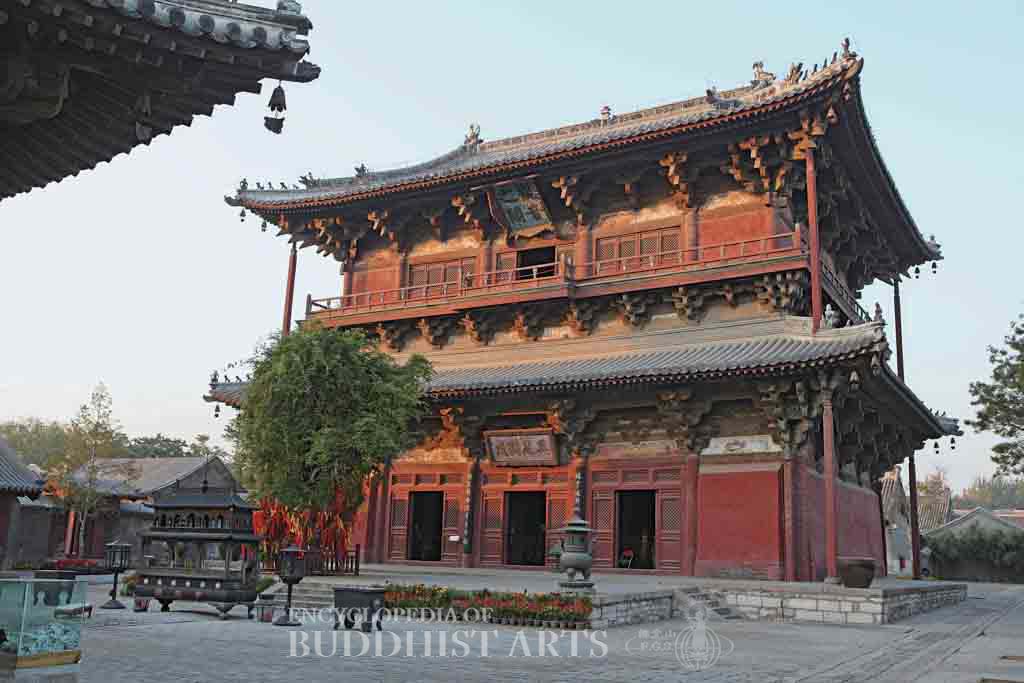
Dule Temple Avalokitesvara Pavilion
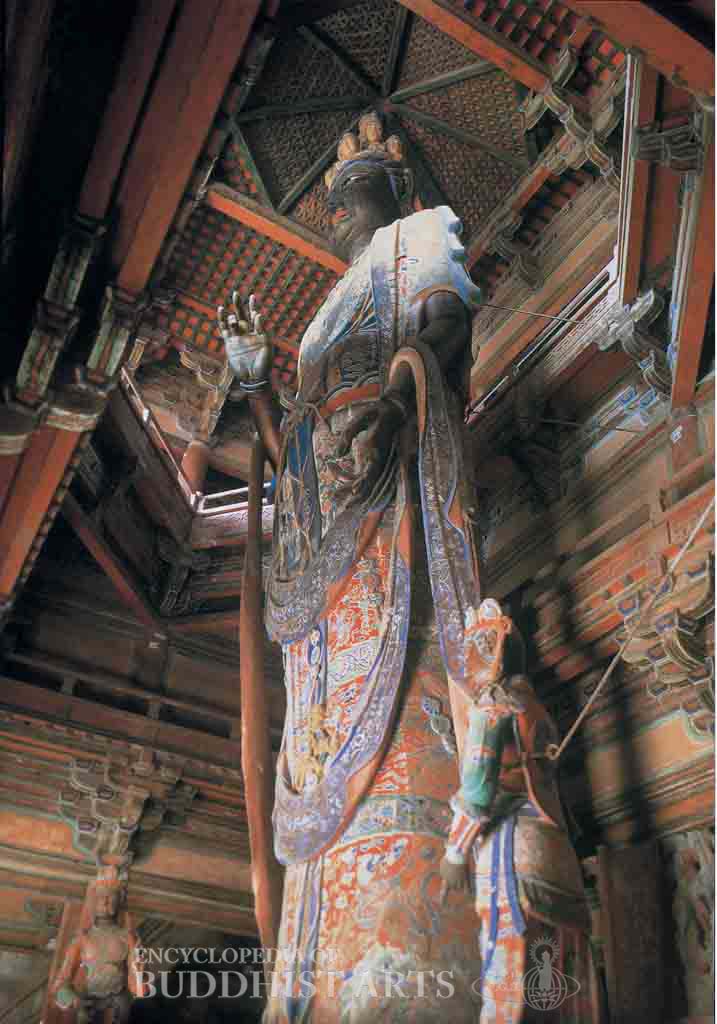
Dule Temple Avalokitesvara Pavilion (interior)
Dule Temple Avalokitesvara Pavilion
CHINA, Tianjin
The pavilion was built in 984 during the Liao dynasty. It is considered to be one of the oldest pavilions with a timber structure in China. The pavilion houses one of the largest clay statues in China, an Eleven-Headed Avalokitesvara from the Liao dynasty (907–1125).
The five-by-four bay pavilion is 23 m high. From the exterior, it seems to have two stories but internally it has three stories. It has a single-eave hip-and-gable roof. The slope of the roof is gentle. It has exaggerated eaves and the bracket sets are rather large. All these are features of Tang dynasty (618–907) architecture.
The building is supported by two sets of columns: those surrounding the 16 m statue and those for the outside walls of the building. The statue can be viewed from three levels. The structural design and utilization of space is ingenious: on the second level the balustrades are rectangular and have been deliberately increased in size; those on the third level are smaller and are hexagonal; while the octagonal coffered ceiling above the statue is even smaller. These changes in geometry and the decrease in size create an illusion of grandeur when viewing the statue from below. Light shining through the windows at the top is cast straight into the statue’s face. This particular technique was adopted from early Buddhist caves. There are two Bodhisattvas in attendance with similar facial features to those of the main statue.
Yuan dynasty (1271–1368) murals were discovered behind a thick coat of mud on the lower levels during renovation in 1972. The murals depict the Sixteen Arhats and two Wisdom Kings, while painted in between them there are secular subjects and images of donors.
For more details, go to the Encyclopedia of Buddhist Arts: Architecture A-F, page 259.
Cite this article:
author = Hsingyun and Youheng and Johnson, Peter and Mankuang and Lancaster, Lewis,
booktitle = {Encyclopedia of Buddhist Arts: Architecture A-F},
pages = 259,
title = {{Dule Temple Avalokitesvara Pavilion}},
volume = 1,
year = {2016}}