
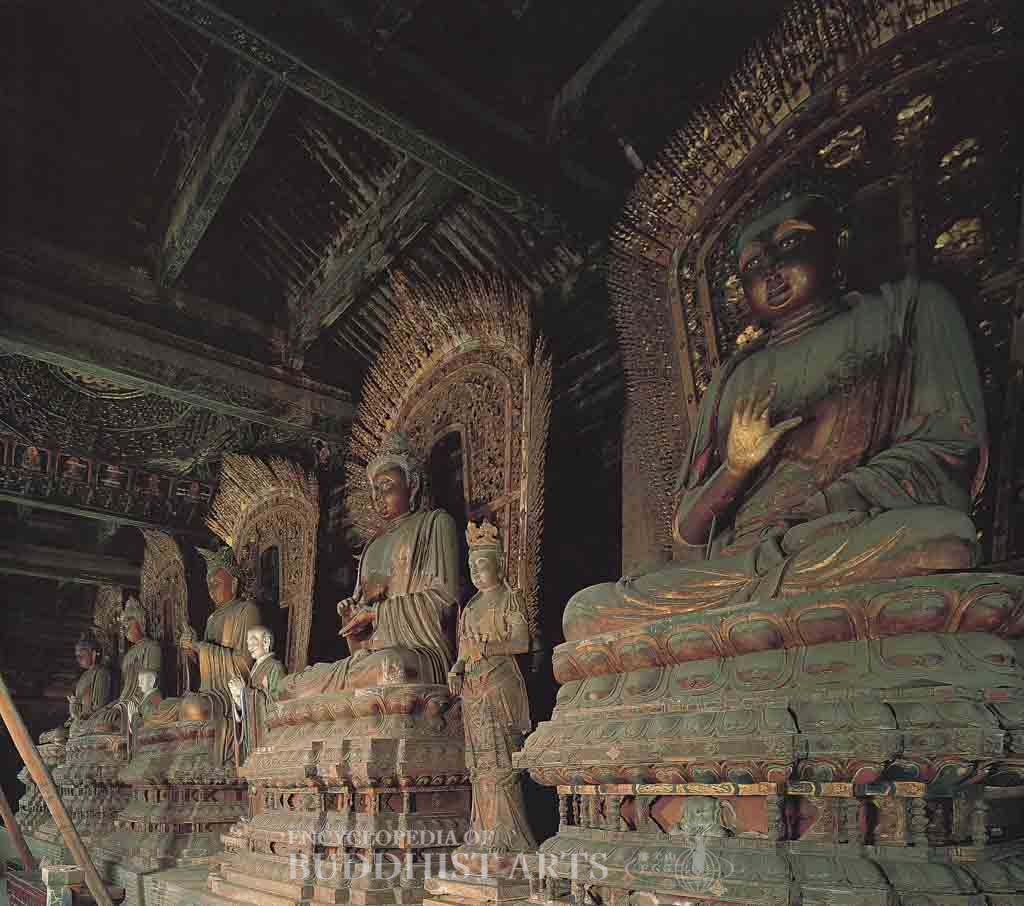
Shanhua Temple Great Hero Hall Sculptures: Five Dhyani Buddhas
Clay
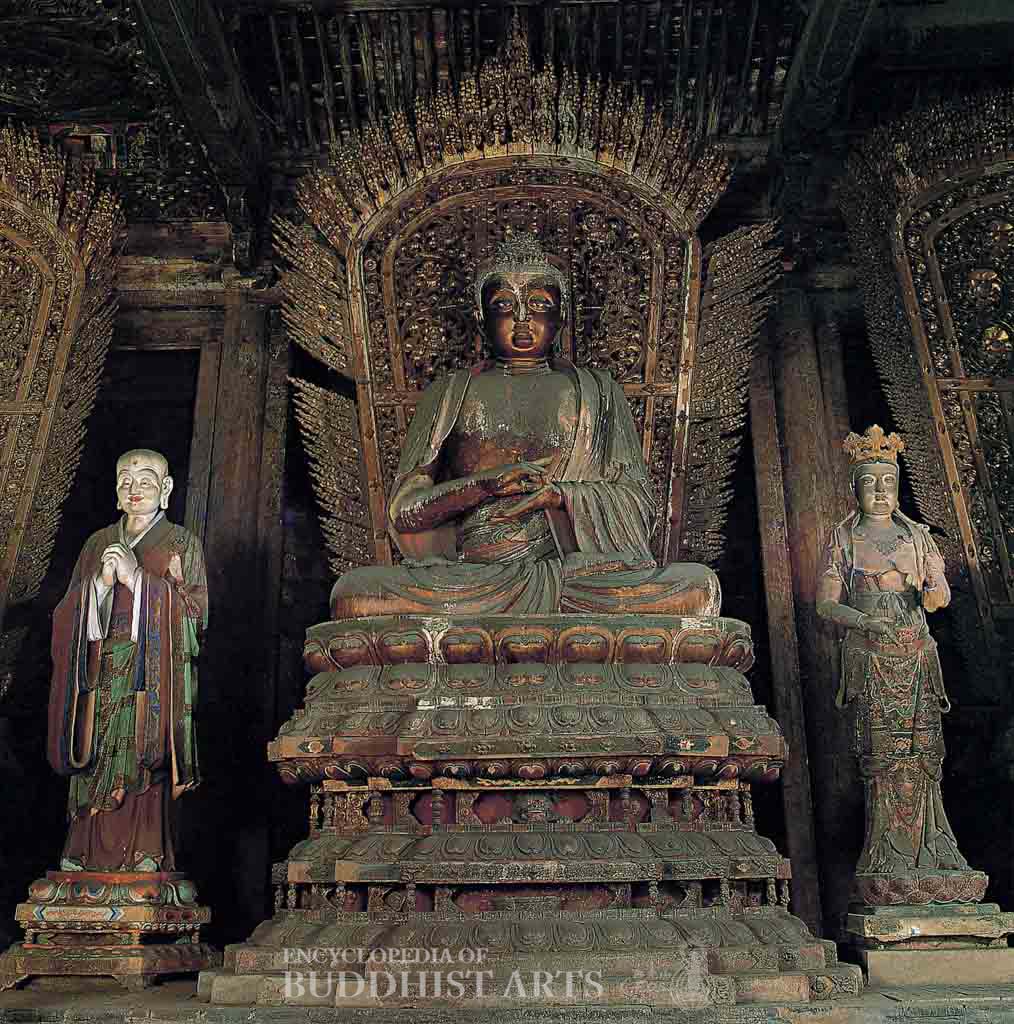
Shanhua Temple Great Hero Hall Sculptures: Ratnasambhava Buddha
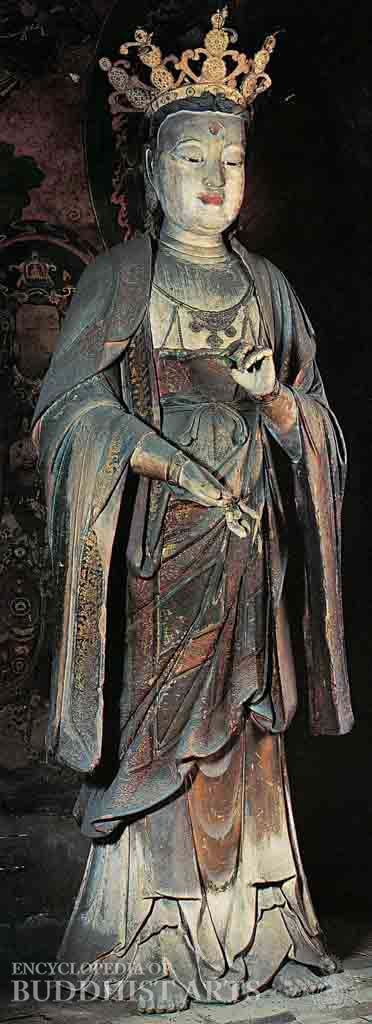
Shanhua Temple Great Hero Hall Sculptures: Bodhidruma
Shanhua Temple Great Hero Hall Sculptures
CHINA, Shanxi, Datong; Jin dynasty
The main statues in the hall represent the Five Dhyani Buddhas, each one separated by either a disciple or a Bodhisattva. From left to right, they include: Amoghasiddhi of the North, Amitabha of the West, Vairocana of the Center, Ratnasambhava of the South, and Aksobhya of the East. All the Buddhas are seated in full lotus positions on lotus thrones supported on a complex double Sumeru throne. Each figure displays an identifying mudra and is backed by an individual mandorla. These statues were repainted during the Jin dynasty (1115–1234), when the other statues in the hall were created.
Statues of Twenty-Four Heavenly Beings are on display along the walls at either end of the hall. The figures along the east wall include Brahma, Sajjneya, Surya, Skanda, Prthivi, Agni, Marici, Dhrtarastra, Virudhaka, Hariti, General Shensha and Yama. On the west wall the statue of Sakra is followed by Isana, Candra, Raksasa, Bodhidruma, Vayu, Sarasvati, Vaisravana, Virupaksa, Mahadevi, Guhyapadavajra, and Varuna.
The Twenty-Four Heavenly Beings are derived from the original Twelve Heavenly Beings, and are mostly Dharma protectors, although they differ from sutra to sutra. Each being has some specialization, with some looking like scholars while others are clad in armor. Mahadevi and Hariti protect all living beings, while Agni, Isana, Skanda and the Four Heavenly Kings wear armor and guard rather than protect.
For more details, go to the Encyclopedia of Buddhist Arts: Sculpture N-Sr, page 1050.
Cite this article:
author = Hsingyun and Youheng and Lovelock, Yann and Chou, Yuan and Huntington, Susan and Edson, Gary and Neather, Robert,
booktitle = {Encyclopedia of Buddhist Arts: Sculpture N-Sr},
pages = 1050,
title = {{Shanhua Temple Great Hero Hall Sculptures}},
volume = 12,
year = {2016}}