
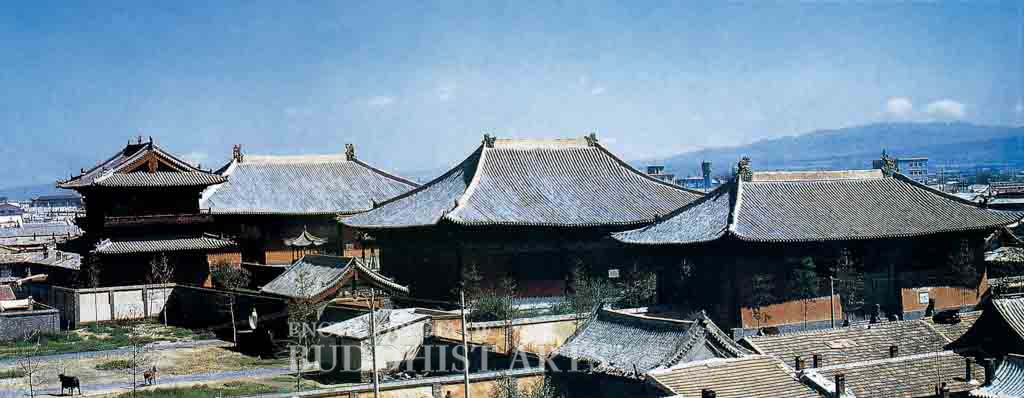
Shanhua Temple
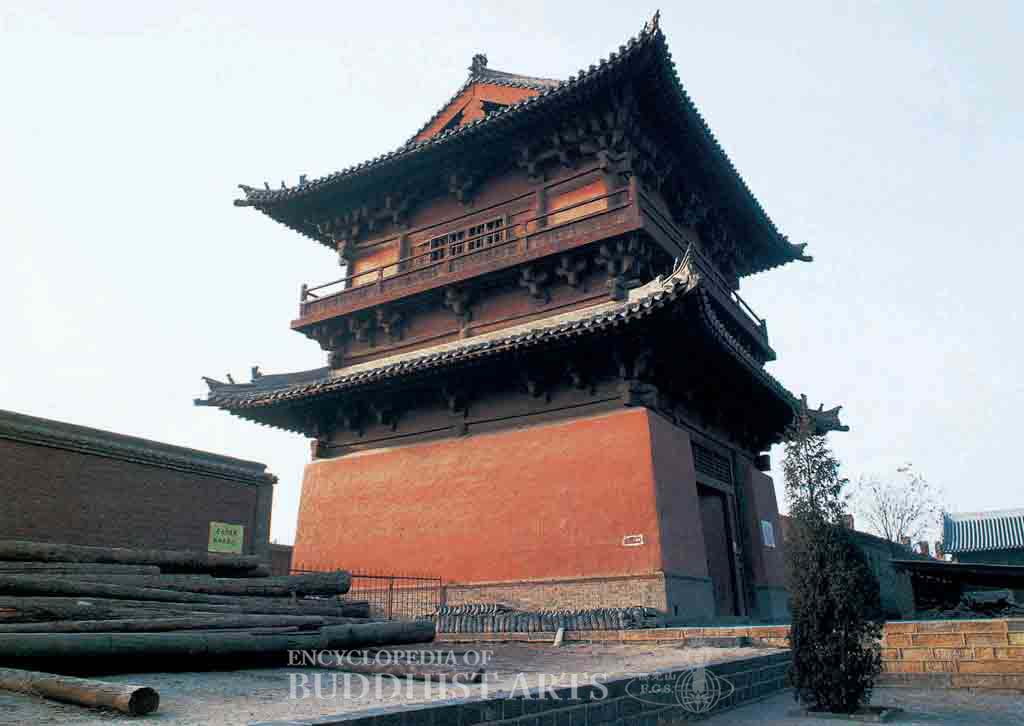
Shanhua Temple: Samantabhadra Tower
Shanhua Temple
CHINA, Shanxi, Datong
Shanhua Temple is located to the west of Datong city wall’s South Gate and is the best preserved temple from the Liao (907–1125) and Jin (1115–1234) dynasties. According to the records, it was built between 713 and 741 during the Tang dynasty. In 1122 during the Liao dynasty, a large part of the temple was destroyed by war. It was rebuilt between 1128 and 1143 during the Jin dynasty. It was listed as a National Cultural Heritage Site in 1961.
The temple faces south and occupies around 1.4 ha. Along the central axis are the main temple gate and Hall of the Three Sages, both of which were built during the Jin dynasty, followed by the Great Hero Hall, which was constructed in the Liao dynasty. Manjusri Tower and Samantabhadra Tower used to stand to the sides in front of the Great Hero Hall, but currently only Samantabhadra Tower exists. Besides the Great Hero Hall there are the Avalokitesvara Shrine and Ksitigarbha Shrine.
The five-by-two bay main temple gate has a single-eave hip roof. The side bays contain Four Heavenly Kings statues cast during the Ming dynasty (1368–1644). The five-by-four bay Hall of the Three Sages was rebuilt during the Jin dynasty and has a single-eave hip roof. The Avatamsaka Triad, consisting of Vairocana Buddha, Manjusri and Samantabhadra Bodhisattvas, is enshrined in the hall. The figures date back to the Jin dynasty but were repaired during the Qing dynasty (1644–1911). All the columns in front of the Buddha altar were removed to allow greater space. The three-by-three bay Samantabhadra Tower was built in 1154 during the Jin dynasty. It has a double-eave hip-and-gable roof. From the outside it looks as if it has two stories but it actually has three stories.
The roofs of the Great Hero Hall and Samantabhadra Tower have a gradual slope, while the Triad Hall and main temple gate have steep roofs, which demonstrates the difference in Liao and Jin architectural styles. The brackets sets upon the four buildings are all angled and, although they decrease in size, they become increasingly complex.
For more details, go to the Encyclopedia of Buddhist Arts: Architecture M-S, page 968.
Cite this article:
author = Hsingyun and Youheng and Johnson, Peter and Mankuang and Lancaster, Lewis,
booktitle = {Encyclopedia of Buddhist Arts: Architecture M-S},
pages = 968,
title = {{Shanhua Temple}},
volume = 3,
year = {2016}}