
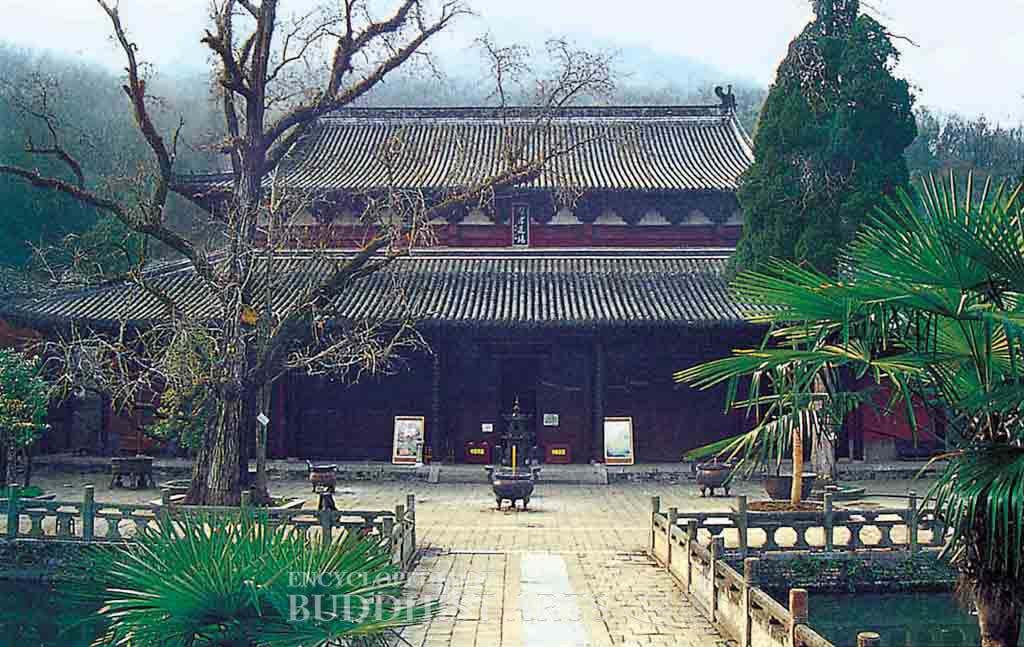
Yuquan Temple: Great Hero Hall
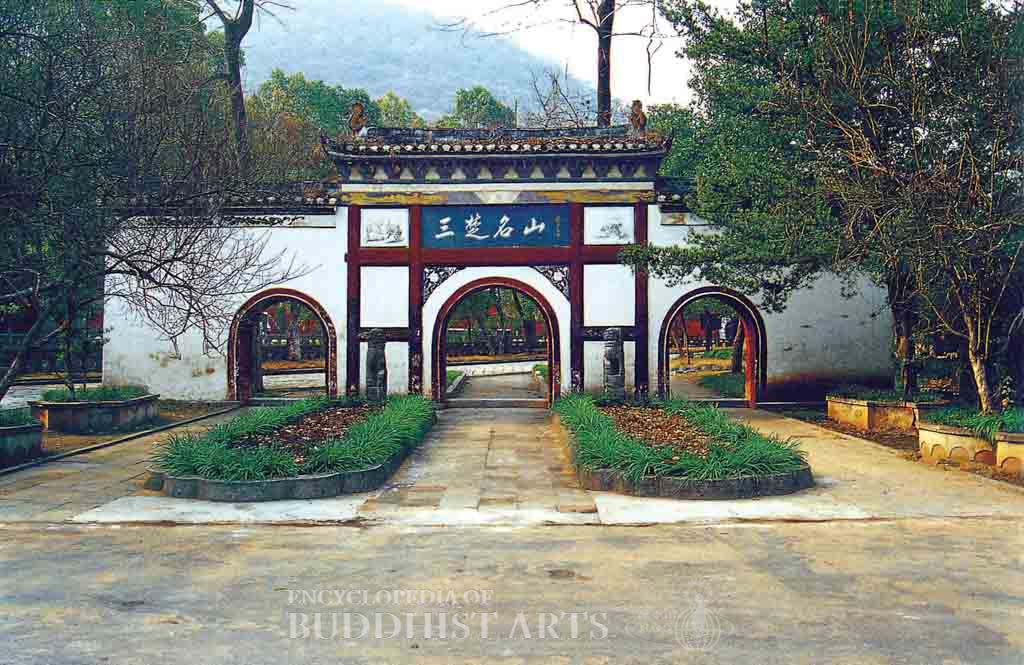
Yuquan Temple: Main Temple Gate
Yuquan Temple
CHINA, Hubei, Yichang
Yuquan means Jade Fountain. The temple is located at the foot of the east side of Yuquanshan (Jade Fountain Mountain). It was established in 592 during the Sui dynasty by Master Zhiyi, founder of the Tiantai school. During the rule of Emperor Gaozong (reigned 676–679) of the Tang dynasty, Master Shenxiu, founder of the Northern Chan school of Buddhism, built a hut on the east side of the temple. It was expanded in 1021 during the Northern Song dynasty. At that time, it covered a large area and was often described as being the leading monastery of Hubei. It underwent major renovations twice, once during the Song dynasty (960–1279) and again during the Qing dynasty (1644–1911). After 1949 there have been a number of minor renovations. It was listed as a National Cultural Heritage Site in 1982.
The surviving buildings of the temple include the main temple gate, Heavenly King Hall, Great Hero Hall, Vairocana Hall, sutra repository, Pratyutpanna Hall, and Perfect Understanding Pavilion, with an iron pagoda in front of the temple. The seven-by-seven bay Great Hero Hall has a double-eave hip-and-gable roof. The building occupies 1,253 sq m and has a height of 21 m. It is considered to be the largest historic building in the south of China. In front of the Great Hero Hall there are more than ten large iron artifacts, such as an iron brazier cast in 615 during the Sui dynasty, and iron incense burners and bells made during the Yuan dynasty (1271–1368). To the side of the building there is a stone carving of Avalokitesvara Bodhisattva by Wu Daozi, a renowned Tang dynasty (618–907) artist.
For more details, go to the Encyclopedia of Buddhist Arts: Architecture T-Z, page 1386.
Cite this article:
author = Hsingyun and Youheng and Johnson, Peter and Mankuang and Lancaster, Lewis,
booktitle = {Encyclopedia of Buddhist Arts: Architecture T-Z},
pages = 1386,
title = {{Yuquan Temple}},
volume = 4,
year = {2016}}