

Sakya Monastery Murals: South Monastery Central Hall - Mandalas (west corridor)
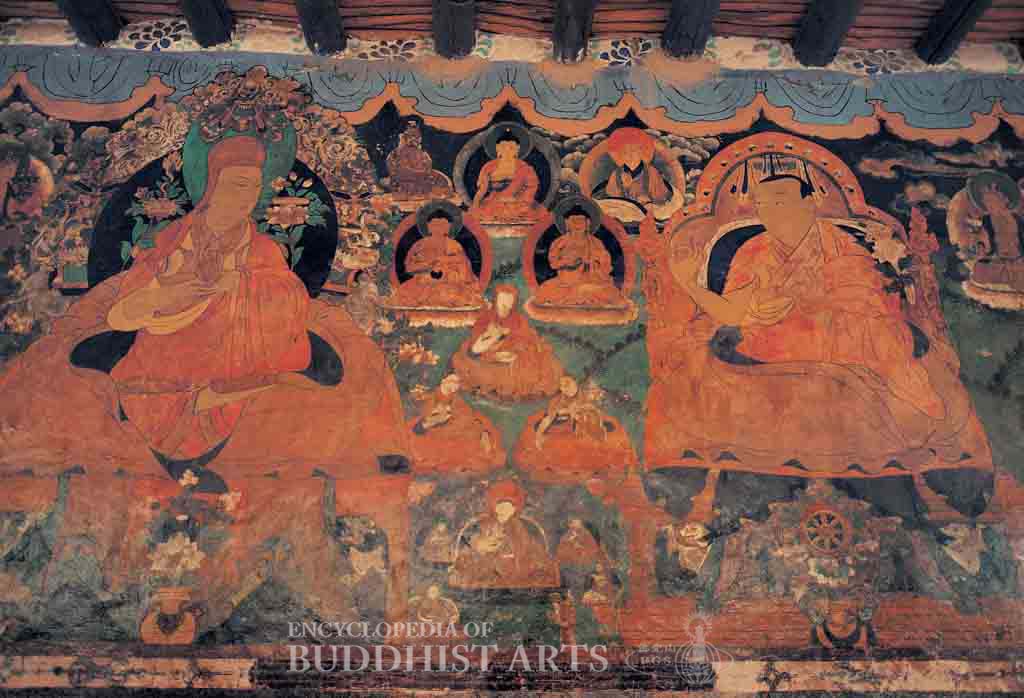
Sakya Monastery Murals: South Monastery - Sakya Pandita Meeting Godan Khan
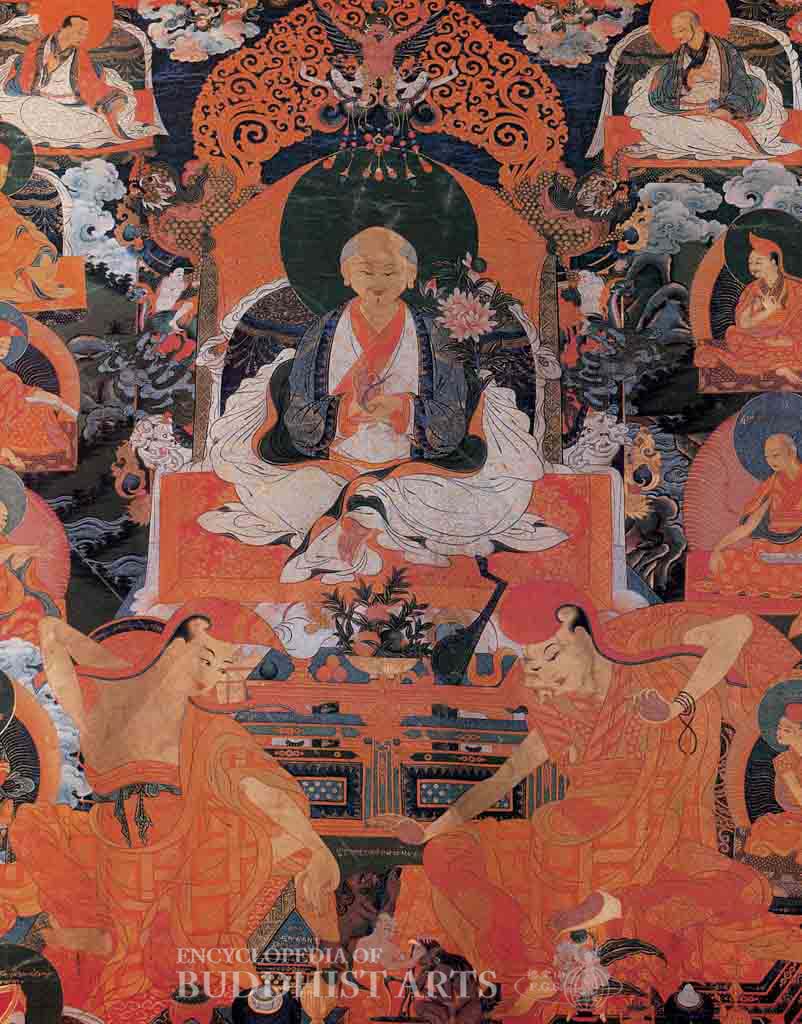
Sakya Monastery Murals: South Monastery - Debate Scene
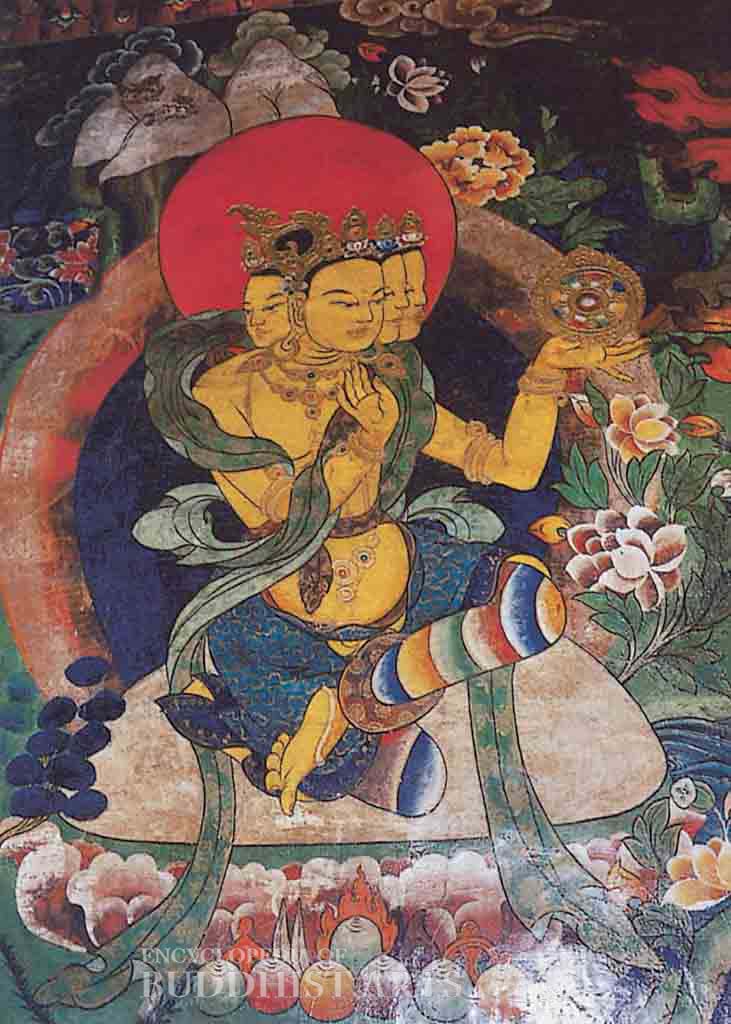
Sakya Monastery Murals: South Monastery - Four-Headed Bodhisattva
Sakya Monastery Murals
CHINA, Tibet, Shigatse
The Sakya Monastery is the principal seat of the Sakya school of Tibetan Buddhism. It is made up of a North Monastery and a South Monastery built on opposite banks of the Trum Chu River in 1073 and 1268 respectively. Parts of the original murals painted when the monastery was constructed can still be seen on the top story of the central hall of the South Monastery, in the west corridor as well as along the north and south corridors.
The most well-known murals in the monastery are the mandalas in the west corridor on the top story of South Monastery’s central hall. Painted between the 14th and 17th centuries, the large central mandala is flanked by four smaller ones, each representing a different deity. The individual mandalas are composed of a large circle surrounding a square palace with a smaller circle inside it. Images of Buddhas, Bodhisattvas, and Dharma protectors are symbolically arranged within the shapes.
The assembly hall in the central hall contains a portrait of Drogon Chogyal Phagpa, the Fifth Patriarch of the Sakya school, as well as scenes of the construction of Sakya Monastery. In the shrine behind the assembly hall there is a depiction of Sakya Pandita meeting the Mongol ruler Godan Khan. Paintings of the patriarchs of the Sakya school are painted on the top story of the south corridor. In the corridor on the upper story of the South Monastery, there is the painting of the Eight-Headed, Sixteen-Armed Hevajra, dated between the 17th and 20th centuries. Hevajra is portrayed standing on a lotus pedestal and embracing his consort Nairatmya. Another mural depicts a Sakya patriarch sitting in full lotus position on a Sumeru throne surrounded by monastics. In front of the master, two monks appear to be engaged in a debate.
For more details, go to the Encyclopedia of Buddhist Arts: Painting P-Z, page 780.
Cite this article:
author = Hsingyun and Youheng and Youlu and Wilson, Graham and Manho and Mankuang and Huntington, Susan,
booktitle = {Encyclopedia of Buddhist Arts: Painting P-Z},
pages = 780,
title = {{Sakya Monastery Murals}},
volume = 16,
year = {2016}}