
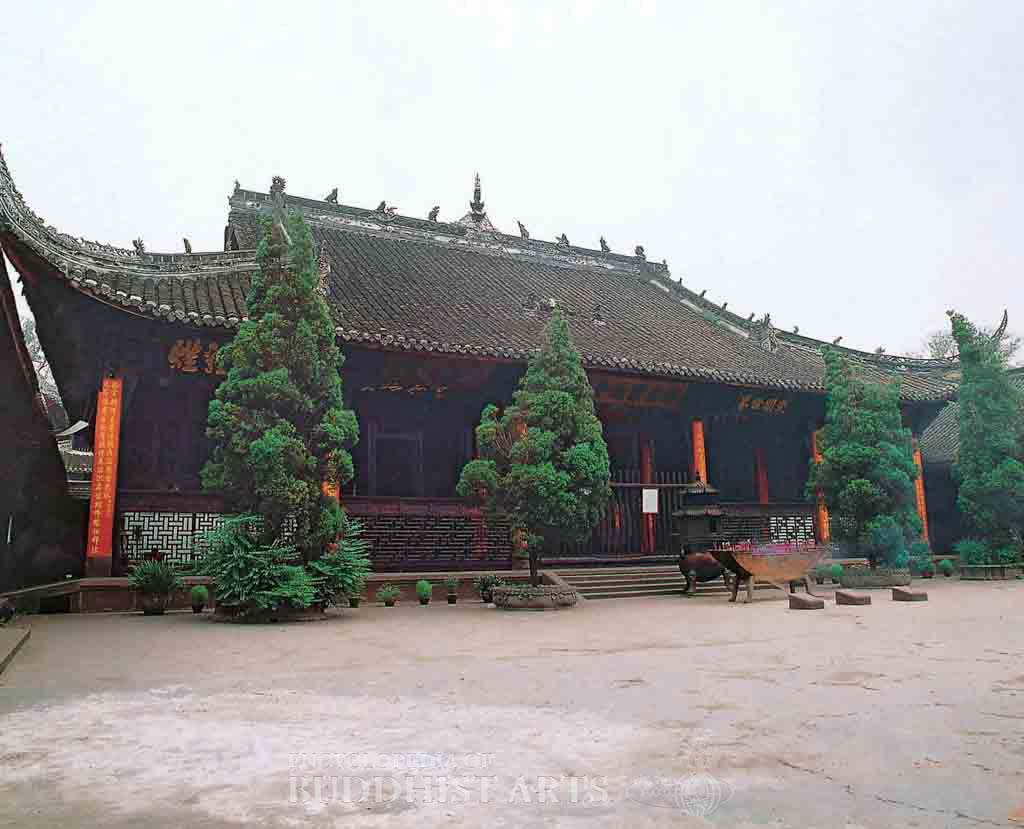
Baoguang Temple: Great Hero Hall
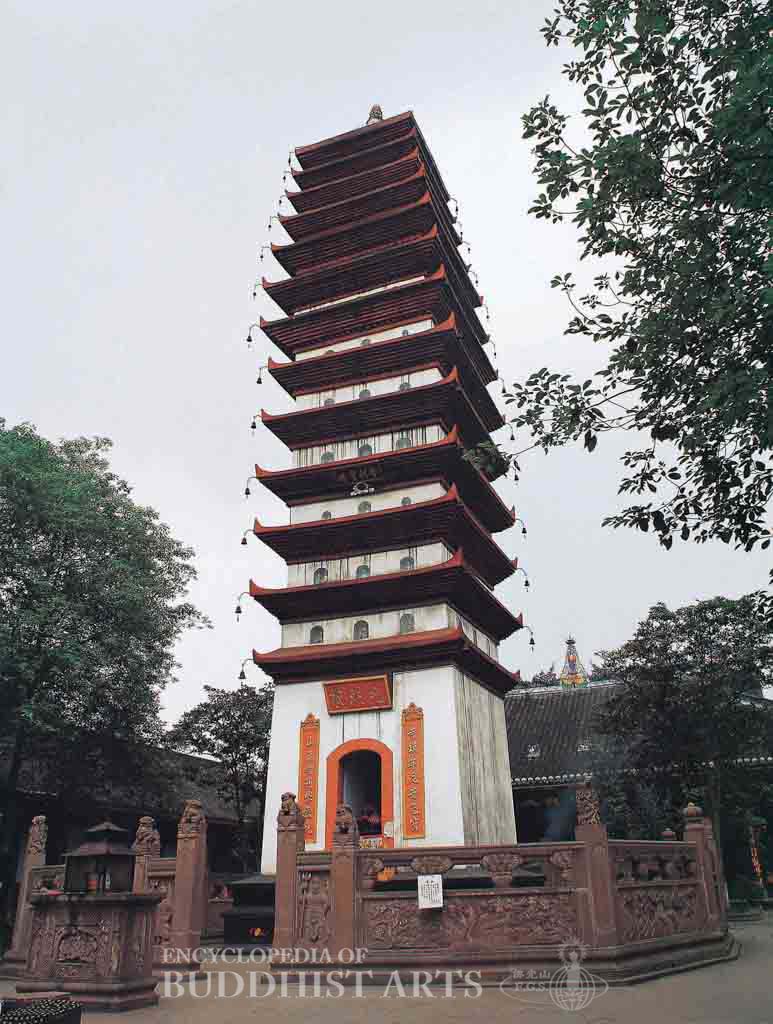
Baoguang Temple: Relic Pagoda
Baoguang Temple
CHINA, Sichuan, Chengdu
It is believed that the temple was constructed during the Eastern Han dynasty (25–220). It has undergone several name changes and has been repaired a number of times throughout its history. Expansion occurred during the late Qing dynasty (1644–1911) resulting in the present layout. It was listed as a National Cultural Heritage Site in 2001.
Facing south, the temple covers an area of 9 ha with the buildings occupying 2 ha. Along the central axis, the principal buildings are the main temple gate, Heavenly King Hall, Relic Pagoda, Hall of the Seven Buddhas, Great Hero Hall, and the sutra repository. On either side there are the bell and drum towers, abbot’s quarters, and the Arhat Hall. To the east of the Great Hero Hall, there is a separate Pure Land temple. Along its central axis there are the Longevity Buddha Hall, Ultimate Bliss Hall, and the chanting hall. It is extremely rare to find a temple within a temple in China.
The Great Hero Hall is the main building and was built in 1859. It has a single-eave hip-and-gable roof. It houses statues of Sakyamuni Buddha and his two disciples, Mahakasyapa and Ananda. To the left of the Ultimate Bliss Hall and Longevity Buddha Hall there is the Arhat Hall, which was built in 1851. The hall covers an area of 1,600 sq m and is ranked number one among the Four Great Arhat Halls of China in its age and size. The 6 m high statue of Avalokitesvara Bodhisattva at the center is surrounded by the Five Hundred Arhats.
The 13-tier, square, brick relic pagoda is 30 m high. The large niche on the first tier houses a seated statue of Sakyamuni Buddha. The remaining tiers have three Buddha niches on each side. The eaves are in the form of corbeling and they turn upwards at the corners, from which bronze bells hang.
Artifacts housed by the temple include a stele erected in 546 during the Southern Liang dynasty and a palm leaf manuscript that was a gift from the King of Siam in 1906.
For more details, go to the Encyclopedia of Buddhist Arts: Architecture A-F, page 50.
Cite this article:
author = Hsingyun and Youheng and Johnson, Peter and Mankuang and Lancaster, Lewis,
booktitle = {Encyclopedia of Buddhist Arts: Architecture A-F},
pages = 50,
title = {{Baoguang Temple}},
volume = 1,
year = {2016}}