
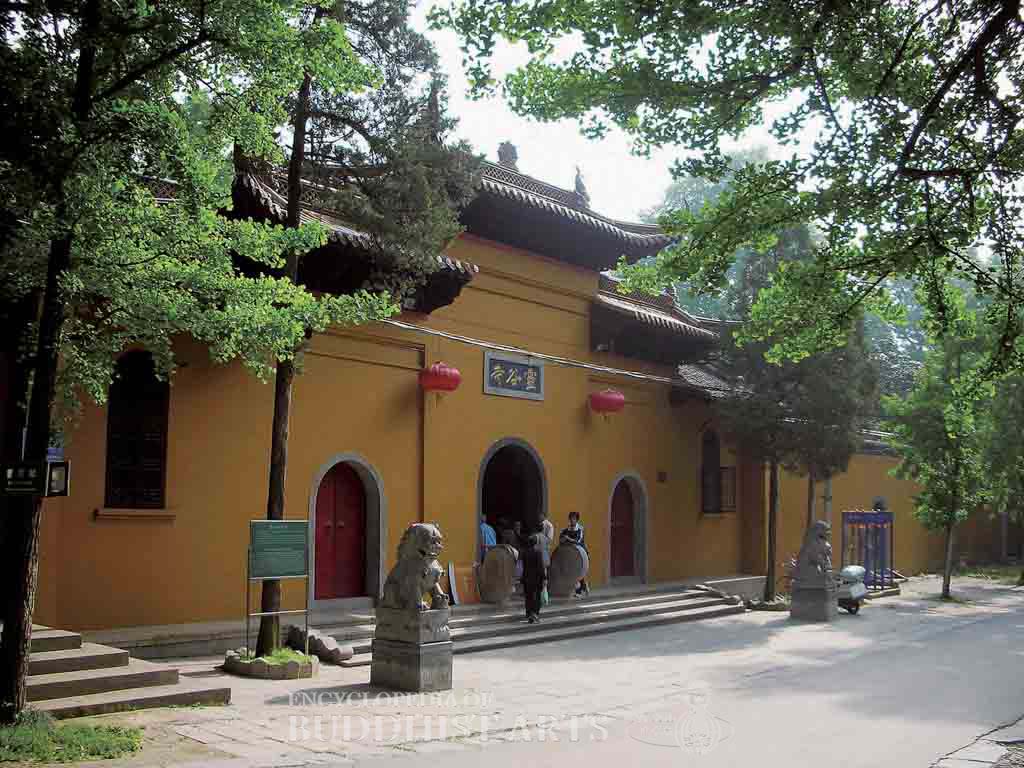
Linggu Temple: Main Temple Gate
Linggu Temple
CHINA, Jiangsu, Nanjing
Linggu means Spiritual Valley, and it is considered one of the most famous temples in Jiangnan (region south of the Yangtze River). The temple was built in 515. It was listed as one of the Ten Major Temples of the Chan school during the rule of Emperor Ningzong (reigned 1194–1224) of the Southern Song dynasty. It was forced to move to its current location in 1382, on imperial orders. It was destroyed in wartime during the rule of Emperor Xianfeng (reigned 1850–1861) of the Qing dynasty and repaired in 1867 with funds raised by the monk Dekai. In 1973 the Xuanzang Memorial Hall was added in order to house his skull relic. The temple was listed as a key Buddhist temple in the Han region of China in 1983.
The temple buildings include the main temple gate, Great Hero Hall, sutra repository, Beamless or Infinity Hall, Zhigong Hall, Avalokitesvara Pavilion, Linggu Pagoda, Baogong Pagoda, and the Xuanzang Memorial Hall. The Beamless Hall is the only building from the Ming dynasty (1368–1644) and houses a statue of Amitabha Buddha. The sutra repository contains the Qisha Tripitaka, as well as the Qing Tripitaka.
The Baogong Pagoda is the funerary pagoda of Chan Master Baozhi, who lived during the Southern and Northern Dynasties (420–589). It is located to the west of the Beamless Hall and was repaired in 1981.
For more details, go to the Encyclopedia of Buddhist Arts: Architecture G-L, page 661.
Cite this article:
author = Hsingyun and Youheng and Johnson, Peter and Mankuang and Lancaster, Lewis,
booktitle = {Encyclopedia of Buddhist Arts: Architecture G-L},
pages = 661,
title = {{Linggu Temple}},
volume = 2,
year = {2016}}