
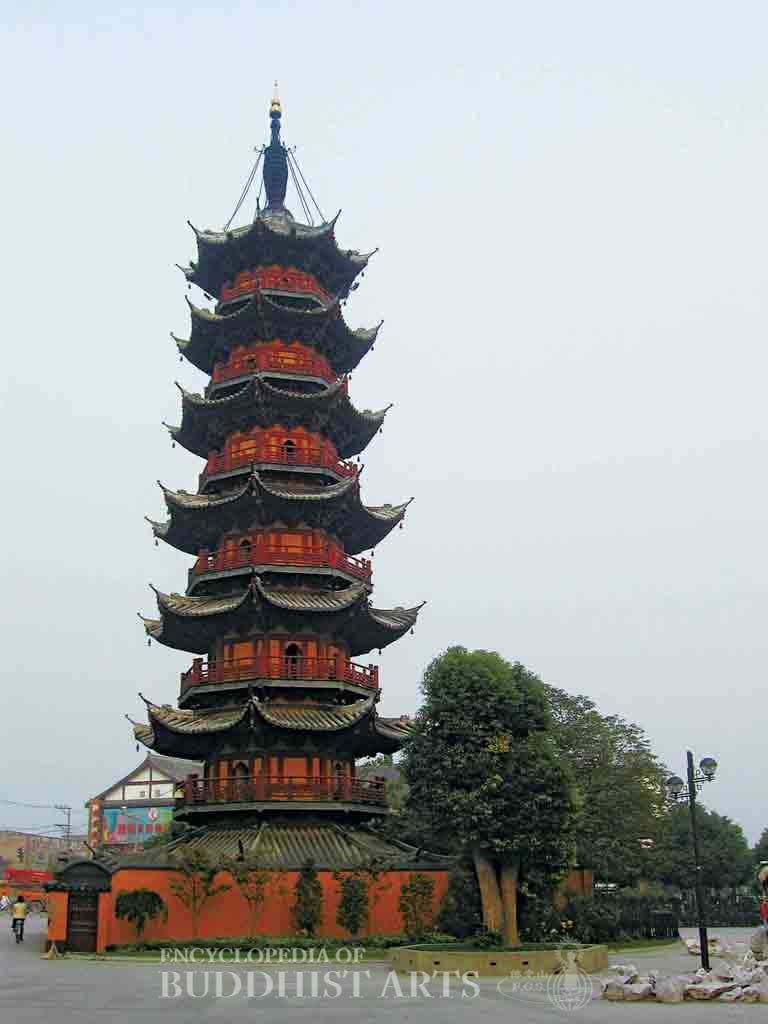
Longhua Temple Pagoda
Longhua Temple Pagoda
CHINA, Shanghai
The pagoda was rebuilt in 977 during the Northern Song dynasty by King Qian Hongchu (reigned 948–978) of Wuyue. It is considered to be one of the earliest versions of the multi-story pagoda with a brick and timber structure. The brick body is original, while the timber structure, including the eaves and balconies, have been repaired a number of times. Overall, the pagoda still retains its original style from the Song dynasty (960–1279). It was listed as a National Cultural Heritage Site in 2006.
The seven-story, octagonal, brick and timber pagoda measures over 40 m in height. Each story above the first one has a balcony. The eaves are imposing and their corners are upturned steeply and hung with bronze bells. Each side of the pagoda has three bays with doors set in the central bay on alternate sides. Inside the pagoda there are square chambers which are angled at 45 degrees to the one above and below. There are wooden ladders that lead to the seventh floor. The spire is sizable, taking up one fifth of the structure’s total height, and has eight chains linking it to the roof.
For more details, go to the Encyclopedia of Buddhist Arts: Architecture G-L, page 686.
Cite this article:
author = Hsingyun and Youheng and Johnson, Peter and Mankuang and Lancaster, Lewis,
booktitle = {Encyclopedia of Buddhist Arts: Architecture G-L},
pages = 686,
title = {{Longhua Temple Pagoda}},
volume = 2,
year = {2016}}