
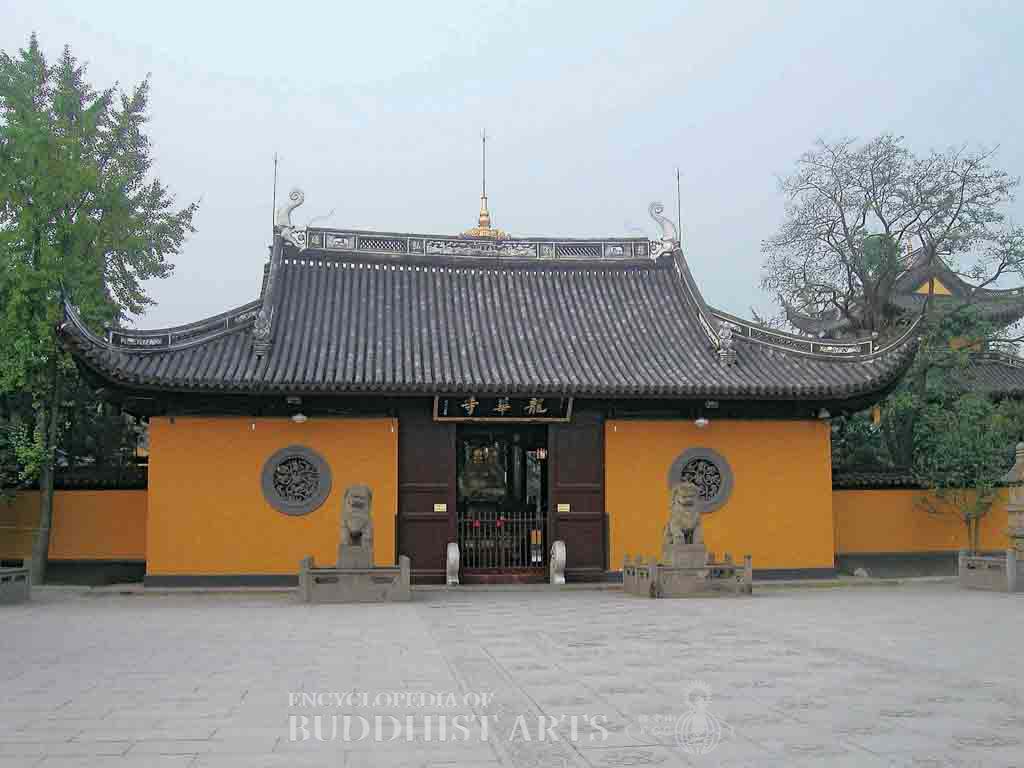
Longhua Temple: Maitreya Hall
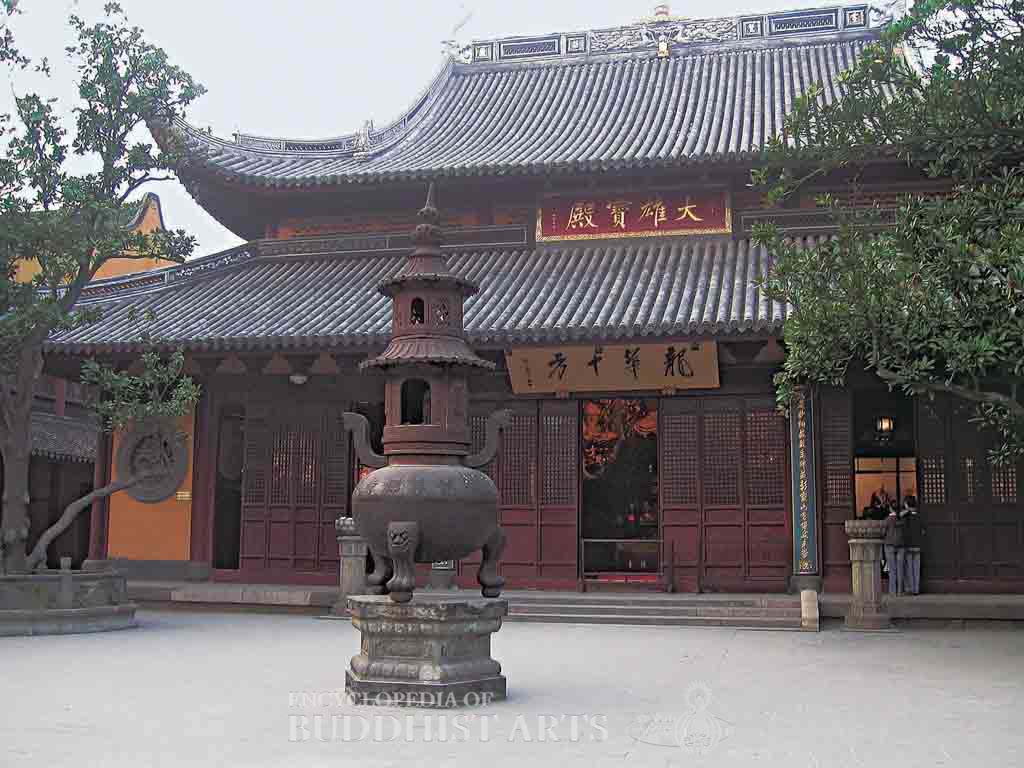
Longhua Temple: Great Hero Hall
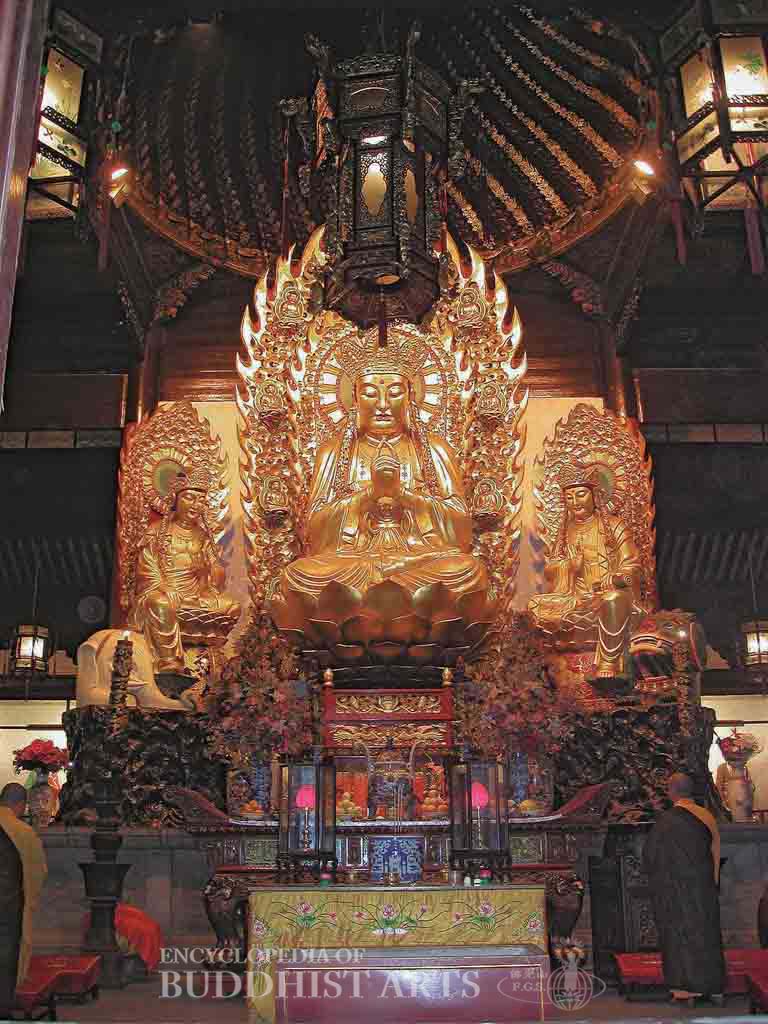
Longhua Temple: Great Hero Hall - Avatamsaka Triad
Longhua Temple
CHINA, Shanghai
Longhua means Dragon Flower. Some people believe that the temple was built in 242 during the Three Kingdoms period for a gathering of monks. However, records from the Song (960–1279) and Yuan (1271–1368) dynasties state that the temple was built during the Five Dynasties period (907–960) by the King of Wuyue. It is the oldest and largest temple in Shanghai. It has been destroyed and rebuilt a number of times throughout its history. The present appearance of the temple stems from its reconstruction during the rule of Emperor Guangxu (reigned 1875–1908) of the Qing dynasty, as well as major renovations that occurred in 1934, 1957, and 1979.
The temple faces south and retains its Song dynasty layout. The buildings along the central axis include the decorated archway, temple gate hall or Maitreya Hall, Heavenly King Hall, Great Hero Hall, Hall of the Three Sages, abbot’s quarters, and the sutra repository. Along either side there are the bell and drum towers, the Arhats Hall, and Avalokitesvara Hall. The Longhua Pagoda is located outside the temple.
The five-bay wide decorated archway has five sets of eaves with slightly upturned corners. The three-bay wide temple gate hall has a single-eave hip-and-gable roof. A door is located in the central bay with two circular windows on either side. A statue of Maitreya is enshrined within the hall. The Great Hero Hall is 26 m wide, 21 m deep, and 16 m high. It has a double-eave hip-and-gable roof. The hall houses the Avatamsaka Triad, which consists of Vairocana Buddha, as well as Manjusri and Samantabhadra Bodhisattvas. The sutra repository contains the three treasures of Longhua Temple: a gilt bronze statue of Vairocana Buddha dating back to the rule of Emperor Wanli (reigned 1572–1620) of the Ming dynasty, a golden seal, and the Ming Tripitaka.
For more details, go to the Encyclopedia of Buddhist Arts: Architecture G-L, page 684.
Cite this article:
author = Hsingyun and Youheng and Johnson, Peter and Mankuang and Lancaster, Lewis,
booktitle = {Encyclopedia of Buddhist Arts: Architecture G-L},
pages = 684,
title = {{Longhua Temple}},
volume = 2,
year = {2016}}