
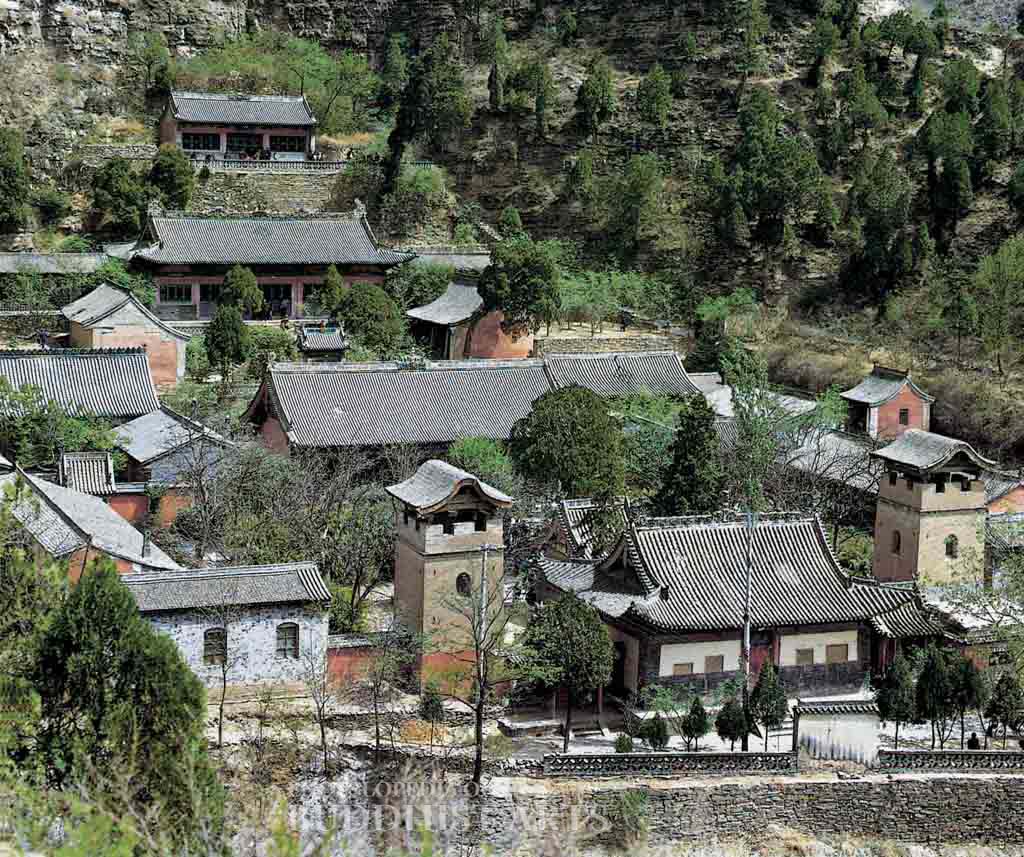
Xuanzhong Temple
Xuanzhong Temple
CHINA, Shanxi, Luliang
Located on the northwest slope of Shibishan (Stone Cliff Mountain), it is the founding temple of the Pure Land school of Chinese Buddhism and is recognized as the ancestral temple of the Japanese Pure Land school. According to a stele inside the temple, construction was undertaken between 472 and 476 during the Northern Wei dynasty. When Master Tanluan became the abbot during his later years, he established the Pure Land school. In 609 during the Sui dynasty, Master Daochuo came to the temple and continued to propagate Master Tanluan’s principles. Between 641 and 645 during the Tang dynasty, Master Shandao visited the temple to pay his respects and accepted the Pure Land teachings. The temple was expanded during the rule of Emperor Taizong (reigned 626–649). Sometime between 785 and 805, Shenwei established an ordination platform, one of the three major ordination platforms at that time. The temple later followed the Vinaya school. In the Yuan dynasty (1271–1368) the temple became a Chan monastery. In its heyday it had 40 branch temples; however, towards the end of the Qing dynasty (1644–1911), it was almost abandoned. Repairs have been on-going since 1954. It was listed as a key Buddhist temple in the Han region of China in 1983.
The surviving buildings include the Heavenly King Hall, Great Hero Hall, Thousand Buddha Pavilion, Patriarch Hall, bell and drum tower, and the White Pagoda. On either side of the main buildings there are the side halls and stele passageway. The most valuable artifacts within the temple are the cast-iron memorial stele of Maitreya and the Ganluyi platform stele, which were created in the Yuan dynasty to replicate the originals from the Tang dynasty (618–907). There are also other ancient steles, as well as close to a thousand statues created from wood, clay, and iron.
For more details, go to the Encyclopedia of Buddhist Arts: Architecture T-Z, page 1333.
Cite this article:
author = Hsingyun and Youheng and Johnson, Peter and Mankuang and Lancaster, Lewis,
booktitle = {Encyclopedia of Buddhist Arts: Architecture T-Z},
pages = 1333,
title = {{Xuanzhong Temple}},
volume = 4,
year = {2016}}