
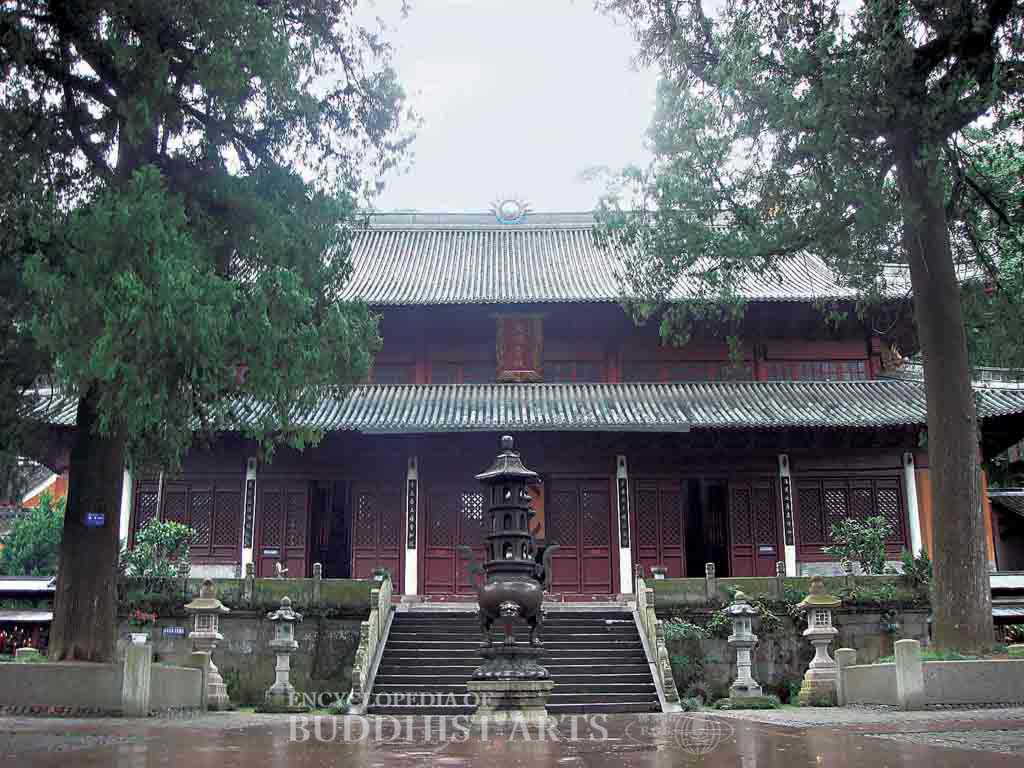
Guoqing Temple: Great Hero Hall
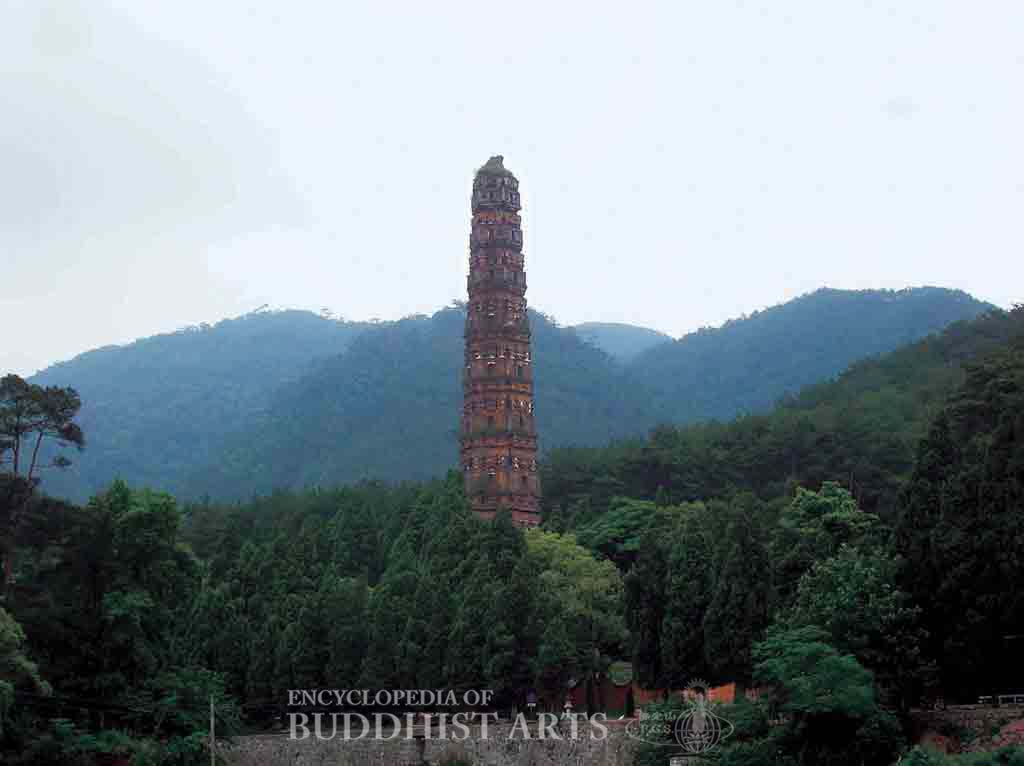
Guoqing Temple: Sui Pagoda
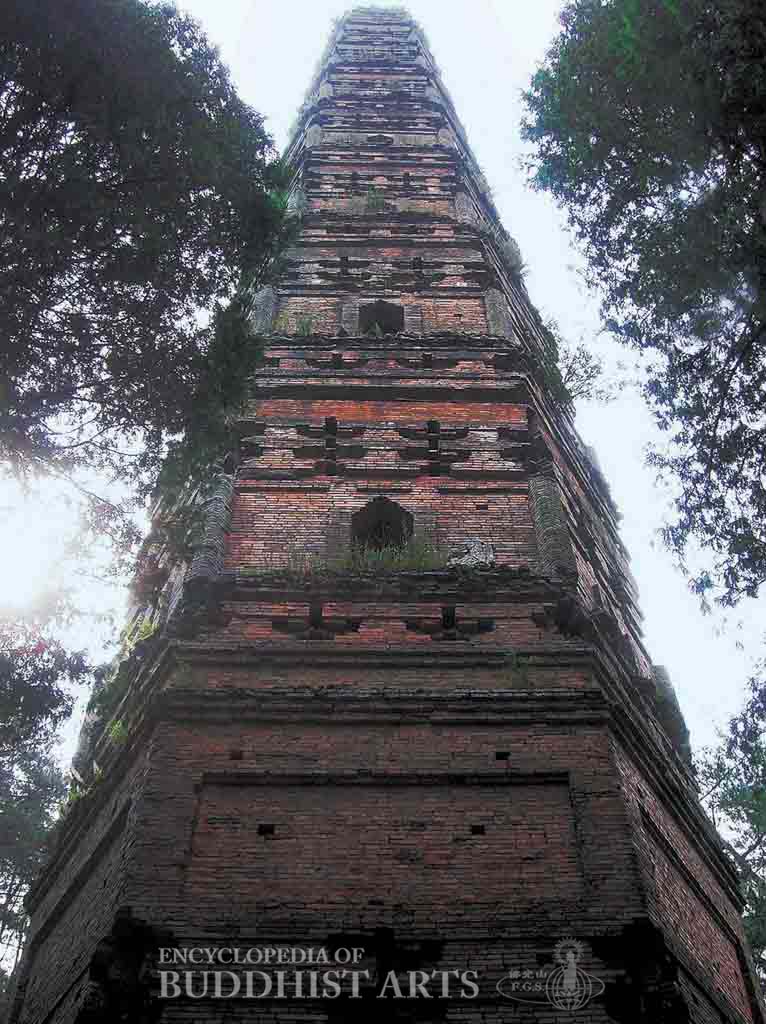
Guoqing Temple: Sui Pagoda
Guoqing Temple
CHINA, Zhejiang, Taizhou
Guoqing Temple is situated at the southern foot of Folong Peak of Tiantaishan (Celestial Platform Mountain). In 575 during the Southern Dynasties, Master Zhiyi arrived at Tiantai and built a small grass hut. He began giving Dharma talks and subsequently founded the Tiantai school of Buddhism. After Master Zhiyi passed away, a temple was built in 598 during the Sui dynasty to honor his wish and was originally named Tiantai Temple. The temple has been repaired and reconstructed a number of times. The present buildings date back to 1734 during the Qing dynasty, and a repair occurred in 1973. It was listed as a National Cultural Heritage Site in 2001.
The temple faces south and occupies 1.3 ha. The buildings are located along four axes. The principal buildings include the main temple gate, Maitreya Hall, Rain Flower Hall, Great Hero Hall, Avalokitesvara Hall, bell and drum towers, abbot’s quarters, Welcoming Pagoda, sutra repository, Wondrous Dharma Hall, and Anyang Hall. Around the perimeter of the temple there are the Fenggan Bridge, Hanshi Pavilion, stupa of Master Yixing and the Sui Pagoda. The seven-by-five bay Great Hero Hall has a double-eave hip-and-gable roof. The hall houses a gilt copper alloy statue of Sakyamuni Buddha created during the Ming dynasty (1368–1644). Along either side of the hall there are finely carved gilded wooden statues of the Eighteen Arhats, which date back to the Yuan dynasty (1271–1368). The nine-story hexagonal Sui Pagoda is 59.3 m high. It was reconstructed during the Southern Song dynasty (1127–1279). The structure is a combination of brick and timber; however, the original wooden parts decayed long ago and have since been replaced.
In 804 during the Tang dynasty, the Japanese Monk Saicho visited the temple with his disciple, Gishin, to study Tiantai Buddhism and the following year he returned to Japan to establish the Tendai school. Guoqing Temple was recognized as its ancestral temple.
For more details, go to the Encyclopedia of Buddhist Arts: Architecture G-L, page 415.
Cite this article:
author = Hsingyun and Youheng and Johnson, Peter and Mankuang and Lancaster, Lewis,
booktitle = {Encyclopedia of Buddhist Arts: Architecture G-L},
pages = 415,
title = {{Guoqing Temple}},
volume = 2,
year = {2016}}