
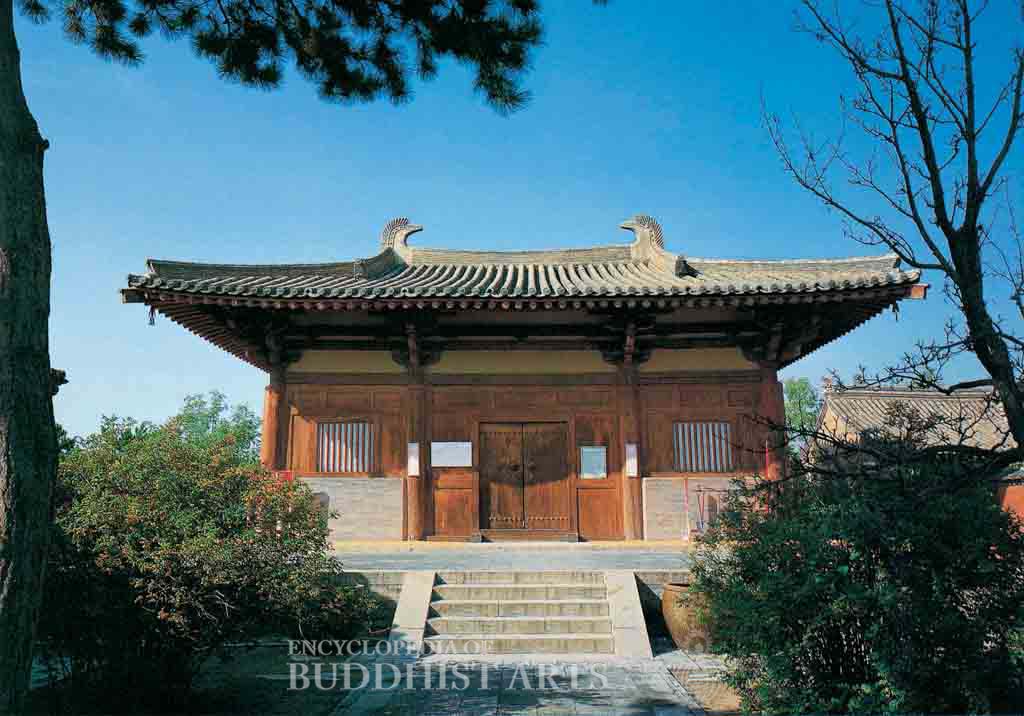
Wutaishan Nanchan Temple Main Hall
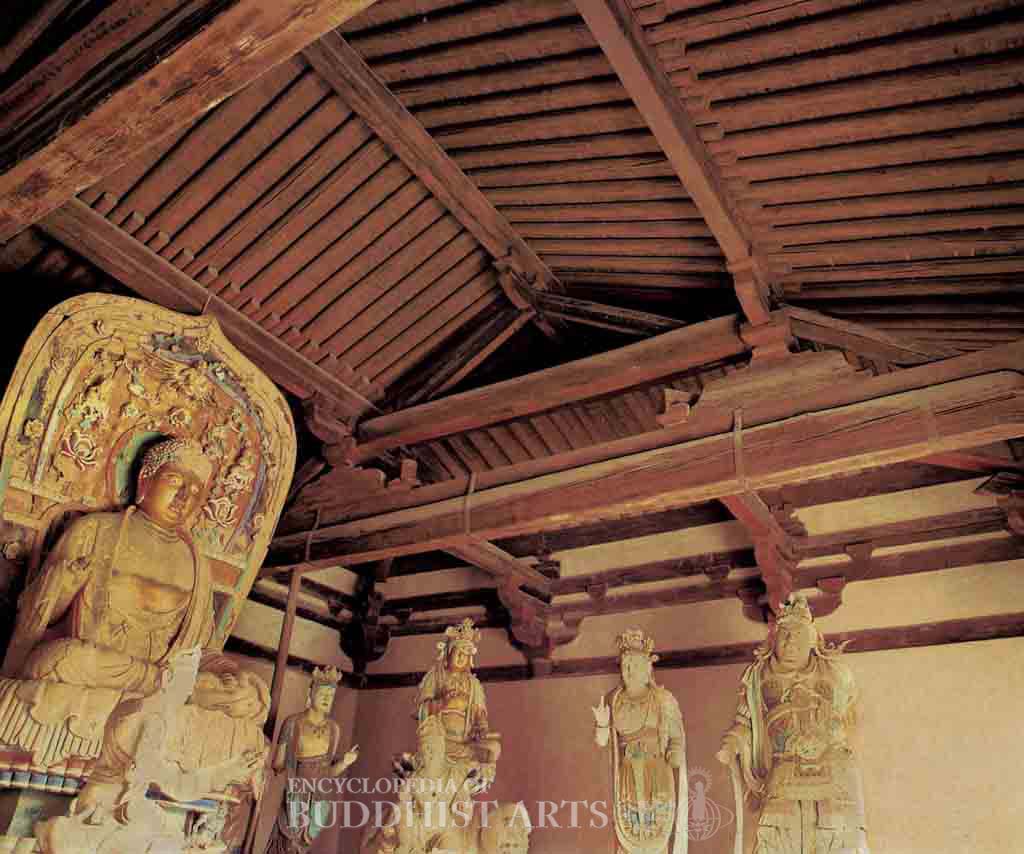
Wutaishan Nanchan Temple Main Hall (interior)
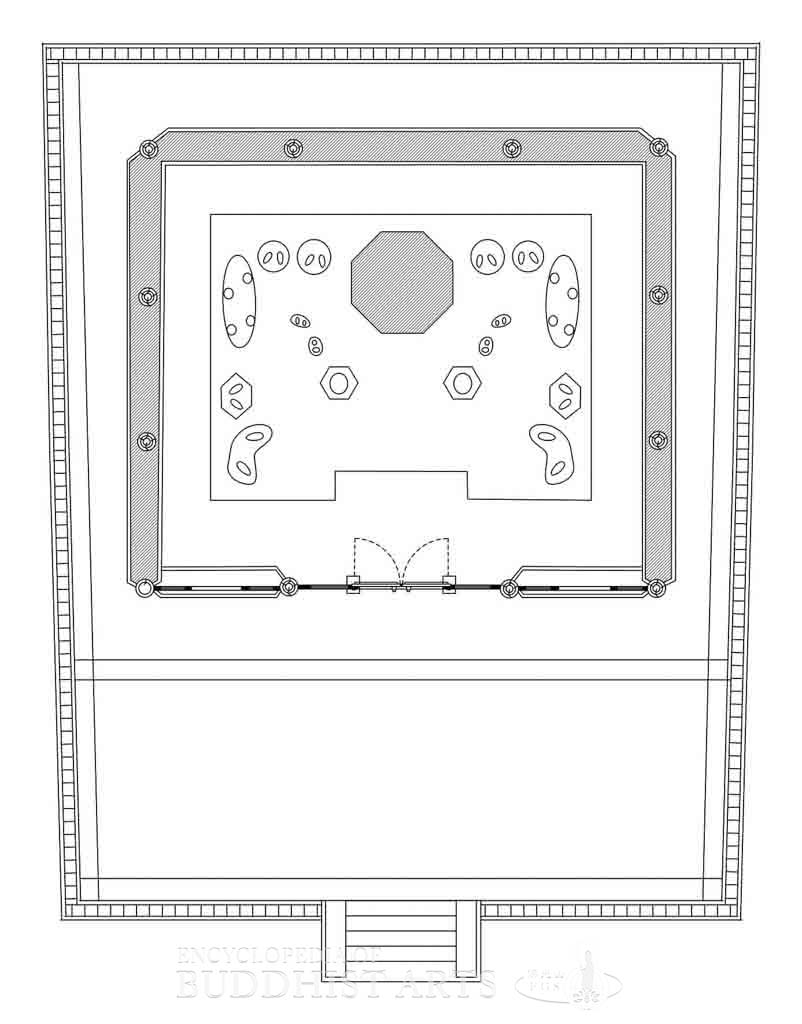
Wutaishan Nanchan Temple Main Hall (site layout)
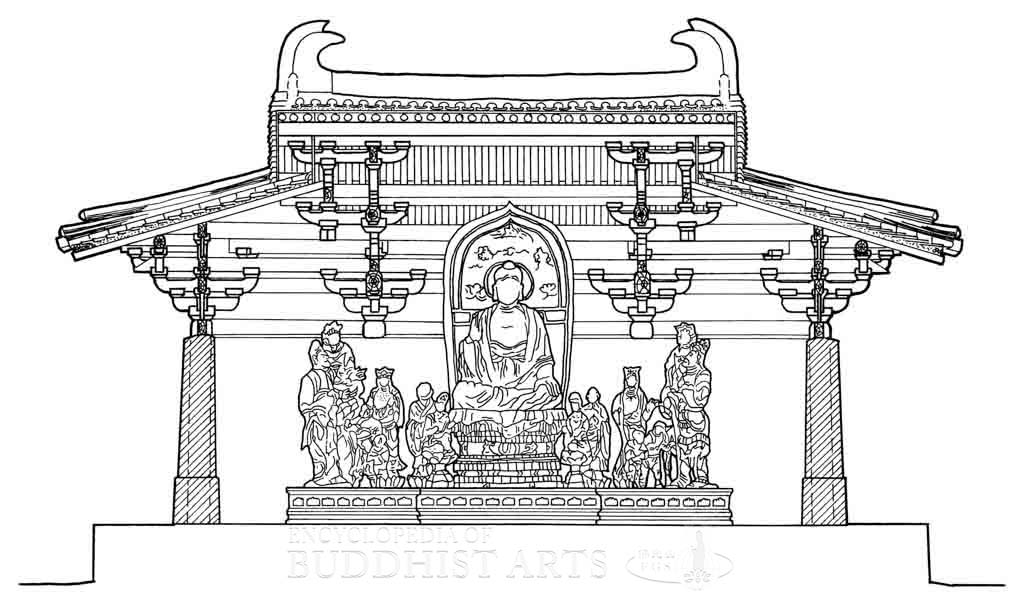
Wutaishan Nanchan Temple Main Hall (section drawing)
Wutaishan Nanchan Temple Main Hall
CHINA, Shanxi, Xinzhou
This is the oldest extant wooden building in China. The date of its construction is unclear but inscriptions found beneath the crossbeams state that it was rebuilt in 782 during the Tang dynasty. The temple escaped damage from Buddhist persecution under Emperor Wuzong (reigned 840–846) of the Tang dynasty due to its remoteness and its absence from local government and Buddhist records. A major renovation was conducted in 1086 during the Northern Song dynasty. After the earthquake in 1966 repairs to the hall were carried out in 1974 and 1975. It was listed as a National Cultural Heritage Site in 1961.
The three-by-three bay building has a single eave hip-and-gable roof with an almost straight ridge. It is 11.6 m wide by 9.9 m deep. Architraves connect the external columns but do not protrude at the corners, which is a common Tang dynasty (618–907) characteristic. Above the columns there are two-tier bracket sets with two projecting bracket arms.
There are no columns inside the hall, and instead two sets of long four-rafter tie beams act as underpinning for the roof. The crossbeams support inverted V-shaped braces, which in turn support the ridge purlin. This layout is also typically found in Tang dynasty structures. The altar is in the shape of a U, which was common among early altars. There are 17 statues upon the altar, the main ones being Sakyamuni Buddha, Manjusri and Samantabhadra Bodhisattvas. Although some modifications were made during the Yuan dynasty (1271–1368), they still retain their original Tang dynasty features and have high historic value.
For more details, go to the Encyclopedia of Buddhist Arts: Architecture T-Z, page 1291.
Cite this article:
author = Hsingyun and Youheng and Johnson, Peter and Mankuang and Lancaster, Lewis,
booktitle = {Encyclopedia of Buddhist Arts: Architecture T-Z},
pages = 1291,
title = {{Wutaishan Nanchan Temple Main Hall}},
volume = 4,
year = {2016}}