
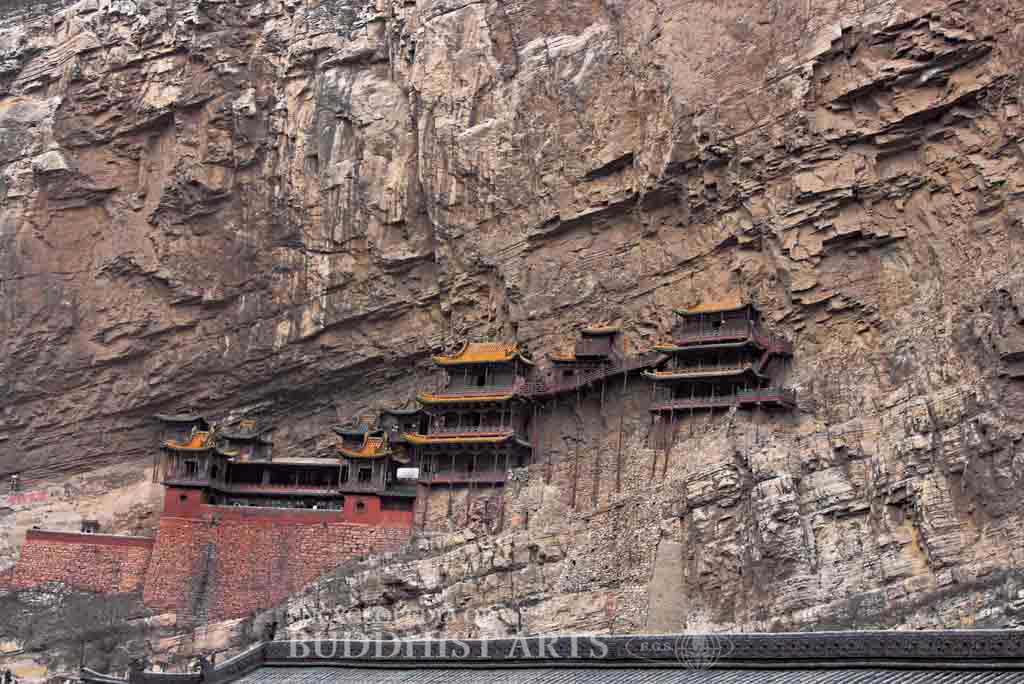
Xuankong Temple
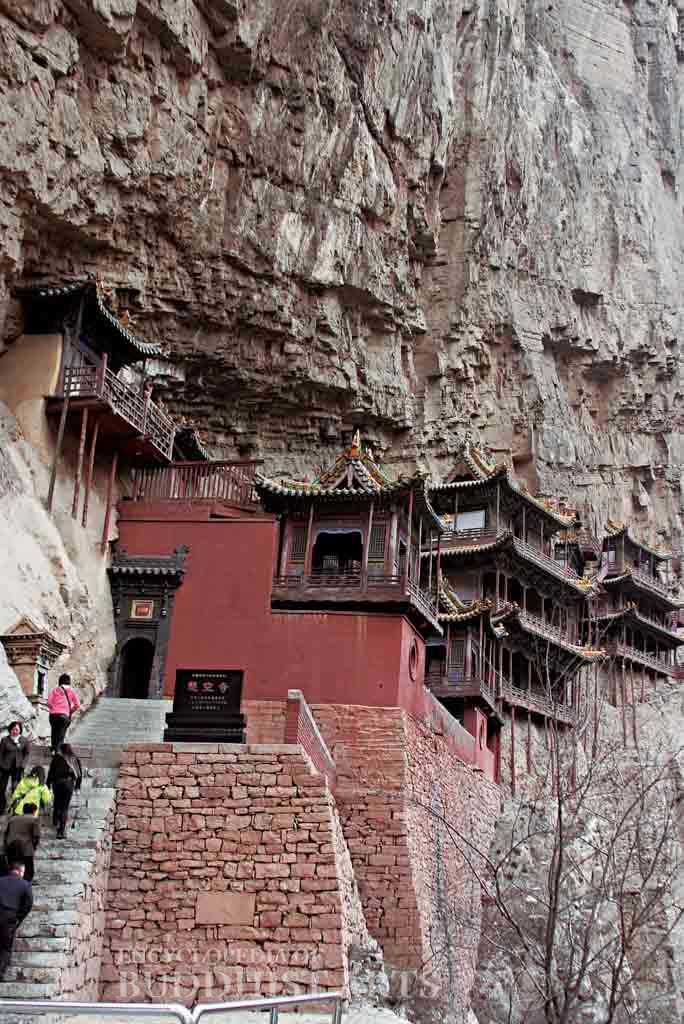
Xuankong Temple
Xuankong Temple
CHINA, Shanxi, Datong
The temple is located on the west cliff of Jinlong Gorge at the foot of Hengshan Mountain. It is the largest cliff-hugging temple of its type and is famous for its precipitous location and its ingenious support structure and layout. It was built in the late Northern Wei dynasty (386–534) and has seen numerous renovations. Most of the existing structures were built during the Ming (1368–1644) and Qing (1644–1911) dynasties. The temple includes elements of three religious and philosophical traditions: Buddhism, Daoism, and Confucianism. The Hall of Three Religions contains images of Sakyamuni Buddha, Laozi, and Confucius. This is rarely seen among temples in China. It was listed as a National Cultural Heritage Site in 1982.
The temple faces east, although the main temple gate faces south. There are more than 40 buildings of various sizes, including halls, pavilions, and monastic quarters. The main temple gate is followed by a walkway leading to a two-story rectangular courtyard and a building. On the lower story there is the Buddha Shrine, while on the upper story there is the Shrine of the Three Buddhas, which is the main hall, the Taiyi Shrine, and the Lord Guan Shrine. Looking toward the north, there are north building and south building facing each other. They are both three stories high with hip-and-gable roofs and surrounded by balconies on three sides. The shrines within the north building are the Shrine of the Five Dhyani Buddhas, Shrine of the Three Sages, and the Shrine of the Three Religions. The south building includes the Chunyang (Lu Dongbin) Shrine, Shrine of the Three Officials, and the Sound of Thunder Shrine.
The temple houses images such as the wooden statue of Avalokitesvara Bodhisattva in the Buddha Shrine, and the stone carved images of Dharmakaya Buddha, Sambhogakaya Buddha, and Nirmanakaya Buddha within the Shrine of the Three Buddhas.
For more details, go to the Encyclopedia of Buddhist Arts: Architecture T-Z, page 1331.
Cite this article:
author = Hsingyun and Youheng and Johnson, Peter and Mankuang and Lancaster, Lewis,
booktitle = {Encyclopedia of Buddhist Arts: Architecture T-Z},
pages = 1331,
title = {{Xuankong Temple}},
volume = 4,
year = {2016}}