
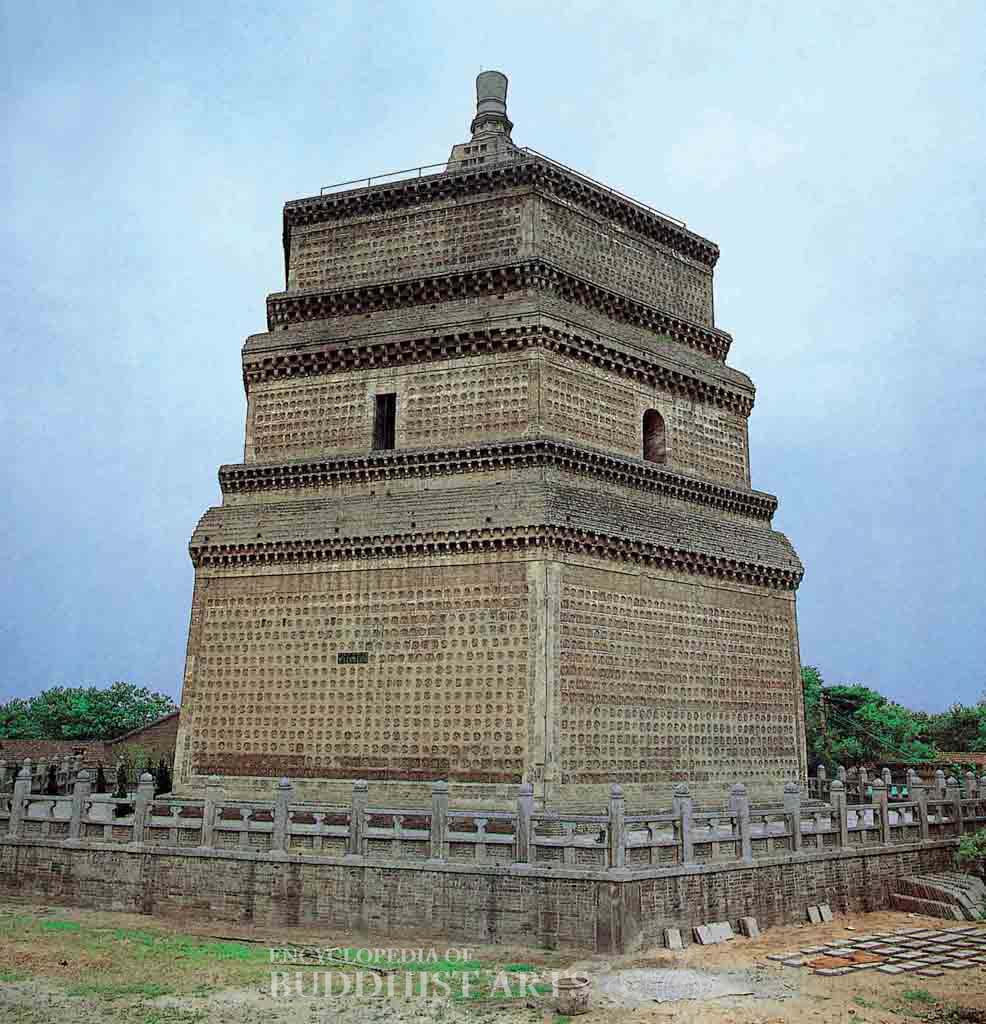
Tianqing Temple Pagoda
Tianqing Temple Pagoda
CHINA, Henan, Kaifeng
The pagoda was built in 977 during the Northern Song dynasty, and it is the earliest structure in Kaifeng. Originally the structure was nine stories high but during the Song dynasty (960–1279) it was damaged in wartime and damaged again during the Ming dynasty (1368–1644), leaving it with only three stories. During the early Qing dynasty (1644–1911), a spire was added.
The three-story, hexagonal, brick pagoda is 31.7 m high. The first story is much higher than the other two and its base is 14.1 m long. There are arched doorways on the north and south sides, with the door on the south side leading to a chamber. The ceiling of the chamber is formed by brick corbeling. Between each story there are eaves consisting of reverse corbeling with densely arranged miniature bracket sets below. The pagoda is covered in small Buddha niches and it is a fine example of Song dynasty brick carving. Inside the pagoda there are wooden stairs that lead to the top. It houses over 200 inscribed steles, including the Diamond Sutra and Excerpt from the Sutra on the Ten Wholesome Ways of Action, both by calligrapher Zhao Anren and dated 977, as well as Sutra of Perfect Enlightenment carved in 982. These works are an invaluable source of information for the study of Buddhist sutras and calligraphy.
For more details, go to the Encyclopedia of Buddhist Arts: Architecture T-Z, page 1128.
Cite this article:
author = Hsingyun and Youheng and Johnson, Peter and Mankuang and Lancaster, Lewis,
booktitle = {Encyclopedia of Buddhist Arts: Architecture T-Z},
pages = 1128,
title = {{Tianqing Temple Pagoda}},
volume = 4,
year = {2016}}