
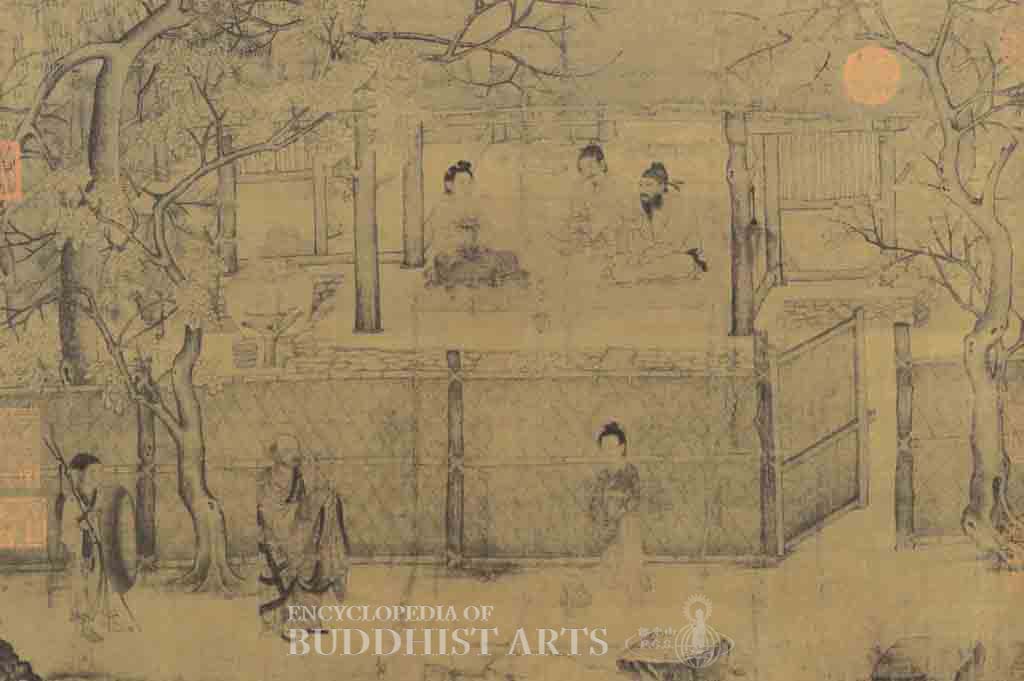
Master Danxia’s Visit to Pang Yun attributed to Li Gonglin; Southern Song dynasty
Ink and color on silk
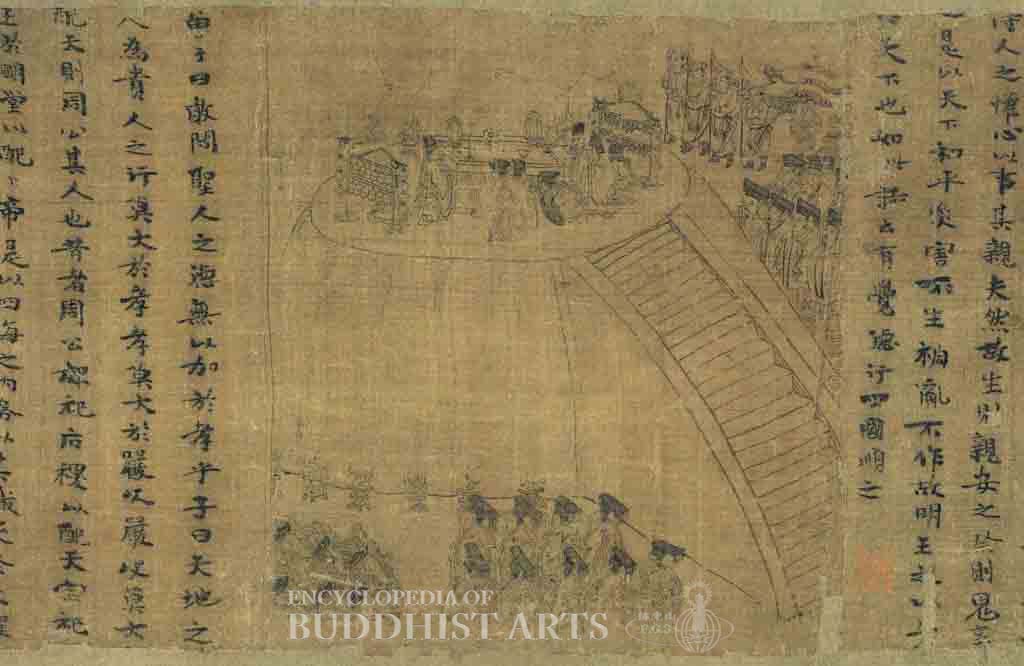
Classic of Filial Piety attributed to Li Gonglin; Northern Song dynasty, dated 1085
Ink on silk
Li Gonglin
CHINA, Anhui, Lu’an; Northern Song dynasty
Also known as Longmian Jushi or by his style name Boshi, Li Gonglin was a painter born in Shuzhou (present day Shucheng, Lu’an). He passed the imperial examination, attaining the title of Imperial Scholar, and eventually became Chief Deputy Imperial Censor. He befriended fellow artists such as Su Shi, Huang Tingjian, and Mi Fu. In middle age he became a devout Pure Land Buddhist and was devoted to meditation. After he retired, he lived a reclusive life in the Longmian Mountains.
Among his many skills, Li was knowledgeable and passionate about poetry and literature, and had a rich vocabulary of obscure words. He was also an accomplished archaeologist, critic, and calligrapher. Wu Daozi taught him how to paint, and his horse paintings soon became well-known. Intently observing the life of horses day and night, he captured both their physical appearance and spirit in his paintings. He was later warned by Chan Master Fayun Faxiu that should he continue to paint horses obsessively, he would be reborn as one, and so Li turned exclusively to Buddhist art.
Li’s paintings are mostly monochromatic, with rhythmic brushstrokes of varying thickness that flow seamlessly. In his portraits he is able to capture the likeness, personality, proportion, mood, and expression of the subject. Li incorporated the merits of many historical schools of painting into his works, but still established his own unique style, making him the one of the most highly respected painters of the Song dynasty (960–1127). Paintings attributed to Li include Pilgrimage of Hundreds of Buddhas, Landscape of Longmian Mountains, and Painting of Seven Buddhas, all of which are currently kept at the National Palace Museum in Taipei, Taiwan, Master Danxia’s Visit to Pang Yun kept at Kaikodo Asian Art in New York, USA, as well as the Classic of Filial Piety kept at the Metropolitan Museum of Art in New York, USA.
For more details, go to the Encyclopedia of Buddhist Arts: People, page 158.
Cite this article:
author = Hsingyun and Youheng and Youlu and Pokorski, Stefanie and Yichao and Mankuang and Miaohsi,
booktitle = {Encyclopedia of Buddhist Arts: People },
pages = 158,
title = {{Li Gonglin}},
volume = 19,
year = {2016}}