
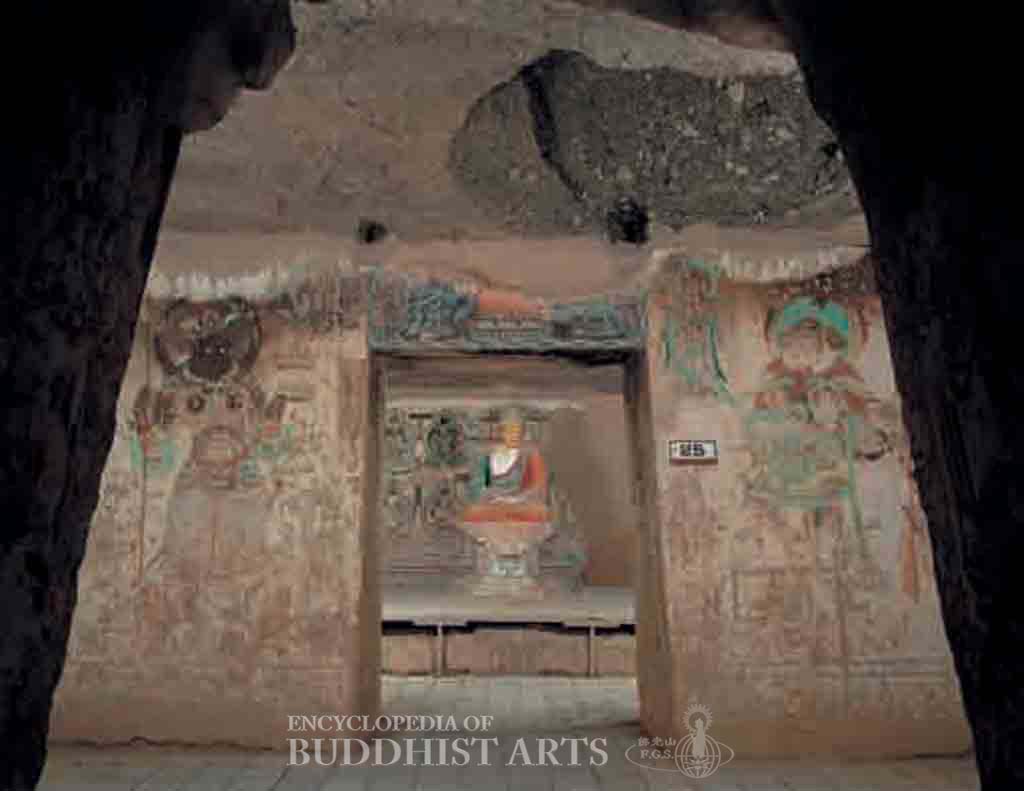
Yulin Cave 25
Yulin Cave 25
CHINA, Gansu, Guazhou
This cave is located in the east cliff and contains some of the most representative artwork from the Tang dynasty (618–907) at the Yulin site. It was created during the Mid-Tang period (756–846) and scholars believe that the Tibetan inscriptions and statues inside the cave may be due to Tibetan activities around the Guazhou area at the time. The layout consists of a front passageway, an antechamber, a corridor, and the main chamber. Additional passageways leading to Caves 23 and 26 are located on both the south and north sides of the front passageway.
The murals painted on the walls of the front passageway, antechamber, and the corridor between the antechamber and main chamber were mostly repainted during the Five Dynasties (907–960) and Song dynasty (960–1279). Virudhaka, Heavenly King of the South, and Vaisravana, Heavenly King of the North, are found on either side of the doorway on the back (east) wall of the antechamber.
The main chamber measures 5.9 m wide, 4.5 m high, and 6.2 m deep. The truncated pyramidal ceiling was originally painted with the Thousand Buddhas, but these images have largely worn off. The featured carving in the cave is a seated Buddha on a square platform in the center, repaired during the Qing dynasty (1644–1911).
The murals on the walls within the main chamber are Tang dynasty originals. The Mandala of the Eight Great Bodhisattvas is depicted on the back wall, while the front (west) wall contains illustrations of Manjusri and Samantabhadra Bodhisattvas with their attendants. The south wall is painted with an illustration of the Amitayurdhyana Sutra, and the north wall has an illustration of the Sutra on the Descent of Maitreya.
For more details, go to the Encyclopedia of Buddhist Arts: Caves T-Z, page 1596.
Cite this article:
author = Hsingyun and Youheng and Johnson, Peter and Mankuang and Huntington, Susan and Edson, Gary and Neather, Robert,
booktitle = {Encyclopedia of Buddhist Arts: Caves T-Z},
pages = 1596,
title = {{Yulin Cave 25}},
volume = 9,
year = {2016}}